BlackRock Exec Pressed On XRP ETF: His Answer Raises More Questions

bitcoinist2025-09-27 tarihinde yayınlandı2025-09-27 tarihinde güncellendi

Özet

BlackRock’s global head of digital assets, Robbie Mitchnick, was pressed on the prospect of a spot XRP exchange-traded fund during...

Trusted Editorial content, reviewed by leading industry experts and seasoned editors. Ad Disclosure

BlackRock’s global head of digital assets, Robbie Mitchnick, was pressed on the prospect of a spot XRP exchange-traded fund during an interview with Nate Geraci on the “Crypto Prime” podcast.

Will BlackRock Launch A Spot XRP ETF?

While he offered no product reveal, he did spell out precisely how BlackRock is thinking about what could come next after its blockbuster Bitcoin and Ether launches.

Geraci noted on air that he has “publicly predicted that BlackRock would file for a spot XRP ETF and a spot Solana ETF,” then asked how the firm evaluates “future product development around crypto-related ETFs.”

Mitchnick declined to speak to any specific tickers but was explicit about the decision framework: “There’s a lot of factors that go into that decision-making process obviously, but the biggest driver ultimately is our clients… What is the level of investor demand? What is the logic and investment thesis for investors and for our clients around these potential products? What problem are we solving for them?”

He added that BlackRock weighs “market cap, liquidity, [and] maturity,” along with “clarity of investment thesis and overall… portfolio considerations,” describing it as “a constant evaluation process,” not a single point in time.
The exchange came amid a wide-ranging discussion of how quickly BlackRock’s crypto business has scaled and how starkly the firm differentiates Bitcoin from Ether in client portfolios.

BlackRock Exec On Bitcoin Vs. Ethereum

Geraci highlighted the growth figures—“[IBIT] launched in early January 2024. It’s over $85 billion in assets… [ETHA] launched in July… around $16 billion”—and asked whether Ethereum’s trajectory matched expectations after Bitcoin’s record start.

Mitchnick pushed back on early narratives that Ether ETFs were a “bust” only because they were “being compared against the extraordinary record-setting numbers” of Bitcoin, pointing out that ETHA became “the third fastest ETF in history to reach $10 billion.”

Mitchnick drew a bright line between the two assets from a portfolio-construction perspective. Bitcoin, he said, functions for many allocators as “this sort of digital gold type instrument,” a “global scarce decentralized non-sovereign asset” with distinct risk and return drivers.

Ethereum is “a more nuanced, more technical discussion,” effectively “a bet around blockchain adoption and digital assets more broadly,” with competitive dynamics and questions about “value capture in the Ether token versus the activity level on the Ethereum blockchain.” As a result, Bitcoin has seen “much greater penetration” among institutional and wealth advisory channels, while Ether ownership remains “overwhelmingly” in the direct investor segment.

On the gating factors that could unlock the next wave of demand, Mitchnick said it is “still early days” for both institutions and wealth platforms in the United States. Many large firms allow execution-only access, but “the vast majority of advisers… still do not have the ability to make decisions on this on behalf of their clients.”

He described “various stages of approving this” across the wirehouses, including one firm “starting to put it in model portfolios,” and noted that BlackRock’s own model-portfolio team “early in 2025… put IBIT allocations into one of our model portfolios.” For institutions, he argued that further episodes of Bitcoin “decoupling from equities in a… distressed market environment” would be “critical” in cementing its role as a diversifier.

Asked about the SEC’s recent move to approve generic listing standards for commodity-based ETPs—the category that includes spot crypto ETFs—Mitchnick called it “a pragmatic step” that “streamlin[es] the process,” with clear, transparent standards that “support innovation.”

Taken together, Mitchnick’s comments sketched the contours of BlackRock’s next steps without tipping its hand. On an XRP ETF, he didn’t confirm or deny anything—but he gave a clear readout of the bar any new product must clear: credible client demand, a defensible investment thesis, sufficient market depth and maturity, and a well-defined role in diversified portfolios.

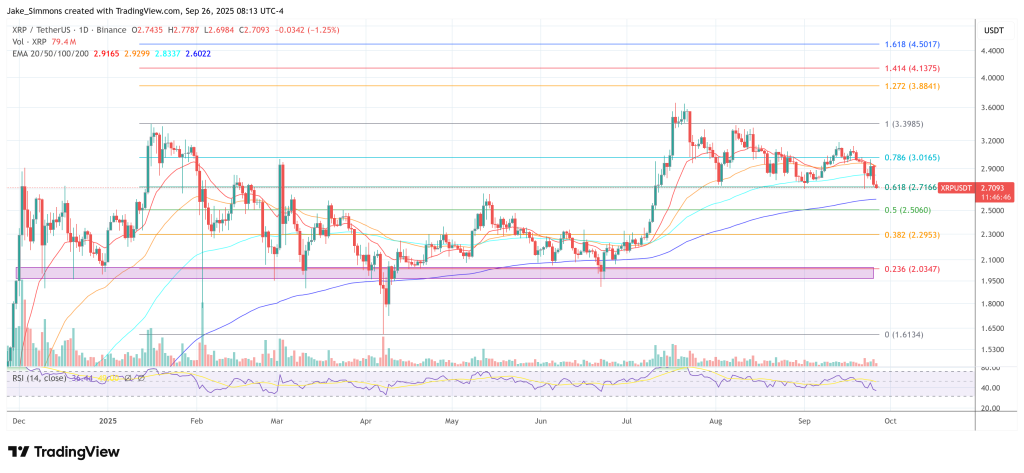
At press time, XRP traded at $2.71.
XRP price
XRP price, 1-day chart | Source: XRPUSDT on TradingView.com
Featured image from YouTube, chart from TradingView.com
Editorial Process for bitcoinist is centered on delivering thoroughly researched, accurate, and unbiased content. We uphold strict sourcing standards, and each page undergoes diligent review by our team of top technology experts and seasoned editors. This process ensures the integrity, relevance, and value of our content for our readers.

Jake Simmons has been a Bitcoin enthusiast since 2016. Ever since he heard about Bitcoin, he has been studying the topic every day and trying to share his knowledge with others. His goal is to contribute to Bitcoin's financial revolution, which will replace the fiat money system. Besides BTC and crypto, Jake studied Business Informatics at a university. After graduation in 2017, he has been working in the blockchain and crypto sector. You can follow Jake on Twitter at @realJakeSimmons.

İlgili Okumalar

Second Half of U.S. Crypto Policy: The Clarity Act Aims for 60 Votes, CFTC's "One-Person Commission" Becomes Biggest Variable

In a pivotal year for US crypto policy, the "CLARITY Act" is advancing in the Senate but faces a high hurdle, needing 60 votes to pass. Key challenges include bridging partisan divides on ethics and swaying undecided Republican senators within a tight legislative calendar of only about 40 working days. The policy "second half" involves intense negotiations on a broader framework for Web3 and DeFi, including crypto tax reforms and the Blockchain Regulatory Certainty Act. A significant uncertainty is the understaffed CFTC, operating with four commissioner vacancies, which complicates regulatory clarity. Meanwhile, the departure of key "crypto champions"—SEC Commissioner Hester Peirce and Senator Cynthia Lummis—will impact ongoing policy efforts. Industry experts are cautiously optimistic but realistic. Sara K. Weed notes that while progress is being made, CLARITY is unlikely to pass this Congress, pushing agencies like the SEC and CFTC to provide more guidance. Sulolit Mukherjee suggests meaningful crypto tax legislation is more likely to be attached to larger must-pass bills. Rashan Colbert discusses the jurisdictional debate over prediction markets, emphasizing the need for a regulatory framework that fosters their development as financial tools rather than treating them broadly as gambling. The clock is ticking, but opportunities remain for substantive progress through continued bipartisan dialogue and pragmatic efforts.

marsbit2 saat önce

Second Half of U.S. Crypto Policy: The Clarity Act Aims for 60 Votes, CFTC's "One-Person Commission" Becomes Biggest Variable

marsbit2 saat önce

Dan Koe's New Essay: Escaping the Fate of the Wage Slave, How to Survive the AI Replacement Wave?

Dan Koe argues that the true threat in the AI era isn't technology itself, but a reliance on others for one's livelihood and happiness. The core problem is "wage slavery"—spending life on unfulfilling work. To survive and thrive, one must escape this by building their own enterprise. The key is developing five elements: Agency (initiative), Taste (discernment), Persuasion, Persistence, and Iteration. These boil down to problem-solving skills and experiential knowledge, which cannot be learned passively but only through doing your own projects. The solution is to become "unemployable" by shifting your identity. This requires: 1) Radically changing your environment to force growth, 2) Choosing a medium (like content creation) that provides real feedback through trial and error, and 3) Mastering either code or, preferably, media (content). Content creation is more valuable because its subjective nature and need for human perspective create a durable advantage over generic AI output. To start, define your life's work by answering foundational questions about your innate knowledge, unique abilities, and contrarian beliefs. Then, immediately act by publishing your first piece of content. The cycle of creating, receiving feedback, and iterating is the essential path to developing the skills needed for an independent, meaningful career and financial resilience.

marsbit3 saat önce

Dan Koe's New Essay: Escaping the Fate of the Wage Slave, How to Survive the AI Replacement Wave?

marsbit3 saat önce

Research Report Analysis: Morgan Stanley Details SanDisk SNDK, The Truth About Cloud Data Center Pricing Power and AI Inference Benefits

Morgan Stanley raised its price target for SanDisk (SNDK) from $1100 to $1750 on June 22, maintaining an Overweight rating. The upgrade is driven by AI inference demand reshaping the NAND market, particularly for KV Cache and context window storage in cloud data centers. These cloud clients exhibit price inelasticity and sign long-term contracts, granting SanDisk significant pricing power. SanDisk's New Business Model (NBM) agreements, covering over one-third of FY27 bit shipments with 3-5 year terms and fixed price/price collar structures, are crucial. They are projected to sustain gross margins around 80% even at floor prices, providing a buffer against cyclical downturns. Morgan Stanley forecasts gross margins to surge from 30.3% in FY25 to 86.7% in FY27e. With NAND supply expected to remain tight into 2026/2027 and cloud/data centers becoming the largest end-market, SanDisk holds supply-side pricing power. The company targets 15-19% bit growth via technology transitions, not capacity expansion. Revenue is projected to grow ~6.6x from FY25 to FY27, with EPS rising from $2.74 to $14.73, driven by high-margin cloud business. Key upside catalysts include faster enterprise SSD adoption and edge AI growth. Downside risks involve slower industry growth, competitor capex increases, market share loss, and competition from Chinese players like YMTC. The investment thesis rests on AI-driven structural demand, NBM's margin protection, and sustained supply tightness. The $1750 target implies ~28x FY27e P/E.

marsbit3 saat önce

Research Report Analysis: Morgan Stanley Details SanDisk SNDK, The Truth About Cloud Data Center Pricing Power and AI Inference Benefits

marsbit3 saat önce

İşlemler

Spot
Futures
活动图片