SEC Greenlights New ETF Standards, Opening Door for Altcoin ETFs

bitcoinist2025-09-18 tarihinde yayınlandı2025-09-19 tarihinde güncellendi

Özet

The U.S. Securities and Exchange Commission (SEC) has approved new generic listing standards for spot crypto and altcoin exchange-traded funds...

Trusted Editorial content, reviewed by leading industry experts and seasoned editors. Ad Disclosure

The U.S. Securities and Exchange Commission (SEC) has approved new generic listing standards for spot crypto and altcoin exchange-traded funds (ETFs), marking a landmark shift in digital asset regulation.

Previously, every crypto ETF required lengthy case-by-case approval under Section 19b-4—a process that could drag on for months. With this new framework, ETFs meeting specific conditions can now be listed directly on major exchanges like Nasdaq, Cboe, and NYSE without waiting for individual sign-offs.

This decision is expected to accelerate the arrival of altcoin ETFs in the U.S., broadening investment access beyond Bitcoin and Ethereum. Analysts say the streamlined system represents the clearest path yet toward regulated, diversified crypto exposure.

Grayscale Leads With First Multi-Crypto ETF

Grayscale secured a first-mover advantage as its Digital Large Cap Fund (GDLC) was approved under the new standards. The fund includes Bitcoin, Ethereum, XRP, Solana, and Cardano, making it the first diversified multi-crypto ETF in the U.S.

“Grayscale Digital Large Cap Fund $GDLC was just approved for trading… with Bitcoin, Ethereum, XRP, Solana, and Cardano,” Grayscale CEO Peter Mintzberg confirmed.

ETF analysts noted this milestone signals a shift toward broader portfolio products rather than single-asset ETFs. Bloomberg’s Eric Balchunas estimated that 12–15 cryptos could soon qualify under the SEC’s framework, provided they have established regulated futures trading for at least six months.
ethereum eth ethusd

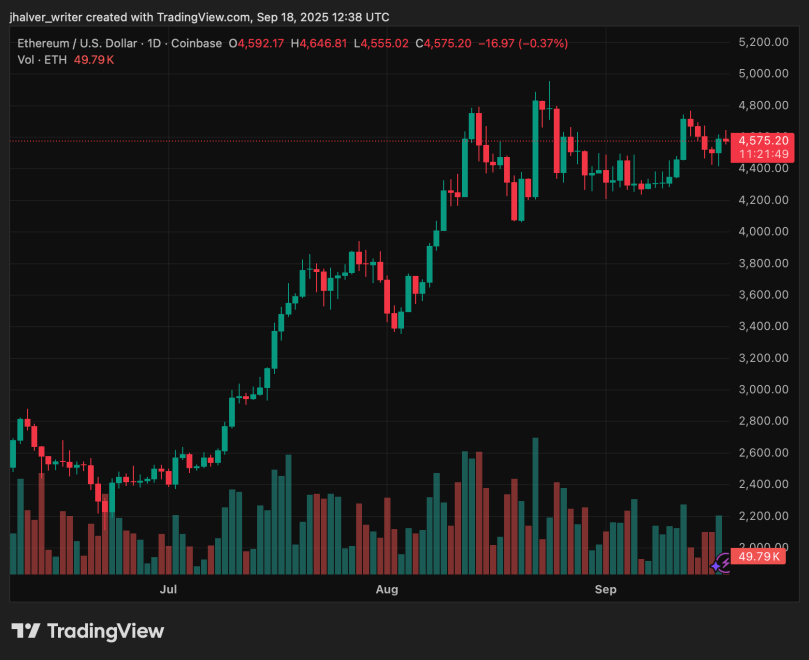
ETH's price trends to the upside on the daily chart. Source: ETHUSD on Tradingview

Altcoin ETFs Considered Imminent

Beyond the majors, other altcoins are lining up for potential ETFs. Dogecoin (DOGE), Litecoin (LTC), and Chainlink (LINK) already meet the key requirement of regulated futures trading on Coinbase Derivatives.

Solana, for instance, became eligible on August 19, six months after its futures launch. The Chainlink community has also expressed optimism, with both Bitwise and Grayscale filing LINK ETF applications.

Meanwhile, the Litecoin Foundation has welcomed the decision, seeing it as a pathway for LTC listings in U.S. markets. Even Hedera (HBAR) is gaining attention, with investors speculating on its ETF prospects.

Industry watchers describe the SEC’s move as a turning point for crypto, one that reduces regulatory friction and boosts market confidence. As ETF analyst James Seyffart put it, “We’re gonna be off to the races in a matter of weeks.”

With the SEC’s greenlight, the question is no longer if altcoin ETFs will launch, but which will debut first.

Cover image from ChatGPT, ETHUSD chart from Tradingview

Editorial Process for bitcoinist is centered on delivering thoroughly researched, accurate, and unbiased content. We uphold strict sourcing standards, and each page undergoes diligent review by our team of top technology experts and seasoned editors. This process ensures the integrity, relevance, and value of our content for our readers.

İlgili Okumalar

The Danger of Old Bookmarks: How an Expired Tornado Cash Domain Cost a User 1,000 ETH

A user lost over 1,010 ETH (worth millions) due to a phishing attack via an expired official domain of the Tornado Cash protocol. As reported on August 20, 2026, the domain `tornado.cash` was not renewed by the original developers amid U.S. OFAC sanctions and was subsequently registered by malicious actors. They deployed a fake frontend mimicking the legitimate Tornado Cash interface. Through this site, the attackers gained access to the user's deposit notes—the data required to withdraw funds from the protocol's pools—and drained the ETH within 12 hours. On-chain data shows the stolen funds (e.g., wallet 0xd8B356...) were withdrawn from Tornado Cash pools. However, on-chain analyst Specter cast doubt on the victim's story. He suggested the individual might be involved in illicit activity, noting that a large sum of BTC was received from a coin-mixing service (Whirlpool) and converted to ETH before being sent to the fake Tornado Cash site. The victim's explanation of urgently moving funds due to a compromised hardware wallet was questioned, as the fund trail indicated deliberate obfuscation. Specter speculated this might be a conflict between malicious actors rather than a simple phishing case. The incident highlights the danger of expired domains for major protocols, where old bookmarks can lead to compromised sites. WHOIS records show the domain was registered in March 2025. Broader analysis notes that in 2025, over $1.8 billion was lost to scams and exploits, largely through social engineering like phishing via familiar but hijacked links. This case underscores the persistent risk when a domain's legal status changes but user trust and search engine reputation remain.

cryptonews.ru37 dk önce

The Danger of Old Bookmarks: How an Expired Tornado Cash Domain Cost a User 1,000 ETH

cryptonews.ru37 dk önce

You'll Be Surprised How Much WeChat's Architecture Differs from Telegram's

An article compares the core architectural philosophies of WeChat and Telegram, highlighting fundamental differences in data storage, monetization, and developer ecosystems. **Data Storage:** Telegram offers unlimited, synchronized cloud storage for seamless access across all devices. In contrast, WeChat stores chat history locally on each device, requiring a manual migration process for transfer and tethering desktop sessions to an active smartphone. **Features & Ecosystem:** Telegram's open Bot API allows for easy, free bot creation, while WeChat's massive ecosystem of over 4.8 million "mini-programs" operates within a closed, curated, and more regulated platform. Commenting also differs: Telegram uses integrated discussion threads for channels, whereas WeChat relies on pre-moderated comments for official accounts and separate chats for interaction. **File Sharing & Payments:** Telegram supports large file transfers (up to 4GB for Premium), while WeChat limits most files to 200MB. A key divergence is in payments: WeChat Pay is deeply integrated into daily life and commerce in China, whereas Telegram lacks a comparable built-in fiat payment system, focusing instead on third-party bots and crypto. **Analysis:** The comparison reveals two distinct models: WeChat is a tightly integrated, closed ecosystem deeply embedded in the real economy, while Telegram prioritizes open protocols, flexible data handling, and low barriers for developers. An added perspective notes that WeChat's fusion of messaging and payments in a single interface without end-to-end encryption for chats potentially broadens the attack surface, raising security questions as more functions converge.

cryptonews.ru5 saat önce

You'll Be Surprised How Much WeChat's Architecture Differs from Telegram's

cryptonews.ru5 saat önce

İşlemler

Spot
活动图片