Биткоин растет после снижения ставки ФРС США на 0,25%.

cryptonews.ru2025-09-26 tarihinde yayınlandı2025-09-26 tarihinde güncellendi

Федеральная резервная система сегодня снизила процентные ставки на 25 базисных пунктов, ссылаясь на нестабильность на рынке труда и рост инфляции.

Для обычного американца это означает более низкие затраты на кредиты и может стать положительным фактором для крипторынка. Однако решение также увеличивает инфляционные риски и вызывает вопросы о независимости ФРС.

ФРС снизила ставки впервые за 9 месяцев

Цена биткоина сразу пошла вверх после того, как Федеральная резервная система США снизила процентные ставки на 25 базисных пунктов в среду.

Федеральный комитет по открытым рынкам (FOMC) сделал то, что многие экономисты и трейдеры ожидали: он снизил базовую ставку федеральных фондов до диапазона 4,00%–4,25%. Это первое снижение за девять месяцев после аналогичного снижения в декабре 2024 года.
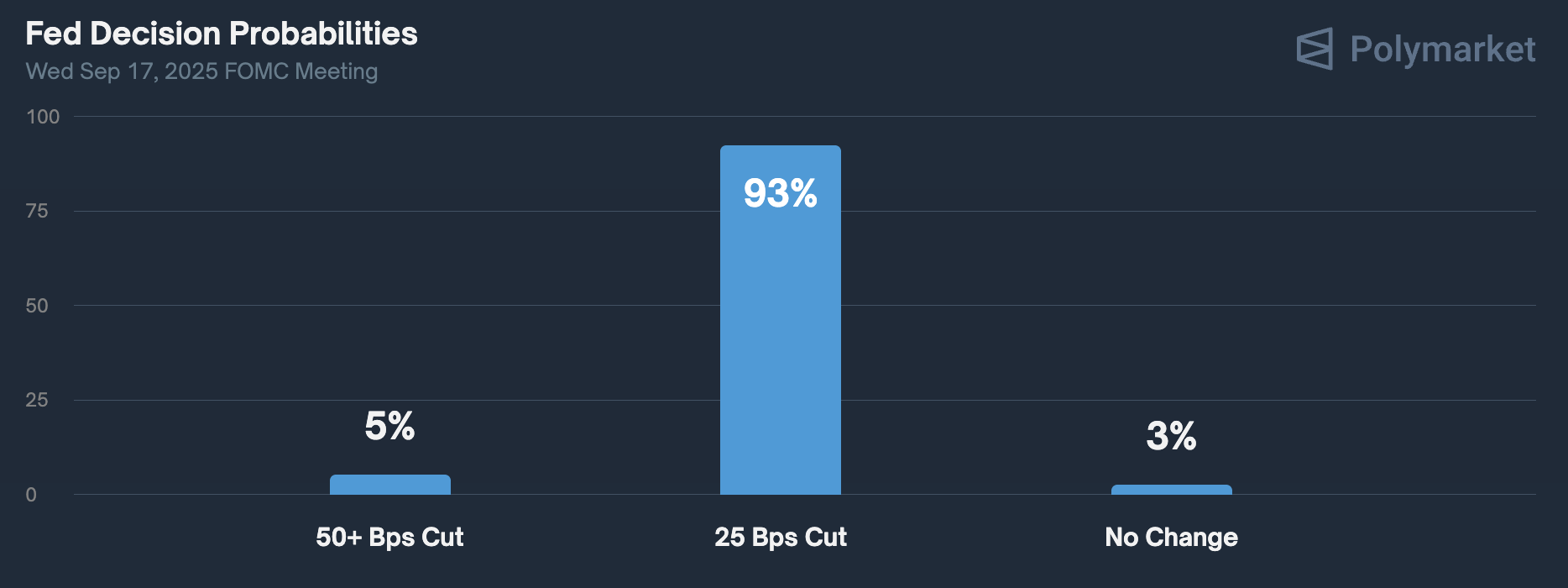
93% of Polymarket voters predicted a rate cut of 25 bps during today's FOMC meeting. Source: Polymarket.
93% участников Polymarket предсказали снижение ставки на 25 базисных пунктов на сегодняшнем заседании FOMC. Источник: Polymarket.

«Комитет решил снизить целевой диапазон ставки федеральных фондов на 1/4 процентного пункта до 4-4,25%», — говорится в заявлении Федеральной резервной системы. «Недавние данные показывают замедление экономического роста в первой половине года. Прирост рабочих мест снизился, а безработица немного выросла, но остается низкой. Инфляция увеличилась и остается несколько повышенной».

О возможности дальнейшего снижения ставок было сказано:

«При рассмотрении степени и сроков дополнительных корректировок ставки федеральных фондов Комитет будет внимательно оценивать поступающие данные, изменяющийся прогноз и баланс рисков».

Это решение может положительно повлиять на биткоин и остальную часть крипторынка в ближайшие дни.

Позитивный катализатор для крипто?

Крипторынок был осторожно оптимистичен перед решением ФРС по процентным ставкам. Теперь, когда снижение ставок стало реальностью, трейдеры могут ожидать хорошие новости. Согласно данным CryptoQuant, инвесторы готовятся к покупкам.

«В целом, снижение ставки ФРС является положительным катализатором для рискованных активов, таких как криптовалюты», — сказал Хулио Морено, руководитель отдела исследований в CryptoQuant.

Инвесторы удерживают свои самые ценные криптоактивы, включая биткоин и Ethereum. Это говорит о том, что крупные держатели не паникуют и вероятно ожидают роста цен после снижения ставки.

«Для BTC и ETH инвесторы, похоже, ожидают ралли, так как притоки на биржи низкие — это значит, что они не планируют продавать», — отметил Морено.

Тем временем средства поступают в стейблкоины. Морено объяснил, что эти активы часто служат наличными на биржах, что указывает на готовность инвесторов к покупкам.

«Более высокие депозиты в стейблкоинах — это “сухой порох” инвесторов перед покупками», — сказал он.

Ончейн-данные также показывают, что некоторые инвесторы обналичивают менее ценные активы, такие как альткоины. Это может быть признаком осторожности или стратегической подготовки к важным событиям.

Большинство данных подтверждает, как крипторынки обычно реагируют на снижение процентных ставок. Более низкие затраты на заимствование традиционно побуждают инвесторов искать более высокую доходность в более рискованных активах.

Снижение ставок в 2020-2021 годах после пандемии COVID-19 стало ярким примером того, как финансовое смягчение подстегнуло исторический бычий рынок криптовалют. Тогда приток капитала напрямую увеличил аппетит к риску среди розничных инвесторов.

Однако связь между снижением процентных ставок и крипторынком не всегда прямая.

Политически заряженное решение

Заявление Пауэлла прозвучало на фоне обострения напряженности между Федеральной резервной системой и администрацией Трампа. С момента вступления в должность Трамп неоднократно давил на FOMC с требованием снизить процентные ставки, даже пытаясь уволить губернатора ФРС Лизу Кук.

Вчера Сенат утвердил Стивена Мирана, бывшего главного экономического советника Трампа, в Совет управляющих Федеральной резервной системы.

Постоянное давление вызвало сомнения в независимости ФРС при принятии решений. Неясно, снизил ли Пауэлл ставки из-за экономической ситуации или под давлением властей. Эксперты расходятся во мнениях о необходимости этих снижений.

Если сегодняшнее решение было принято под политическим давлением, это может привести к росту инфляции, что снизит покупательную способность американцев и перегреет экономику. Такая нестабильность также уменьшит интерес к риску, отвлекая торговые объемы от криптовалютного рынка.

Тем временем американская экономика в последние месяцы переживает значительные потрясения.

Что дальше для американского потребителя?

Последние данные показывают слабый рынок труда с более медленным ростом занятости, чем ожидалось. Инфляция также остается значительной проблемой.

Предпочитаемый ФРС показатель инфляции, индекс цен на личное потребление (PCE), вероятно, останется выше целевого уровня в 2%. Это частично связано с импортными налогами, введенными Трампом, которые, по мнению экономистов, могут еще больше повысить цены в ближайшие месяцы.

В ближайшие месяцы станет ясно, удастся ли новому снижению процентных ставок помочь ФРС достичь максимальной занятости и стабильности цен. Также будет интересно увидеть, сможет ли криптовалютный рынок на этот раз извлечь из этого выгоду.

The post Биткоин растет после снижения ставки ФРС США на 0,25%. appeared first on BeInCrypto.

İlgili Okumalar

Will the Ethereum Foundation Evolve into a 'Mascot'? Diversified Organizations Are Fragmenting Its Functions

The Ethereum Foundation (EF) is undergoing significant internal turmoil and functional erosion. Following its largest-ever layoff of 54 staff (20% of its workforce) and a major organizational restructuring announced in June, its Protocol Support Team has been officially dissolved. This comes alongside the high-profile resignation of key figures like co-executive director Xiaowei Wang, bringing senior departures this year to at least eight. Criticism of EF's rigid structure, opaque decision-making, and perceived lack of a clear value narrative for ETH has intensified within the community. The layoffs have catalyzed the emergence of independent, non-profit organizations like Ethlabs and Ethereum Institutional, founded by former EF researchers and members. These entities are now taking on core functions such as protocol research/development and institutional adoption, effectively fragmenting the EF's traditional leadership role. Concurrently, EF's security team is adapting to technological change, deploying specialized AI agents to audit Ethereum's codebase, which successfully discovered a critical vulnerability (CVE-2026-34219). While EF states AI complements rather than replaces researchers, it signals a potential future shift in its operational model. Faced with these challenges—internal restructuring, talent drain, the rise of competing organizations, and AI integration—the Ethereum Foundation appears to be stepping back from a central commanding role. Analysts and community observers speculate it may increasingly transition towards a symbolic "ecosystem mascot" function, while decentralized initiatives drive Ethereum's future growth and institutional adoption.

marsbit20 dk önce

Will the Ethereum Foundation Evolve into a 'Mascot'? Diversified Organizations Are Fragmenting Its Functions

marsbit20 dk önce

Nearly a Hundred Players Rush into Embodied Data: With 4.47 Billion Yuan in Financing in One Year, Who Can Really Make Money by 'Selling Data'?

The domestic embodied AI data industry has attracted nearly 100 players, with 70 focused on data collection and 27 on data infrastructure. In the past year, 15 independent embodied data service providers raised approximately 4.47 billion yuan. Despite this growth, the sector remains early-stage, fragmented, and faces significant challenges. Data collection methods are diverse, categorized into four main routes: teleoperation of real robots, human demonstration without a robot (using motion capture, exoskeletons, etc.), simulation synthesis, and distillation from internet videos. Most companies (43%) adopt hybrid approaches, combining multiple routes, as no single method can meet all training needs. Teleoperation alone is pursued by 31% of players, often by state-owned platforms and robot companies, while newer firms favor asset-light, no-hardware human demonstration. Independent data service providers now form the largest player group (40%), indicating the emergence of a distinct industry segment rather than just a subsidiary function for robot makers. Two-thirds of all players are "embodied-native" startups, while one-third are companies that pivoted from fields like AI data annotation, which are more prevalent in the data infrastructure layer. Current annual industry capacity is estimated at 1.6-1.8 million hours plus 70-80 million data points, with a short-term goal to increase this 15-20 fold within 1-3 years. Data collection factories are spread across 20 provinces in China, concentrated in the Yangtze River Delta, Beijing-Tianjin-Hebei, and Pearl River Delta regions. Financially, the 4.47 billion yuan raised in the past year pales compared to the 43.8 billion yuan raised by the broader embodied intelligence sector in just the first half of 2026, highlighting that data remains a less "sexy" bet for investors. The 15 funded independent providers show clear stratification: a top tier led by a unicorn (Lightwheel Intelligence, 3.1 billion yuan), a middle tier of 11 firms raising tens to hundreds of millions, and an early-stage tier of 3 companies. Sixty-nine investment institutions have participated, but none have made concentrated bets, reflecting uncertainty about viable business models. Over half of these funded companies are less than a year old, most are at pre-A or A rounds, and profitability remains largely unproven. In summary, the embodied data industry has become an independent track creating jobs and local economic activity. However, it is still nascent, with unformed consensus, unsolved problems, and unproven business models. The coming 1-2 years will be a critical validation window to see if companies can build sustainable, profitable businesses purely by "selling data."

marsbit3 saat önce

Nearly a Hundred Players Rush into Embodied Data: With 4.47 Billion Yuan in Financing in One Year, Who Can Really Make Money by 'Selling Data'?

marsbit3 saat önce

Dialogue with Multicoin Partner: The Crypto Market Has Bottomed Out, Favoring Three Cryptocurrencies in This Cycle

In a recent interview, Multicoin Capital managing partner Tushar Jain shared his views on the crypto market. He believes the market has bottomed and is at an inflection point, citing that negative news no longer causes significant price declines and application adoption continues to grow. Jain remains highly bullish on Solana, viewing it as the correct architectural choice for internet capital markets, particularly for spot and tokenized security trading. He is also positive on Hyperliquid, noting its leadership in decentralized derivatives trading. His investment approach focuses on concentrating capital in top convictions rather than equal allocation. A distinct opportunity he highlights is Zcash (ZEC), which he sees as a return to the industry's cypherpunk ethos and a potential top-five asset by market cap. For assets like Zcash without cash flows, his valuation framework is based on relative market cap ranking. Regarding investment strategy, Jain employs a "three-part" entry method to avoid timing pitfalls and emphasizes long-term "active management" over "active trading." He outlines four sources of investment edge: informational, analytical, behavioral/psychological, and structural. On portfolio management, the fund uses Bitcoin as its "cash," selling assets into Bitcoin during market euphoria to reduce beta risk and using Bitcoin to buy dips. Sales occur only if a better opportunity arises, the investment thesis breaks, or valuations become excessively overheated. While respectful of Ethereum's resilience, he questions its unclear scaling roadmap. Finally, Jain reaffirms his commitment to the thesis that blockchains will form the foundational architecture for future capital markets.

marsbit3 saat önce

Dialogue with Multicoin Partner: The Crypto Market Has Bottomed Out, Favoring Three Cryptocurrencies in This Cycle

marsbit3 saat önce

İşlemler

Spot
活动图片