Четверть биткоин-компаний стоят меньше своих резервов. Что это значит

cryptonews.ru2025-03-16 tarihinde yayınlandı2025-09-17 tarihinde güncellendi

Аналитики отметили критическое падение показателей компаний, скупающих биткоин и другие криптовалюты в качестве резерва. Как это повлияет на спрос на криптоактивы

«РБК-Крипто» не дает инвестиционных советов, материал опубликован исключительно в ознакомительных целях. Криптовалюта — это волатильный актив, который может привести к финансовым убыткам.

Около четверти публичных компаний с биткоином на балансе торгуются с дисконтом к стоимости своих крипторезервов, пишет The Block со ссылкой на аналитиков K33. Это ограничивает их в привлечении капитала на покупку биткоина через выпуск акций, поскольку допэмиссия приводит к размыванию долей инвесторов и становится неэффективной.

Наиболее резкое падение показали акции NAKA объединенной структуры KindlyMD и Nakamoto под управлением Дэвида Бейэли, экс-консультанта по криптовалютам Дональда Трампа. С момента пика ее капитализация сократилась на 96%, а мультипликатор к биткоин-резервам (mNAV) снизился с 75 до 0,7.

rbc.group

Ниже единицы показатель mNAV также у Twenty One, поддерживаемой Tether. Даже у Strategy Майкла Сэйлора mNAV опустился до 1,26, что является минимумом с марта 2024 года.

Средний показатель mNAV среди всех публичных биткоин-компаний снизился с 3,76 в апреле до 2,8. При этом распределение неравномерное: у небольших компаний капитализация чаще ниже стоимости биткоинов, в то время как крупнейшие по-прежнему торгуются с премией.

В сентябре средний объем закупок биткоина публичными компаниями составляет 1428 BTC в день, что является минимальным уровнем с мая. А общая картина рынка такова, что определять рыночный спрос все чаще будут розничные инвесторы и биткоин-ETF, а не корпоративные покупатели, полагают в K33.

Аналитики британского банка Standard Chartered в своем исследовании также отметили, что бум компаний, накапливающих криптовалюты в качестве резерва, начинает сходить на нет.

Другие криптовалюты

Общий объем биткоинов на балансах таких компаний превысил 1 млн монет — более $117 млрд, или 4,8% от эмиссии биткоина, по данным Bitcointreasuries. В отчете K33 рассматриваются компании, скупающие только биткоин. Но у организаций, скупающих другие криптовалюты, наблюдается схожая динамика.

Так, например, в списке топ-6 крупнейших держателей Ethereum (ETH) только две компании имеют mNAV выше 1. Bitmine Тома Ли, являющаяся крупнейшим держателем «эфира» с балансом $9,7 млрд в ETH, имеет мультипликатор 1,21. Следующая за ним SharpLink имеет показатель 0,94 — баланс $3,8 млрд в ETH. У The Ether Machine с активами $2,2 млрд показатель mNAV находится на 0,07, согласно StrategicETHreserve. Оценка Bit Digital зафиксирована на 1,76 при балансе $540 млн, а ETHZilla с активами $460 млн и BTCS $315 млн имеют показатель 0,73.


İlgili Okumalar

Olympus DAO Myth Reappears? A "Sovereign On-Chain Central Bank" Written with 4000 Lines of Immutable Code

A new project called The Standard Reserve has emerged, branding itself as a "sovereign on-chain central bank." It aims to replicate core central bank functions—currency issuance, money supply adjustment, and reserve accumulation—entirely through 4,000 lines of immutable code, with no human governance. Its core mechanism is a "reflexive monetary policy" based on a single signal: the net ETH flow into or out of the system's sole Uniswap v4 ETH/$STANDARD pool. Sustained net ETH inflows trigger an "expansion" phase, increasing $STANDARD issuance and using protocol fees to buy tokenized gold as a permanent hard reserve. Net outflows (or zero flow) trigger an immediate "contraction" phase, reducing issuance and using fees to buy back and burn $STANDARD. The system involves six key entities: the $STANDARD token (hard-capped at 1 billion), the central Uniswap pool, the Central Bank contract, Charter NFTs (acting as "banking licenses"), Branch units under each Charter (which earn a share of newly minted $STANDARD), and separate Vaults for expansion (buying gold) and contraction (buying back $STANDARD). To participate, users ideally acquire a Founding Charter NFT (initially 1,000 are free via allowlist/public mint). Each Charter comes with one Branch; more can be opened by burning $STANDARD for "expansion permits," increasing revenue share. Retiring a Branch lets users claim accumulated $STANDARD but imposes a dynamic exit fee (higher if many exit simultaneously), with half the fee burned and half distributed to remaining participants. All protocol revenue (from pool fees and Charter auctions) is allocated: 70% to the active Vault (for gold or buybacks), 15% to permanent protocol-owned liquidity, and 15% to the team. The project presents an innovative, game-theoretic model where user actions (expanding Branches by burning tokens or exiting) align with system goals of building reserves or inducing deflation. However, it is fully anonymous, with key parameters undefined and unaudited code, posing significant risks.

marsbit12 dk önce

Olympus DAO Myth Reappears? A "Sovereign On-Chain Central Bank" Written with 4000 Lines of Immutable Code

marsbit12 dk önce

US Jobs, China PMI, and Inflation on Stage: Can Global Growth Maintain Resilience?

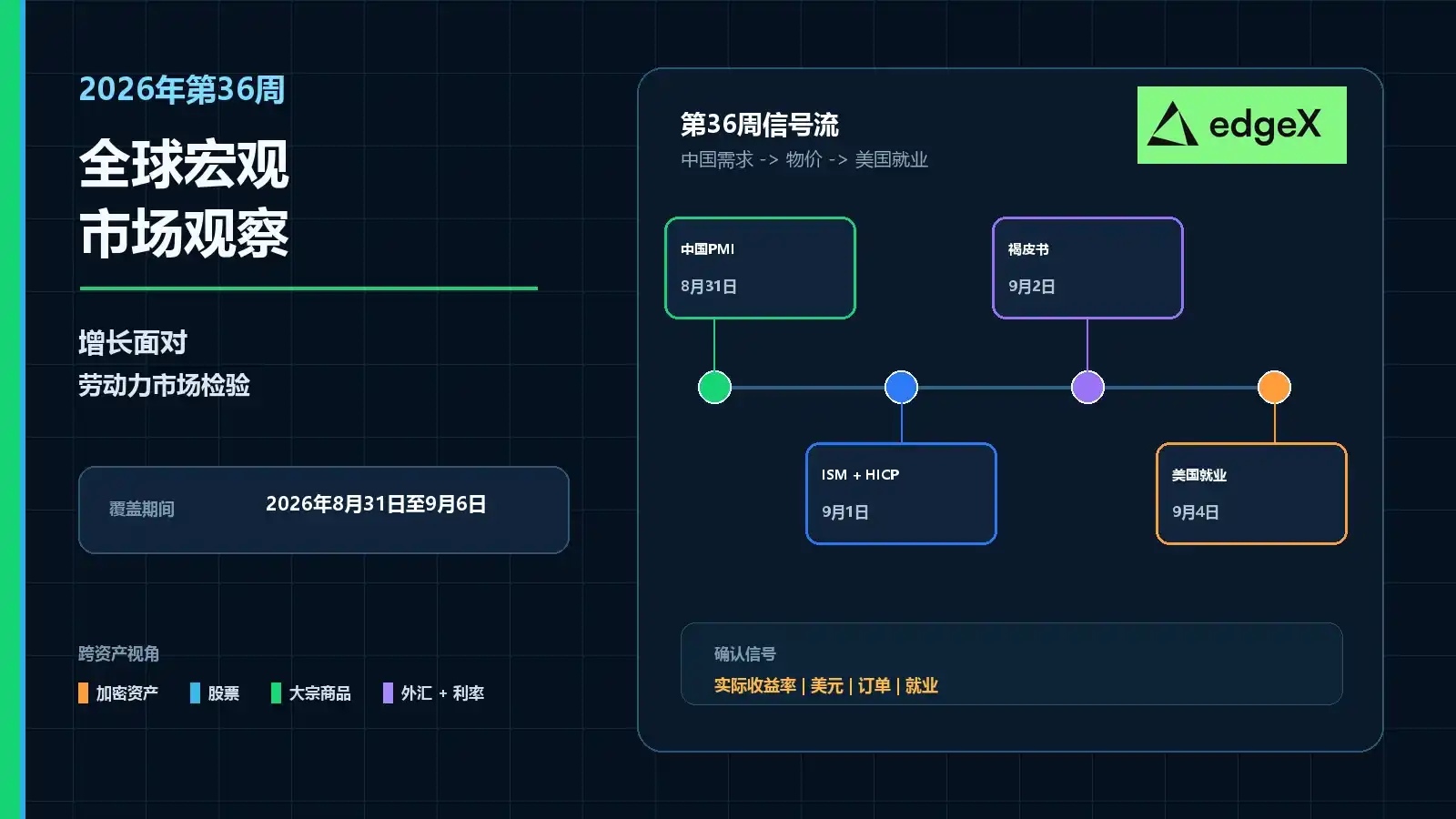
**Week 36 Macro Outlook: Key Data to Test Global Growth Resilience** The week from August 31 to September 6 will shift focus from policy discussions to a critical test of global economic activity. The sequence of events is key, starting with China's official August PMI on Aug 31, which will provide early signals on factory orders, services, and employment following July's contraction. The data flow then broadens. On September 1, US ISM Manufacturing PMI and the Eurozone's flash inflation estimate will offer simultaneous checks on demand, prices, and regional divergence. The subsequent US Federal Reserve Beige Book on September 2 adds granular, qualitative evidence on consumer spending, wages, and regional conditions. Australian Q2 GDP and Canadian trade and jobs data will test resilience in other major economies. The week's pivotal event, however, is the US August employment report on September 4. It will decisively influence expectations for interest rates, the US dollar, and broader risk appetite, acting as a final cross-check for the preceding data. The core question for markets is whether global growth can remain resilient. An ideal outcome would combine a rebound in China's PMI, stable US jobs growth, cooling inflation, and signs of a gradual demand slowdown. Conversely, weak Chinese manufacturing, sticky Eurozone prices, and disappointing US non-farm payrolls would create a more complex scenario of reduced corporate confidence and limited room for aggressive monetary easing, increasing pressure on cyclical assets. Investors should monitor the breadth of improvements—such as new orders and employment—rather than headline PMI figures alone. Confirmation across different data points is crucial. A positive combination of steady activity and disinflation could support equities, industrial commodities, and risk assets like crypto. However, if a growth slowdown triggers lower yields, it must be distinguished from a scenario of rising recession risks that would pressure corporate earnings, potentially limiting rallies. The market's final reaction will hinge on whether the week's signals align to either reinforce or challenge the current growth narrative.

marsbit15 dk önce

US Jobs, China PMI, and Inflation on Stage: Can Global Growth Maintain Resilience?

marsbit15 dk önce

İşlemler

Spot
活动图片