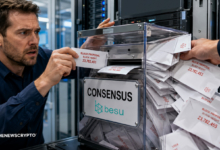
Американский биткоин-фонд семьи Трамп зарегистрирован на Nasdaq

cryptonews.ru2025-05-16 tarihinde yayınlandı2025-09-17 tarihinde güncellendi

Биткоин-компания Трампа Trump Media & Technology Group (TMTG) дебютировала на бирже Nasdaq после слияния со SPAC-компанией Digital World Acquisition Corp. Стоимость компании оценивается в $2,1 млрд, а её акции торгуются под тикером DJT.

Хотя компания ассоциируется с именем Дональда Трампа, её прямая деятельность не связана с майнингом биткоина. TMTG фокусируется на разработке социальных медиаплатформ и технологических проектов. При этом известно, что Трамп является держателем криптовалюты — на его крипто-кошельке хранится более 2400 BTC.

«Выход на Nasdaq позволяет нам вывести эту миссию на глобальный уровень, предоставляя инвесторам инструмент, который укрепит финансовую систему США и поможет построить более устойчивую экономику», — заявил представитель компании.

Аналитики отмечают, что публичные размещения компаний, связанных с крипторынком, часто стимулируют институциональный интерес и могут влиять на волатильность биткоина. На момент публикации биткоин торгуется на уровне $116 937, демонстрируя рост на 1,14% за сутки, а его рыночная капитализация превышает $2,33 трлн, что подтверждает высокий интерес инвесторов.


İlgili Okumalar

Robotic GPT-3 Moment Shakes Silicon Valley: Zero Lines of Code, Learns Instantly, with Investments from Jensen Huang and Fei-Fei Li

Generalist AI's newly released robot foundation model GEN-1.5 is being hailed as the "GPT-3 moment" for embodied AI. The model demonstrates remarkable one-shot and few-shot learning capabilities in physical manipulation tasks. By watching a single 3-12 second demonstration video (physical prompting) without any training or code, the robot can attempt the task with a 59% average success rate across 10 tasks. With just 5 minutes of demonstration data and minimal fine-tuning (10 gradient steps), the success rate jumps to 83%. The most significant breakthrough is the emergence of spontaneous, improvisational problem-solving abilities not present in the training data. For instance, after learning to sweep blocks with a brush, the robot can adapt to use a banana similarly or switch to a completely new "scoop-and-pour" strategy when given a dustpan. Other emergent behaviors include removing obstacles, correcting errors, and spontaneously sorting objects. These capabilities stem from over 8 months of large-scale pre-training on physical interaction data, suggesting the existence of a Scaling Law for embodied intelligence—where model generalization improves with more data and training time. This approach drastically reduces the cost and expertise needed to teach robots new skills, potentially democratizing robot programming. The release coincides with a surge in the humanoid robotics sector, marked by events like the World Robot Conference and significant investments. While the demonstrated tasks are still relatively simple, the scaling trend and emergent behaviors point toward a future where general-purpose robot "brains" could be easily adapted to various hardware "bodies," reshaping the industry's competitive landscape.

marsbit1 saat önce

Robotic GPT-3 Moment Shakes Silicon Valley: Zero Lines of Code, Learns Instantly, with Investments from Jensen Huang and Fei-Fei Li

marsbit1 saat önce

İşlemler

Spot
活动图片