Акции GD Culture, зарегистрированной на бирже Nasdaq, упали на 28 % после сделки по приобретению биткоинов на сумму 875 млн долларов

cryptonews.ru2025-09-12 tarihinde yayınlandı2025-09-17 tarihinde güncellendi

Акции компании GD Culture Group, занимающейся стримингом и электронной коммерцией, упали на 28 % во вторник после объявления о сделке по приобретению всех активов Pallas Capital Holding, включая 7500 биткоинов.

GD Culture выпустит почти 39,2 миллиона обыкновенных акций в обмен на все активы Pallas Capital, включая биткоины (BTC) на сумму 875,4 миллиона долларов, сообщила компания во вторник. Сделка была заключена в прошлую среду.

Генеральный директор и председатель правления GD Culture Сяоцзянь Ван заявил, что сделка «напрямую поддержит» план компании по созданию «мощного и диверсифицированного резерва криптоактивов», а также позволит извлечь выгоду из растущего признания биткоина институциональными инвесторами в качестве резервного актива и средства сбережения.

Компания использует искусственный интеллект для создания фейковых аккаунтов и ведёт бизнес в сфере прямых трансляций и электронной коммерции через TikTok. Благодаря этому приобретению она станет 14-м по величине держателем биткоинов, зарегистрированных на бирже, и присоединится к числу компаний, скупающих криптовалюту.

Источник: BitcoinTreasuries.NET

В 2025 году резко возросло количество так называемых биткоин-казначейских компаний: сейчас более 190 публичных компаний владеют этим активом, тогда как в начале года их было менее 100. Рынок вырос до 112,8 миллиарда долларов, и на нём доминирует компания Strategy Майкла Сэйлора с долей 68%.

Однако в последнее время динамика снизилась, поскольку некоторые инвесторы опасаются, что стратегия привлечения капитала, конвертации его в биткоины и ожидания роста курса может оказаться неустойчивой.

Резервуары для хранения культурных растений GD

Акции GD Culture Group (GDC) во вторник упали на 28,16 % до $6,99, свидетельствуют данные Google Finance. Акции немного выросли в ходе торгов после закрытия основной сессии, поднявшись на 3,7 %.

Это стало самым значительным падением GDC за последние 12 месяцев, в результате чего рыночная капитализация компании снизилась до 117,4 млн долларов. Акции компании сейчас на 97 % ниже исторического максимума в 235,8 доллара, установленного 19 февраля 2021 года.
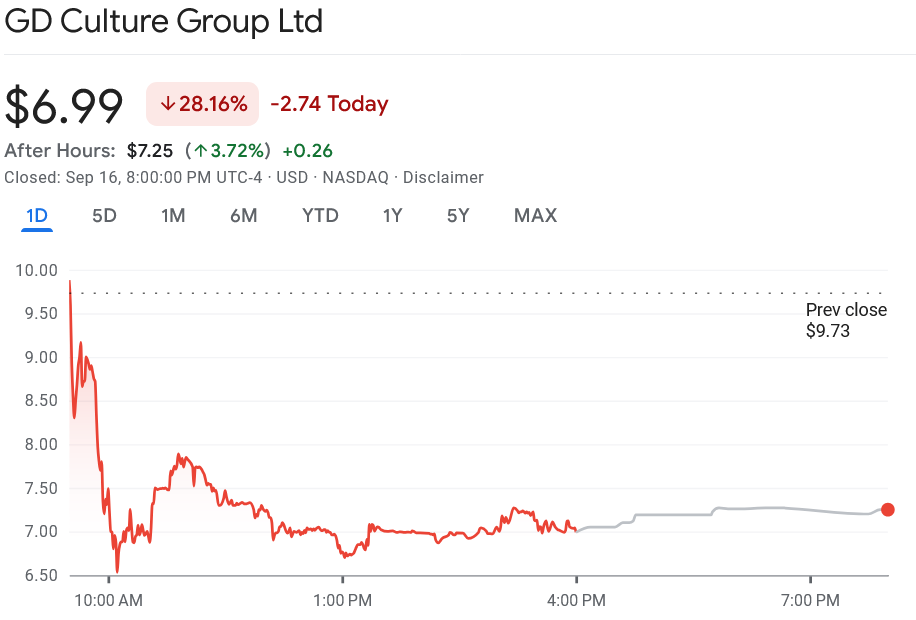
Изменение стоимости акций GDC во вторник, в том числе после закрытия торгов. Источник: Google Finance

Разводнение акционерного капитала компании часто вызывает негативную реакцию на рынке, поскольку это снижает долю владения существующих акционеров.

16 июня VanEck предупредил, что компании, финансирующие покупку биткоинов за счёт выпуска акций или долговых обязательств, могут столкнуться с сокращением капитала, если цены на их акции упадут, поскольку стоимости их биткоин-активов может не хватить для поддержки новых инвестиций без ущерба для существующих акционеров.

“Поскольку некоторые из этих компаний привлекают капитал с помощью крупных рыночных программ (ATM) для покупки BTC, возникает риск: если акции торгуются на уровне или около NAV [чистой стоимости активов], продолжение выпуска акций может привести к размыванию, а не созданию стоимости”, - сказал тогда глава VanEck по исследованию цифровых активов Мэтью Сигел.

GD Culture нацелилась на биткоин, мемкоин Трампа в мае

Компания GD Culture объявила о своей стратегии в отношении криптовалютного казначейства в мае, когда сообщила, что планирует продать до 300 миллионов долларов своих обыкновенных акций, чтобы инвестировать в криптовалюту, в том числе в биткоин и токен Official Trump (TRUMP) президента Дональда Трампа.

О размещении акций было объявлено более чем через месяц после того, как компания получила предупреждение от Nasdaq о несоблюдении требований в связи с тем, что её акционерный капитал был ниже минимального требования в 2,5 миллиона долларов.


İlgili Okumalar

An Eight-Year Investment Takes a Sharp Turn: Why Did Ethereum Suddenly Abandon Poseidon?

On August 13, Ethereum researcher Justin Drake announced a significant shift in Ethereum's Layer-1 cryptographic roadmap: abandoning the SNARK-friendly hash function Poseidon in favor of traditional functions like SHA2 or BLAKE2. This decision ends eight years of research and investment, marking a major revision to the post-quantum security strategy. Poseidon, introduced in 2019, was highly efficient for zkRollups and zkVMs within SNARK circuits. However, its need for prolonged cryptanalysis and the pressing timeline for quantum resistance revealed limitations. Recent breakthroughs in SNARK design, specifically using binary fields, now enable traditional, battle-tested hash functions to perform as efficiently as Poseidon within SNARKs. Benchmarks show modern laptops can now verify over a million traditional hash calls per second. This change is partly driven by accelerated concerns over quantum computing threats. Reports warn that "Cryptographically Relevant Quantum Computers" could break current blockchain signatures like ECDSA by the early 2030s, risking trillions in assets. Ethereum's response focuses on hash-based post-quantum signature schemes, deemed more quantum-resistant than some lattice-based alternatives under pressure from AI cryptanalysis. Ethereum's updated post-quantum roadmap targets a production-ready "leanVM" for signature aggregation by 2027, with full deployment across consensus, execution, and data layers by 2028. The shift to mature hash functions like SHA2 reduces reliance on newer algorithms and aligns with the goal of using widely analyzed cryptographic primitives. Other major blockchains are also preparing. Solana's core teams have independently chosen the NIST-standardized Falcon signature scheme for its compact size. Starknet plans a phased migration, starting with replacing its Pedersen hash with BLAKE2. Ethereum's move signifies a strategic pivot towards proven security foundations for the quantum era.

marsbit35 dk önce

An Eight-Year Investment Takes a Sharp Turn: Why Did Ethereum Suddenly Abandon Poseidon?

marsbit35 dk önce

Programmers Worldwide Are Wasting Money on Anthropic! The Company Can't Stand It Anymore

Anthropic recently published guidelines to help developers using Claude Code reduce unnecessary token costs. The key recommendations include: 1) Clear (/clear) conversations after completing a task to avoid carrying irrelevant file reads and command outputs into the next task. 2) Set the model and reasoning effort level at the start of a session, as switching mid-session invalidates the prompt cache, requiring a full-price recalculation of the entire dialog history. 3) Attach files using @ references instead of typing paths manually to avoid extra tool calls and searches that bloat the context. 4) Add quiet flags to verbose commands (e.g., in CLAUDE.md) to minimize lengthy output in the dialog history. 5) Use /compact while the session cache is still warm (before breaks) to compress the dialog at one-tenth the cost. 6) Offload large-output tasks to a sub-agent, which runs in an isolated context and only returns conclusions, preventing intermediate outputs from polluting the main dialog. The article explains token pricing: input tokens (prefill) are processed in parallel, while output tokens (decode) are generated serially, making output tokens five times more expensive. Caching is crucial for savings—if a request's prefix (system prompt, CLAUDE.md, dialog history) matches the previous one byte-for-byte, reading it costs only 10% of the standard input price. However, cache invalidation occurs when changing models, effort levels, fast mode, compressing dialogs, after cache expiration, or when resuming old sessions. Dialog history also grows quadratically (O(n²)) as file contents and command outputs accumulate, increasing costs per round. Proactive context management—like isolating noisy tasks, using /rewind to trim unproductive turns, and task-based session clearing—is becoming an essential skill for cost-effective AI-assisted development.

marsbit2 saat önce

Programmers Worldwide Are Wasting Money on Anthropic! The Company Can't Stand It Anymore

marsbit2 saat önce

Pax Silica vs. WAICO: The US Wants to Prohibit Europe from Using Chinese Artificial Intelligence

The United States is preparing to demand that European and other partners abandon Chinese artificial intelligence initiatives, threatening exclusion from the American-led "Pax Silica" coalition, according to a leaked U.S. State Department document. This ultimatum forces signatories of the "AI Opportunity Statement" to choose between the Western technological ecosystem and alternative frameworks, with China not explicitly named but clearly targeted. Pax Silica is a U.S. strategy for AI and semiconductor hegemony, launched in late 2025. Its European presence expanded significantly in mid-2026. Concurrently, China, Russia, and 27 other nations established the World AI Cooperation Organization (WAICO) in July 2026 as an independent intergovernmental platform promoting AI governance based on UN principles. This situation creates a difficult choice, especially for European nations balancing strategic autonomy with dependence on U.S. tech and security. It also pressures Global South countries with pragmatic ties to both Washington and Beijing. The formation of competing blocks risks fragmenting the global tech landscape, forcing companies to split supply chains, increasing costs, and potentially leading to incompatible standards and protocols. The era of open globalization in AI may be ending, replaced by geopolitical confrontation where technological sovereignty trumps economic efficiency. The decisions made will shape the global digital economy for decades.

cryptonews.ru4 saat önce

Pax Silica vs. WAICO: The US Wants to Prohibit Europe from Using Chinese Artificial Intelligence

cryptonews.ru4 saat önce

Robert Kiyosaki Shares His Mentor's Predictions About the Emergence of Bitcoin and AI

American entrepreneur and author of "Rich Dad Poor Dad," Robert Kiyosaki, discussed the influence of futurist R. Buckminster Fuller on his worldview, linking Fuller's past technological predictions to the emergence of Bitcoin and the development of artificial intelligence. In an X post, Kiyosaki also reflected on personal purpose, sharing his journey from the music business—where he worked with bands like The Police and Iron Maiden—to creating the "Cashflow" board game and writing his famous book. He described feeling an inner emptiness despite his success, a turning point that came after meeting Fuller, whom he studied with for three summers. Kiyosaki described Fuller as a "friendly genius" who foresaw world-changing developments like Bitcoin and AI. However, the core of his post focused on Fuller's philosophical impact, particularly a quote about belonging to the universe and finding purpose by dedicating one's life to the maximum benefit of others. The entrepreneur remains a vocal advocate for cryptocurrencies. He regularly advises buying Bitcoin during market panics, viewing it and assets like Ethereum, gold, and silver as hedges against traditional financial system failures. Kiyosaki has predicted a major market crash by 2026, seeing it as an opportunity for prepared investors, with long-term price targets including $750,000 for Bitcoin and $95,000 for Ethereum.

cryptonews.ru6 saat önce

Robert Kiyosaki Shares His Mentor's Predictions About the Emergence of Bitcoin and AI

cryptonews.ru6 saat önce

İşlemler

Spot
活动图片