Altcoin Season Index Sets New 2025 High, What This Means For The Crypto Market

bitcoinist2025-09-15 tarihinde yayınlandı2025-09-15 tarihinde güncellendi

Özet

The wait for the start of the altcoin season has been a long one, and even now, this market phenomenon...

Trusted Editorial content, reviewed by leading industry experts and seasoned editors. Ad Disclosure

The wait for the start of the altcoin season has been a long one, and even now, this market phenomenon remains elusive to investors. It was expected that after the Bitcoin price hit multiple new all-time highs over the last two years, altcoins would follow. Bitcoin continued to outperform the top altcoins by a large margin, and this blocked the way for the altcoin season to begin. However, with the market recovery, there is now a chance that the altcoin season might begin again.

Altcoin Season Index On The Rise

The Altcoin Season index takes into account the performance of the top 100 altcoins versus the performance of the Bitcoin price. This comparison is then charted and plotted over a 90-day period to show how these large-cap altcoins have performed against the pioneer cryptocurrency.

Depending on the number of altcoins that are outperforming Bitcoin in this 90-day period, the index deduces whether the market is headed into an altcoin season or not. Now, the higher the figure on the index, the higher the chances that an alt season might begin. When there are more than 75 altcoins outperforming the Bitcoin price in a 90-day period, then it is the needed signal that the alt season has begun.

In 2025, the Altcoin Season Index has trended low, mostly below the 50% mark. However, with the recent market recovery over the weekend, the index has now achieved its highest level this year, suggesting that an altcoin season is drawing closer.

According to data from the CoinMarketCap website, the Altcoin Season Index is sitting at a score of 67% at the time of this writing. With 75% being the target, it means that the market just needs another 8 of the top 100 altcoins to outperform Bitcoin to use in an alt season.
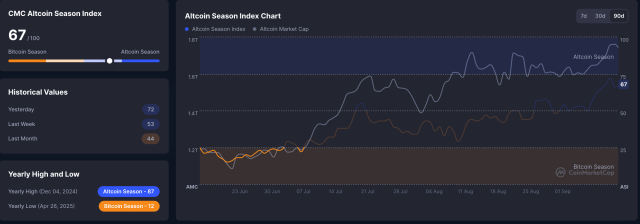
Altcoin season index
Source: Coinmarketcap

What To Expect

Previous market performances have shown altcoin seasons to be a period of explosive rallies for altcoins. The last alt season was categorized by notable rallies such as Dogecoin’s 36,000% rise and Shiba Inu’s legendary rally that saw it temporarily flip Dogecoin.

There was also the DeFi summer during this time that ushered the likes of Fantom, Polygon, and Uniswap into the limelight. Given this, it is expected that the next altcoin season will send existing altcoins flying while giving new narratives a chance to outperform as well.

Altcoin total market cap chart from TradingView.com
Altcoin market cap holds at $1.69 trillion | Source: Crypto Total Market Cap Excluding BTC on TradingView.com
Featured image from Dall.E, chart from TradingView.com
Editorial Process for bitcoinist is centered on delivering thoroughly researched, accurate, and unbiased content. We uphold strict sourcing standards, and each page undergoes diligent review by our team of top technology experts and seasoned editors. This process ensures the integrity, relevance, and value of our content for our readers.

Scott Matherson is a leading crypto writer at Bitcoinist, who possesses a sharp analytical mind and a deep understanding of the digital currency landscape. Scott has earned a reputation for delivering thought-provoking and well-researched articles that resonate with both newcomers and seasoned crypto enthusiasts. Outside of his writing, Scott is passionate about promoting crypto literacy and often works to educate the public on the potential of blockchain.

İlgili Okumalar

Olympus DAO Myth Reappears? A "Sovereign On-Chain Central Bank" Written with 4000 Lines of Immutable Code

A new project called The Standard Reserve has emerged, branding itself as a "sovereign on-chain central bank." It aims to replicate core central bank functions—currency issuance, money supply adjustment, and reserve accumulation—entirely through 4,000 lines of immutable code, with no human governance. Its core mechanism is a "reflexive monetary policy" based on a single signal: the net ETH flow into or out of the system's sole Uniswap v4 ETH/$STANDARD pool. Sustained net ETH inflows trigger an "expansion" phase, increasing $STANDARD issuance and using protocol fees to buy tokenized gold as a permanent hard reserve. Net outflows (or zero flow) trigger an immediate "contraction" phase, reducing issuance and using fees to buy back and burn $STANDARD. The system involves six key entities: the $STANDARD token (hard-capped at 1 billion), the central Uniswap pool, the Central Bank contract, Charter NFTs (acting as "banking licenses"), Branch units under each Charter (which earn a share of newly minted $STANDARD), and separate Vaults for expansion (buying gold) and contraction (buying back $STANDARD). To participate, users ideally acquire a Founding Charter NFT (initially 1,000 are free via allowlist/public mint). Each Charter comes with one Branch; more can be opened by burning $STANDARD for "expansion permits," increasing revenue share. Retiring a Branch lets users claim accumulated $STANDARD but imposes a dynamic exit fee (higher if many exit simultaneously), with half the fee burned and half distributed to remaining participants. All protocol revenue (from pool fees and Charter auctions) is allocated: 70% to the active Vault (for gold or buybacks), 15% to permanent protocol-owned liquidity, and 15% to the team. The project presents an innovative, game-theoretic model where user actions (expanding Branches by burning tokens or exiting) align with system goals of building reserves or inducing deflation. However, it is fully anonymous, with key parameters undefined and unaudited code, posing significant risks.

marsbit12 dk önce

Olympus DAO Myth Reappears? A "Sovereign On-Chain Central Bank" Written with 4000 Lines of Immutable Code

marsbit12 dk önce

US Jobs, China PMI, and Inflation on Stage: Can Global Growth Maintain Resilience?

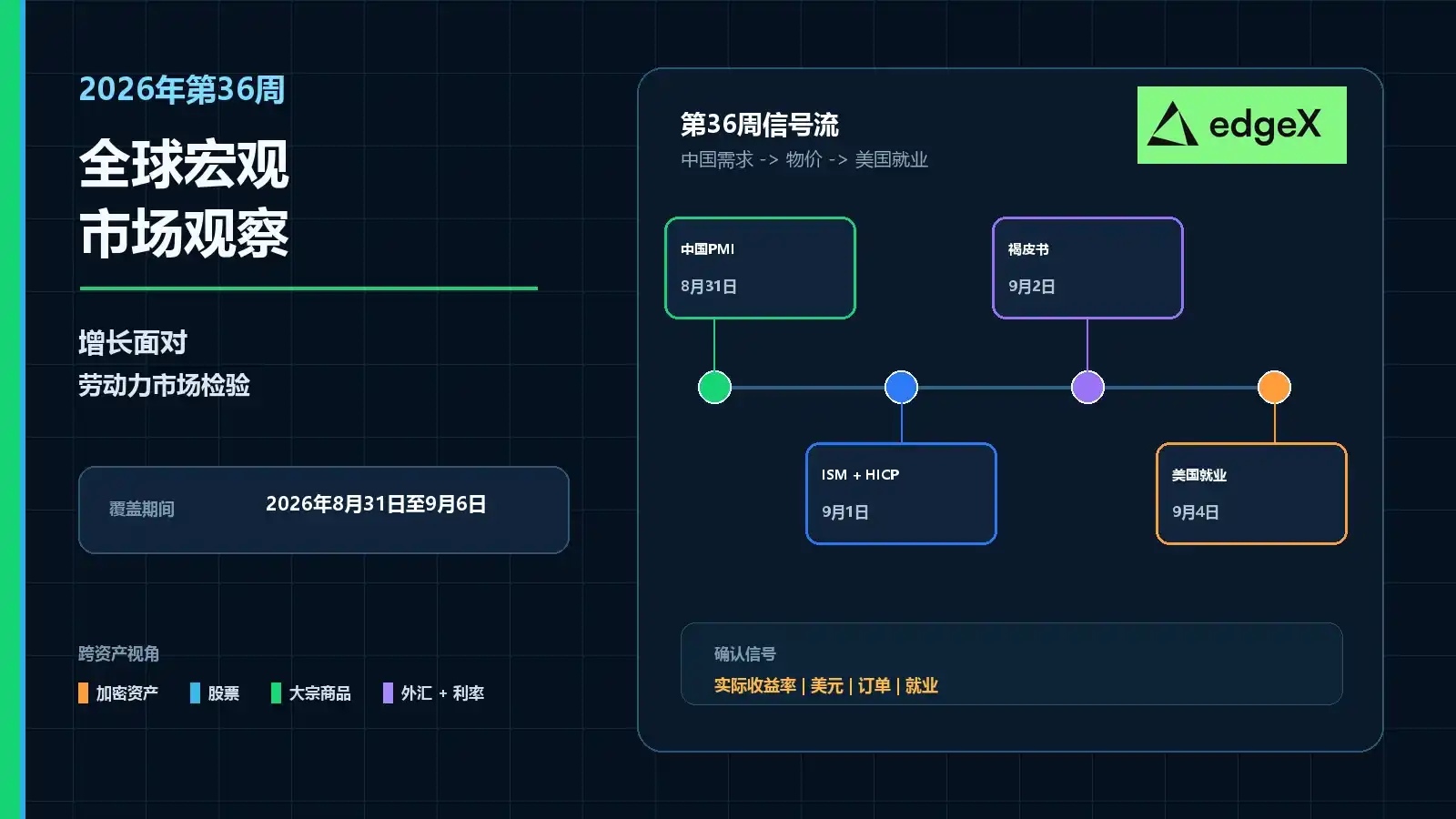
**Week 36 Macro Outlook: Key Data to Test Global Growth Resilience** The week from August 31 to September 6 will shift focus from policy discussions to a critical test of global economic activity. The sequence of events is key, starting with China's official August PMI on Aug 31, which will provide early signals on factory orders, services, and employment following July's contraction. The data flow then broadens. On September 1, US ISM Manufacturing PMI and the Eurozone's flash inflation estimate will offer simultaneous checks on demand, prices, and regional divergence. The subsequent US Federal Reserve Beige Book on September 2 adds granular, qualitative evidence on consumer spending, wages, and regional conditions. Australian Q2 GDP and Canadian trade and jobs data will test resilience in other major economies. The week's pivotal event, however, is the US August employment report on September 4. It will decisively influence expectations for interest rates, the US dollar, and broader risk appetite, acting as a final cross-check for the preceding data. The core question for markets is whether global growth can remain resilient. An ideal outcome would combine a rebound in China's PMI, stable US jobs growth, cooling inflation, and signs of a gradual demand slowdown. Conversely, weak Chinese manufacturing, sticky Eurozone prices, and disappointing US non-farm payrolls would create a more complex scenario of reduced corporate confidence and limited room for aggressive monetary easing, increasing pressure on cyclical assets. Investors should monitor the breadth of improvements—such as new orders and employment—rather than headline PMI figures alone. Confirmation across different data points is crucial. A positive combination of steady activity and disinflation could support equities, industrial commodities, and risk assets like crypto. However, if a growth slowdown triggers lower yields, it must be distinguished from a scenario of rising recession risks that would pressure corporate earnings, potentially limiting rallies. The market's final reaction will hinge on whether the week's signals align to either reinforce or challenge the current growth narrative.

marsbit14 dk önce

US Jobs, China PMI, and Inflation on Stage: Can Global Growth Maintain Resilience?

marsbit14 dk önce

İşlemler

Spot
活动图片