$USDD Takes on Tether: As L2s Innovate, $BEST Benefits

bitcoinist2025-09-09 tarihinde yayınlandı2025-09-09 tarihinde güncellendi

Özet

It looks like the stablecoin space is heating up! Justin Sun’s $USDD just landed on the Ethereum network, and it’s...

Trusted Editorial content, reviewed by leading industry experts and seasoned editors. Ad Disclosure

It looks like the stablecoin space is heating up! Justin Sun’s $USDD just landed on the Ethereum network, and it’s not just a casual visit. It’s a strategic move to challenge Tether, the reigning champ of the $2.5T stablecoin market.

Read on for how the news affects Best Wallet and its native Best Wallet Token ($BEST) bid to bring crypto investing and dApps to the masses.

USDD Launches with Peg Stability and a 12% Yield to Kick Things Off

$USDD is coming in hot with a Peg Stability module that lets you swap it directly for $USDT and $USDC. And to get the party started, there’s an airdrop campaign offering an up to 12% annual yield. That’s what you call a welcome gift!
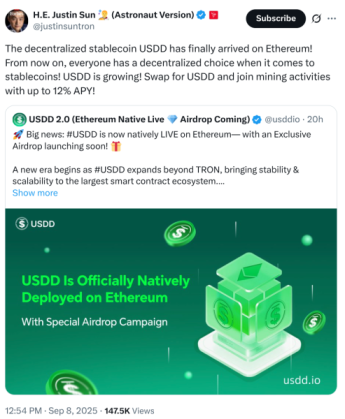
Justin Sun's X $USDD announcement on Ethereum.

Still, $USDD has its work cut out for it. Tether’s dominance is massive, with a market cap of over $169B compared to $USDD’s modest $450M. Tether is deeply rooted and has incredible liquidity, especially on TRON. For $USDD to really compete, it needs to earn trust, diversify its collateral, and get integrated into more real-world uses.

The Yield-Bearing Revolution: A Fresh Business Model for L2s

While $USDD is making its big move, another shift is happening behind the scenes. Ethereum’s Layer-2 (L2) solutions are finding new ways to make money.

MegaETH, an L2 backed by Vitalik Buterin himself, is launching a yield-bearing stablecoin called $USDm.
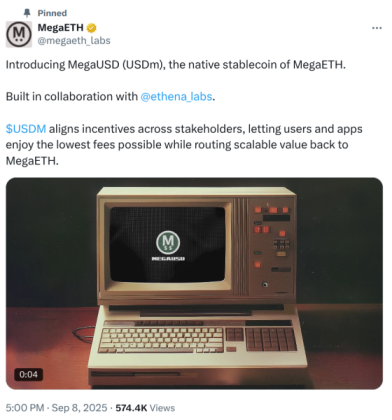
MegaETH announcement on X of the $USDm.Instead of relying on transaction fees, MegaETH plans to use the yield from USDm’s reserves to cover its own costs, specifically the fees it pays to the main Ethereum chain.

This clever approach could mean lower fees for users and more freedom for dApp developers. The stablecoin’s reserves will be invested in BlackRock’s tokenized US Treasury fund, providing a steady income.

This is happening as more yield-bearing stablecoins emerge, especially after the US’s GENIUS Act pushes protocols like Ethena and MegaETH to innovate.

It’s a sign that L2s aren’t just about speed; they’re also figuring out how to be more efficient and economical. It’s something they could learn from Best Wallet Token ($BEST), which provides its holders with everything they need to participate in the crypto economy, in one easy-to-use app.

$BEST Is Your Best Bet

While the battle of high yields rages between Tether and $USDD, what if a single token could help you navigate the entire crypto landscape? Cue Best Wallet Token ($BEST).

While $USDD is just one player in the stablecoin game, $BEST is your all-access pass to the entire digital asset show. It’s something investors are clearly responding to, as the presale has raised over $15.6M so far.

Instead of chasing the next asset, you can hold $BEST and get benefits that work across the board. You get reduced transaction and swap fees on multiple blockchains, saving you money no matter which token you’re trading.
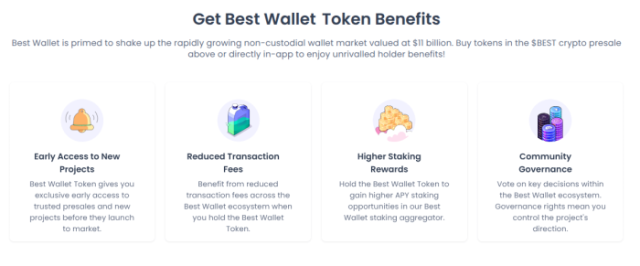
$BEST benefits as listed on the presale website.

Plus, $BEST holders get exclusive access to the ‘Upcoming Tokens’ section, meaning you can get in early on the next big crypto projects before they go public. That’s a massive advantage in a market that moves at lightning speed.

Get your $BEST now for $0.025615, or find step-by-step instructions in our ‘How to Buy Best Wallet Token’ guide.

More Than A Wallet, It’s a Secure Financial Hub

With new L2s like MegaETh boasting ever-improved business models, it’s clear that crypto is constantly evolving, and you need a platform that can keep up.

This is where Best Wallet shines. It’s built with Fireblocks MPC-CMP technology, meaning you can forget about the stress of managing complicated seed phrases. It’s a secure, non-custodial wallet that makes your crypto safe and easy to access.

But the best part? It turns your assets into a source of passive income. Beyond fee reductions and presale access, holding $BEST allows you to earn rewards through staking (currently sitting at a respectable 85%). This means your tokens are working for you, generating value while you hold them.

The upcoming Best Card will even let you spend your crypto in the real world and get cashback rewards.

Best Card feature from the Best Wallet website.

So while other projects are focusing on one specific problem, $BEST is building a complete, user-friendly ecosystem. It’s this focus on the future that leads us to believe it could reach $0.072 by the end of 2025, resulting in a massive 181% ROI on today’s price.

A Central Hub in the Innovation Storm

While $USDD is locked in a high-stakes battle for stablecoin supremacy and MegaETH is pioneering new L2 business models, Best Wallet Token ($BEST) brings everything together for you, the user. Join the presale now and buckle up for the next wave of crypto innovation.

Remember to always do your own research and only invest what you can afford. This is not intended as financial advice.

Authored by Ben Wallis, Bitcoinist, https://bitcoinist.com/justin-sun-launches-usdd-and-best-explodes/

Editorial Process for bitcoinist is centered on delivering thoroughly researched, accurate, and unbiased content. We uphold strict sourcing standards, and each page undergoes diligent review by our team of top technology experts and seasoned editors. This process ensures the integrity, relevance, and value of our content for our readers.

Ben is a freelance writer specializing in crypto developments (mainly altcoins) and the intricate ways global economics shape the digital asset space. His B.Ed. in Education provides a unique foundation for his writing, enabling him to distill complex crypto concepts and market shifts into clear, digestible insights. This skill is key to helping readers adapt and apply their understanding to the ever-evolving world of crypto investment. Passionate about making crypto accessible, Ben crafts content designed to educate a broad audience, from current market events to the essential foundational knowledge that underpins them. His goal is to empower readers through understanding. When he’s not immersed in crypto analysis and breaking down complex topics, Ben is an avid Pokémon fan and enjoys all things Disney.

İlgili Okumalar

Just now, DeepSeek V4 updates with DSpark, improving inference speed by 80%

DeepSeek has updated its DeepSeek V4 model with the DSpark speculative decoding framework, achieving a significant 60-85% speedup in generation for Flash models and 57-78% for Pro models while maintaining the same overall throughput. This engineering-focused update, rather than a core architectural change, introduces DSpark to address latency and throughput bottlenecks in high-concurrency production environments. DSpark combines high-throughput parallel generation with adaptive load-aware verification. Its key innovations include a semi-autoregressive generation architecture to model dependencies within token blocks and a hardware-aware confidence-scheduled verification system. This system uses a confidence head to predict token acceptance probabilities, allowing it to dynamically optimize verification length per request and allocate compute only to tokens with the highest expected payoff. The asynchronous scheduler is designed for real-world deployment, ensuring zero-overhead scheduling and continuous CUDA graph replay while preserving the target model's output distribution. In tests across mathematical reasoning, code generation, and daily dialogue, DSpark outperformed state-of-the-art models like Eagle3 and DFlash, increasing average acceptance length by 26.7%-30.9% and 16.3%-18.4% respectively on Qwen3 target models. DeepSeek also open-sourced DeepSpec, a full-stack codebase for training and evaluating speculative decoding draft models, providing a standardized toolkit that includes data preparation tools, model implementations, training code, and evaluation scripts.

marsbit1 saat önce

Just now, DeepSeek V4 updates with DSpark, improving inference speed by 80%

marsbit1 saat önce

BIT Research: The 2028 Halving Is Not the End, the Real Shake-Up of the Bitcoin Mining Industry Is Just Beginning

The Bitcoin mining industry is undergoing its most complex structural adjustment since inception. Despite Bitcoin's price holding near $61,000 and the network hash rate approaching a record 1 ZH/s, miner profitability is deteriorating. The industry is operating close to its breakeven point, with the 2028 halving expected to accelerate consolidation. The challenges extend beyond the halving's subsidy reduction; the industry's revenue model has yet to successfully transition towards a fee-driven structure. Increasingly, mining companies are evolving from simple Bitcoin producers into infrastructure and energy operators, including providers of AI/HPC computing power. Competition is shifting from pure hash rate expansion to business model upgrades. Economic pressure is evident. The theoretical daily mining revenue at current prices is around $78 million, yet the actual figure is only about $33 million—a 136% gap. Transaction fees remain low at roughly $220k daily, far below historical implied levels. With a current estimated industry-wide breakeven price near $65,000, mining alone is struggling to generate ideal profits. The 2028 halving is projected to push the fundamental production cost floor to approximately $93,289. This will likely accelerate a shift towards consolidation among larger, well-capitalized miners with diversified revenue streams. Competitive advantage will belong to institutionalized players with access to low-cost energy, AI/HPC hosting operations, and stronger balance sheets. In essence, Bitcoin mining is transitioning from a "mining business" to an "infrastructure business." Future profitability and resilience will depend less on block rewards and more on diversified income sources like energy management and computational infrastructure services. For investors, the key question is not the halving itself, but which miners can successfully navigate this business model transformation.

marsbit2 saat önce

BIT Research: The 2028 Halving Is Not the End, the Real Shake-Up of the Bitcoin Mining Industry Is Just Beginning

marsbit2 saat önce

This is How God Karpathy Uses Claude?

Andrej Karpathy, a prominent figure in AI, has reportedly joined Anthropic, leading to a noticeable decrease in his open-source contributions and social media activity. A document claiming to be his personal "CLAUDE.md" file—a set of instructions for the Claude AI to follow within a specific codebase—has been circulating online. While its authenticity is unverified, the content aligns closely with Karpathy's publicly shared principles on effective AI-assisted programming. The document outlines key rules for AI coding assistants, emphasizing the importance of reading existing code thoroughly before writing new code to maintain consistency. It advises against over-engineering, advocating for simple, surgical modifications that match the project's existing style. Other guidelines include clarifying assumptions upfront, writing meaningful tests, thoughtful debugging, and carefully considering dependencies. The core message is that these principles help prevent common AI coding failures, such as introducing unnecessary abstractions, style drift, or making invisible architectural decisions. The community has noted that even experts like Karpathy require detailed instructions to guide AI effectively, akin to managing a junior developer. A related GitHub repository, "andrej-karpathy-skills," which encapsulates these ideas, is reported to significantly reduce Claude's code error rate. Ultimately, the advice stresses that the best CLAUDE.md is tailored to one's own tech stack and coding practices.

marsbit2 saat önce

This is How God Karpathy Uses Claude?

marsbit2 saat önce

İşlemler

Spot
活动图片