Ledn и Sygnum рефинансируют биткоин-кредит на $50 млн на фоне борьбы инвесторов за доходность

cryptonews.ru2025-08-28 tarihinde yayınlandı2025-08-28 tarihinde güncellendi

Кредитор цифровых активов Ledn привлек швейцарский криптобанк Sygnum для рефинансирования своего биткоин-кредита на $50 млн. Эта сделка, по словам компаний, открывает возможности для токенизированных инвестиций, обеспеченных биткоинами.

Хотя рефинансирование соответствует синдицированному кредиту Ledn на $50 млн, полученному в 2024 году, по последнему кредиту подписка была превышена вдвое, сообщили компании в среду.

Переподписка на кредиты указывает на то, что спрос инвесторов превышает доступное распределение кредитов, что часто свидетельствует о сильном институциональном интересе. В таких случаях инвесторы могут получить лишь часть запрошенного ими финансирования, или эмитент может увеличить размер кредита для привлечения дополнительного капитала.

Часть кредита была токенизирована через платформу Desygnate от Sygnum, которая позволяет выпускать частные кредитные сделки в виде ончейн-инвестиционных продуктов. Благодаря токенизации кредит может быть более широко распространен среди квалифицированных инвесторов.
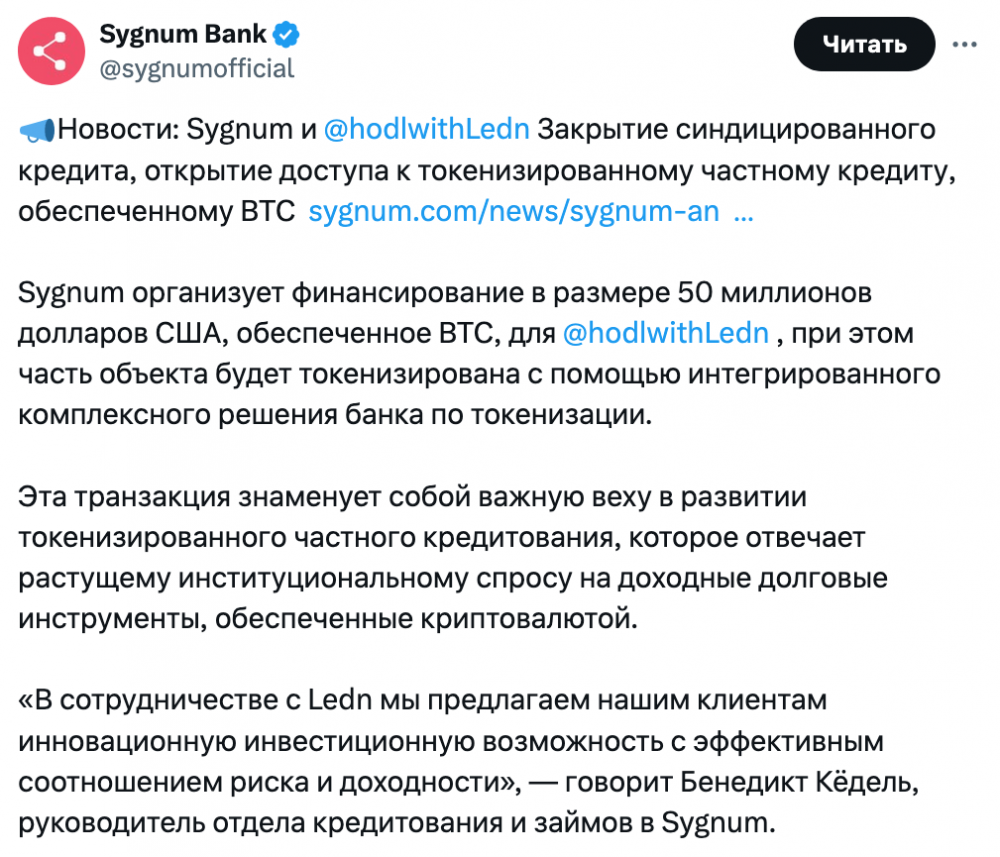

Источник: Sygnum Bank

Компании заявили, что переподписка свидетельствует о растущем спросе инвесторов на доходные продукты, устойчивые к инфляции, особенно на фоне продолжающегося снижения доходности как на традиционных рынках, так и в DeFi.

Ранее в этом году аналитическая компания DeFi Neutrl сообщила о падении доходности, отметив, что годовая процентная ставка по стейблкоинам упала ниже 6% — это значительно меньше, чем двузначные значения доходности, которые инвесторы получали в предыдущем рыночном цикле до медвежьего рынка 2022 года.

Ledn — не единственная компания, предоставляющая кредиты в биткоинах. В январе Coinbase возобновила выдачу кредитов, обеспеченных биткоинами, для клиентов из США, а Morpho Labs упростила процесс кредитования.

В июле издание сообщалось, что Twenty One Capital, поддерживаемый Cantor Fitzgerald, изучает возможность кредитования в долларах США, обеспеченного залогом в биткоинах. Тем временем, как сообщается, JPMorgan Chase рассматривает возможность запуска собственных кредитных продуктов, обеспеченных биткоинами, с потенциальным запуском в 2026 году, хотя сроки могут быть изменены.

Частное кредитование стимулирует бум токенизации

Проект Sygnum–Ledn относится к рынку токенизированного частного кредитования, который в настоящее время является крупнейшим и наиболее быстрорастущим сегментом токенизации активов.

Однако не все кредиты, обеспеченные биткоинами, относятся к частному кредитованию. Кредитные продукты, ориентированные на розничных клиентов, обычно не рассматриваются в этой категории.

Согласно отраслевым данным, частное кредитование в настоящее время составляет более половины всей токенизированной стоимости в блокчейне. По состоянию на среду рынок токенизированного частного кредитования в блокчейне оценивался в $15,6 млрд, что составляет 58% рынка токенизированных реальных активов.
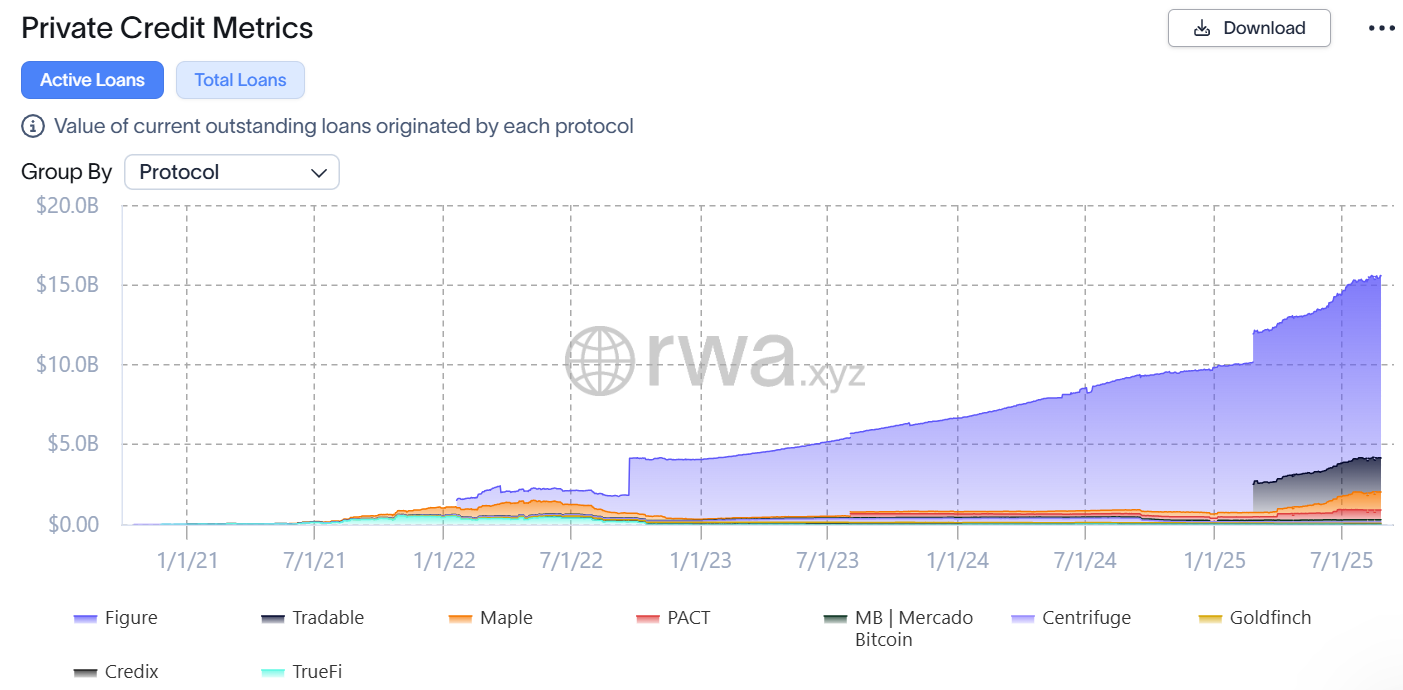

Рост токенизированных частных кредитов. Источник: RWA.xyz

Как отметила компания Galaxy Digital в своем апрельском отчете о криптокредитовании, ончейн-частное кредитование «основано на токенизации, программируемости, полезности и, как следствие, росте доходности».

Согласно июньскому анализу, проведенному DeFi-протоколом Gauntlet и отраслевой платформой RWA.xyz, доходность токенизированных частных кредитов обычно составляет от 8% до 12%.


İlgili Okumalar

Upbit is Anxious: A Hasty Counterattack Aimed at Regaining Stablecoin Market Share

Title: Upbit's Rushed Counterattack to Reclaim Stablecoin Market Share Facing a dramatic shift in South Korea's stablecoin market, leading exchange Upbit launched a promotional campaign from July 26 to August 9, waiving the 0.05% trading fee for stablecoins paired with the Korean Won (KRW) and rapidly listing new stablecoins like RLUSD and USDG. This move is a direct response to its plummeting market share in this sector. Historically a duopoly with Bithumb, the market has been reshaped since October 2025 when Coinone permanently removed fees for USDC trading. By June 2026, Coinone led with 34.8% of stablecoin volume, followed by Bithumb (31.1%) and Upbit (30.1%). This contrasts sharply with the overall crypto market, where Upbit commands 60%. The data shows stablecoin demand is highly sensitive to fees, as users primarily buy them to transfer capital overseas for derivatives trading or forex arbitrage. South Korean exchanges have seen a net outflow of stablecoins for 18 consecutive months, totaling approximately 14.9 trillion KRW, underscoring their role as a cross-border capital conduit. Upbit's limited-time promotion initially boosted its daily stablecoin volume by 162%, but the surge was almost entirely in USDT (98.1% of volume). The newly listed stablecoins saw negligible, fleeting interest. Furthermore, the promotional effect quickly waned in the second week, with volume dropping 33% on weekdays. A concurrent weakening of the KRW also contributed to the trading spike, independent of the fee waiver. The analysis suggests that once the promotion ends, Upbit is unlikely to retain its temporary gains unless it matches Coinone's permanent zero-fee policy, forcing a choice between market share and fee revenue. Upbit's strategic push may be less about immediate profit and more about preparing for future regulatory shifts. With South Korea's *Digital Asset Basic Act* on the horizon, which will regulate KRW-backed stablecoins, and following Dunamu's (Upbit's parent) integration into Naver Financial to build a payment ecosystem, securing a dominant position in the dollar stablecoin distribution channel holds long-term strategic value. However, potential regulatory conflicts could prevent Upbit from listing a future Naver-issued KRW stablecoin, making the current fight for dollar stablecoin flow even more critical.

marsbit2 saat önce

Upbit is Anxious: A Hasty Counterattack Aimed at Regaining Stablecoin Market Share

marsbit2 saat önce

Michael Saylor Compares Bitcoin and Gold!

Michael Saylor, founder of MicroStrategy, argues that Bitcoin fundamentally changes how wealth is stored and transferred by transforming digital scarcity into economic value. He describes Bitcoin as the first digital monetary network, combining computers, digital networks, and cryptography. It digitizes monetary assets, allowing their supply to be controlled by public protocols rather than institutions, thus converting economic value into information transmissible over global networks. Comparing Bitcoin to gold, Saylor states that while increasing Bitcoin's supply is harder, its integration with software and transfer is easier. He highlights Bitcoin's proof-of-work mechanism, which ties it to the physical world by consuming real energy to secure the ledger, making past transactions immutable. This creates a shared security system involving miners, energy companies, and investors. Saylor suggests "digital monetary energy" is a more accurate term than "digital gold." He emphasizes that the Bitcoin network is an adaptive ecosystem of miners, nodes, developers, and users. Its core design is intentionally simple, focused on maintaining a secure ledger for scarce digital assets, with complex functionalities built in higher-layer applications. This architecture allows Bitcoin to serve as a foundation for transmitting value and fostering innovation in payments and financial services. Saylor notes Bitcoin's deeper impact lies in creating digital sovereignty, where private keys give individuals permissionless control over their economic power, with ownership verified mathematically, not by institutions. He concludes that while gold's physical scarcity makes it money, Bitcoin's digital scarcity does the same, characterizing Bitcoin as the monetary energy of the digital age.

cryptonews.ru3 saat önce

Michael Saylor Compares Bitcoin and Gold!

cryptonews.ru3 saat önce

İşlemler

Spot
活动图片