Соло-майнер добыл блок биткоина и заработал $371 000

cryptonews.ru2025-06-17 tarihinde yayınlandı2025-08-18 tarihinde güncellendi

17 августа майнер-одиночка самостоятельно добыл блок #910 440 в сети первой криптовалюты, получив 3,137 BTC (~$371 576) в виде вознаграждения и комиссий. Об этом рассказал администратор CK Pool Кон Коливас.

Congratulations to miner bc1q~nwsgdw0wfh4trqal69fz with 9PH for solving the 305th solo block at https://t.co/UWgBvLk5AE! A miner of this size has about a 1 in 800 chance of solving a block per day.https://t.co/6WKLc4IshW pic.twitter.com/Z0OSzvBCFs

— Dr -ck (@ckpooldev) August 17, 2025

По его словам, майнер добывал монеты на оборудовании с хешрейтом 9 TH/s. Вероятность такого события составляет примерно 1 к 800 в день.

В блоке было 4900 транзакций. Из них около 3300 имели комиссию менее сатоши за виртуальный байт (sat/vB). Дополнительный доход от таких операций составил всего 0,0018 BTC (~$220) — 0,06% от награды за блок.
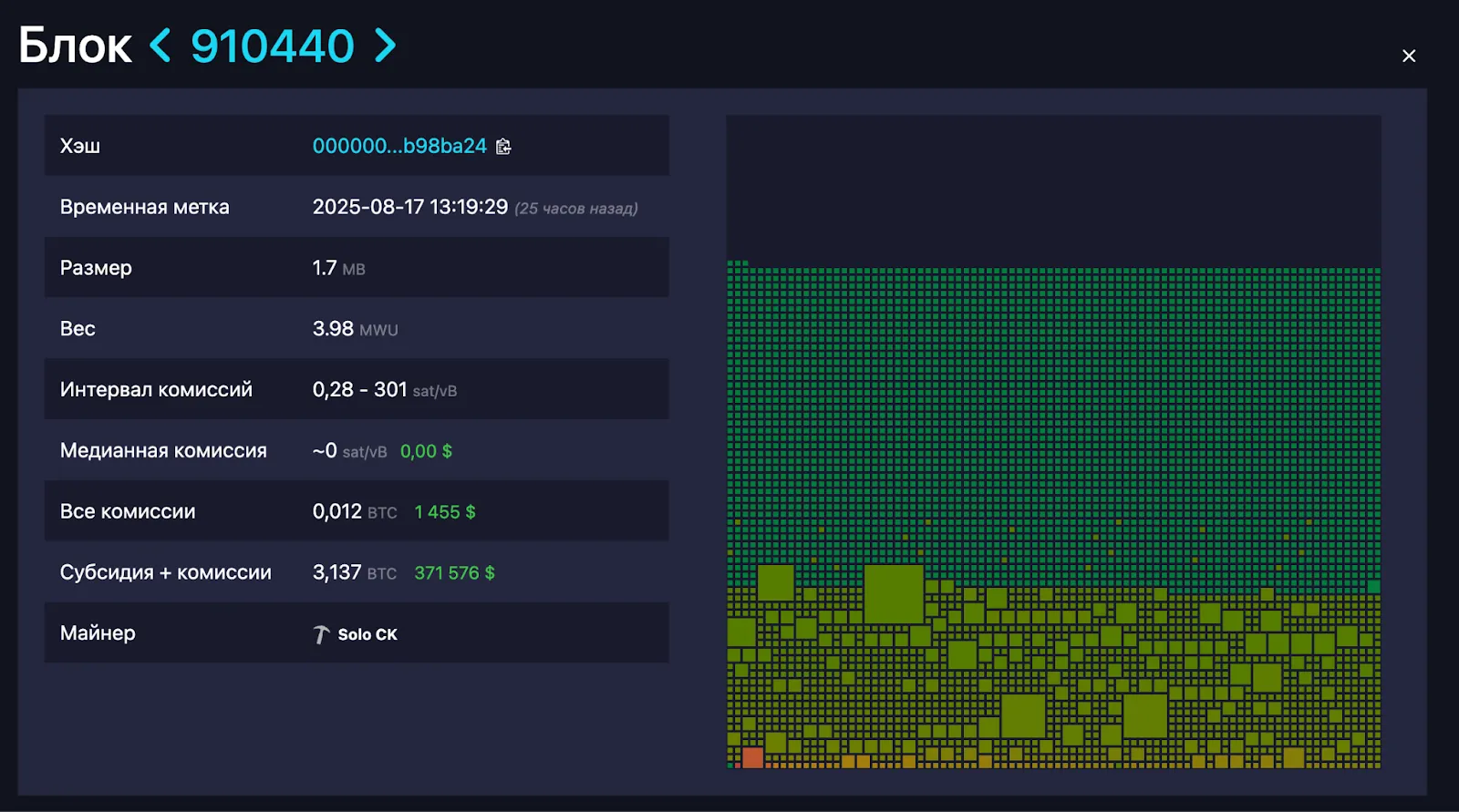
Источник: mempool.space.

При этом каждая такая транзакция создавала новые UTXO, увеличив нагрузку на сеть без существенной выгоды для майнера.

Коливас отметил, что включение операций с низкими комиссиями было экспериментом. Участники сети вроде F2Pool уже начали их обрабатывать, и отказ от этой практики ставил соло-майнеров в невыгодное положение при добыче новых блоков.

Создатель CK Pool пришел к выводу, что потенциальный ущерб от массового создания новых UTXO превышает «незначительную финансовую выгоду». Теперь пул будет лишь отслеживать подобные транзакции, но не включать их в блоки.

«Чтобы транзакции с такими низкими комиссиями стали хоть сколько-нибудь значимыми для майнинговых пулов, вознаграждение за блок должно сократиться до крайне малых величин. Я бы стал учитывать их только в том случае, если они увеличивают доход хотя бы на 1%. Однако это потребует, чтобы общее вознаграждение за блок упало ниже 0,2 BTC — до таких значений в ближайшие десятилетия мы вряд ли дойдем», — подчеркнул эксперт.

Коливас призвал другие пулы пересмотреть свою политику, поскольку подобные транзакции в долгосрочной перспективе могут негативно сказаться на структуре комиссий.

Как работает майнинг биткоина?

Реакция сообщества

Пользователи поблагодарили создателя CK Pool за анализ. Основатель проекта Fedora Уоррен Тогами назвал расширение UTXO «негативным фактором, который большинство годами игнорировало».

UTXO expansion is a negative externality that most people have ignored all these years. Mining UTXO expansion at a too-low fee privatizes gain while socializing the cost to everyone else.

Thank you for taking the time to analyze and to raise awareness of the issue.

— Warren Togami (@wtogami) August 18, 2025

«Добыча блоков, увеличивающих UTXO, при слишком низкой комиссии приватизирует прибыль, перекладывая издержки на всех остальных», — написал он.

27 июля еще одному соло-майнеру удалось заработать $372 773 за добычу блока #907 283.

Напомним, 15 августа компания GoMining спрогнозировала новый хайп вокруг майнинга биткоина.

İlgili Okumalar

Jameson Lopp's BIP-110 Postmortem: Bitcoin Is Driven by Game Theory, Not Morality

Jameson Lopp's analysis concludes that BIP-110, a proposal to restrict arbitrary data (like inscriptions) on Bitcoin, failed due to economic and technical realities, not moral arguments. The proposal, championed by Luke Dashjr and others, aimed to "cleanse" the chain but never reached its 55% miner activation threshold. Upon its forced signaling deadline in August, only the OCEAN pool (with ~1% hash rate) supported it, creating a short-lived fork that quickly died as miners faced unredeemable block rewards. Lopp's earlier predictions about its economic infeasibility were proven correct. Technically, BIP-110 was flawed; workarounds to embed data compliant with its rules were demonstrated almost immediately, proving it couldn't achieve its stated goal. The debate often devolved into moralistic rhetoric, with supporters accusing opponents of supporting child exploitation material—a tactic Lopp criticizes as ineffective for building consensus. Lopp argues Bitcoin is driven by incentives and game theory, not morality. Past forks like Bitcoin Cash promised economic benefits, while BIP-110 offered only restrictions and reduced miner fees, gaining no substantial support from major economic players. He predicts the "puritans" behind the failed fork will continue complaining but their new chain will remain insignificant. The episode reaffirms that attempting to censor data on a permissionless, anti-censorship network like Bitcoin is a futile battle.

marsbit5 dk önce

Jameson Lopp's BIP-110 Postmortem: Bitcoin Is Driven by Game Theory, Not Morality

marsbit5 dk önce

Tokenization Scale Soars to $4.3 Billion, But Why Did Securitize Incur a $5.5 Million Loss?

Securitize's first quarterly report post-IPO reveals a paradox: while its tokenized assets under management hit a record $4.3 billion (up 16% YoY) and platform trading volume surged 147% to $5.3 billion, total revenue fell 5% to $14.4 million. Tokenization revenue specifically dropped ~12% to $7.8 million, leading to an adjusted EBITDA loss of $5.5 million. CFO Francisco Flores explained that most trading volume is not yet monetized, with the majority of tokenization revenue still coming from one-time projects like new protocol integrations. In contrast, asset servicing revenue, a more recurring stream, grew slightly to $6.6 million. The company has lowered its full-year revenue guidance to $70-$80 million from an initial projection of $110 million. Industry experts note this highlights a structural challenge for the tokenization sector. Scaling assets on-chain doesn't automatically scale a profitable business model. Current implementations often rely on costly, customized projects for each new asset or jurisdiction. The future, they argue, lies in building standardized infrastructure that generates recurring "infrastructure revenue" from post-issuance activities like compliance, distributions, and secondary trading—similar to enterprise software. Analysts caution against misinterpreting high trading volumes as indicative of a mature fee-based model, as Securitize's broad volume metric includes many non-monetized actions. The key test for the industry is whether adding billions in new assets can generate sustainable revenue without constant new custom projects.

marsbit8 dk önce

Tokenization Scale Soars to $4.3 Billion, But Why Did Securitize Incur a $5.5 Million Loss?

marsbit8 dk önce

The Five Paradoxes of Artificial Intelligence

**Five Paradoxes of Artificial Intelligence** Artificial intelligence (AI) is an era filled with paradoxes, which we navigate as we advance. **1. The Prediction Paradox** AI experts, from pioneers like Marvin Minsky to contemporary figures like Geoffrey Hinton and Demis Hassabis, have a history of inaccurate forecasts regarding AI's capabilities and timelines, such as achieving human-level machine intelligence or surpassing radiologists. Predictions about Artificial General Intelligence (AGI) vary wildly between optimistic entrepreneurs and skeptical academics, highlighting the inherent unpredictability of technological futures. **2. The Employment Quantification Paradox** Despite numerous studies from institutions like the OECD, IMF, and McKinsey attempting to quantify AI's impact on jobs, estimates of affected employment range from 0.4% to 67%, revealing vast inconsistencies. This paradox arises because isolating AI's effect from other economic, social, and technological factors is virtually impossible, and forecasts depend on static assumptions about a dynamically evolving technology. **3. The Productivity Paradox** While AI is a transformative General Purpose Technology, significant productivity growth has not yet materialized in major economies like the EU and has only matched historical averages in the US. This disconnect between rapid innovation and slow productivity gains, reminiscent of the "Solow Paradox" from the computer age, is often explained by time lags. History shows it takes decades for such technologies to diffuse and trigger complementary innovations that boost productivity. **4. The Data Value Paradox** Data is hailed as the "new oil" and critical for AI, yet its economic value is paradoxical. Its worth is realized only in use, not in straightforward trade. Despite policy emphasis and initiatives for data asset recognition on corporate balance sheets in China, the monetized value remains negligible—accounting for only about 0.06% of major telecom operators' total assets—highlighting the gap between perceived utility and financial valuation. **5. The Industrial Revolution Paradox** For decades, nearly every major new technology, from the internet and nanotechnology to blockchain and now AI, has been proclaimed as the driver of a "Fourth Industrial Revolution." This constant reassignment suggests prior labels were premature. True industrial revolutions are typically identified in hindsight, not in real-time. Furthermore, the coexistence of such a proclaimed transformative revolution with ongoing economic crises would be historically anomalous. Whether AI truly defines a new industrial revolution remains a narrative for the future to decide.

marsbit10 dk önce

The Five Paradoxes of Artificial Intelligence

marsbit10 dk önce

Experts Warn of Mass Crypto Hacks Using AI Agents

Experts warn that AI agents could dramatically lower the cost and scale of attacks against cryptocurrency holders. Speaking at the Wyoming Blockchain Symposium, industry figures noted that automation allows malicious actors to simultaneously search for vulnerabilities in wallets, passwords, and networks across a vast number of potential victims. Ryan Kirkly, co-founder and CEO of Global Settlement Network, criticized the industry for often viewing autonomous agents only as beneficial tools while underestimating their offensive potential. Data from TRM Labs shows the crypto industry experienced a record 207 hacks in the first half of 2026, causing $972 million in losses, with the number doubling from the same period in 2025. Vice President of Technical Operations at Web3 Foundation, Bill Labun, agreed that the efficiency of autonomous systems also benefits attackers. While defenders like the Ethereum Foundation are using AI agents for security audits, the need for human verification remains high due to false positives. A major concern is granting AI agents direct access to financial tools and personal data. New services like MetaMask's Agent Wallet, which allows AI to manage assets within set limits, introduce risks such as prompt injection attacks. Panelists also highlighted risks from metadata leakage, which can compromise privacy even on private networks, and the unresolved issue of legal liability for an AI agent's autonomous and potentially irreversible actions. Lack of user trust, due to AI's tendency to "hallucinate" or generate incorrect information, was cited as a key barrier to widespread adoption.

cryptonews.ru11 dk önce

Experts Warn of Mass Crypto Hacks Using AI Agents

cryptonews.ru11 dk önce

İşlemler

Spot
活动图片