Crypto Market Faces Crucial Week: Key Dates To Watch

bitcoinist2025-08-18 tarihinde yayınlandı2025-08-18 tarihinde güncellendi

Özet

The coming days compress a series of macro and crypto-native catalysts into a tight window, setting up a volatile backdrop...

Trusted Editorial content, reviewed by leading industry experts and seasoned editors. Ad Disclosure

The coming days compress a series of macro and crypto-native catalysts into a tight window, setting up a volatile backdrop for digital assets.

Macro Keeps Grip On Crypto Market

On Wednesday, August 20, at 2:00 p.m. ET (20:00 CEST), the Federal Reserve releases the minutes of its July 29–30 meeting—effectively a fuller “transcript” of the policy debate that markets use to parse tone and conviction. Those minutes arrive exactly three weeks after the decision, per the Fed’s schedule, and should illuminate the extent of divisions that surfaced when the Fed held the target range at 4.25%–4.50% with a 9–2 vote. Two governors—Michelle Bowman and Christopher Waller—dissented in favor of an immediate cut, the first dual Board-member dissent since 1993, underscoring how unusual July’s split was. The timing and mechanics are official; the July hold and the rare double dissent are documented in contemporaneous coverage.

For risk assets, the minutes matter because they transform a terse statement and cautious press conference into something closer to a running narrative: if the text shows broad concern over weakening growth and labor, traders will infer a dovish lean; if the committee emphasized persistence of inflation and tariff spillovers, they’ll see a hawkish tilt. Market lore tends to hold—dovish minutes often coincide with lower yields and a softer dollar, while hawkish minutes have the opposite effect—but the reaction will hinge on how clearly the minutes reveal the balance of risks that produced July’s “hold.”

Two days later, on Friday, August 22, attention shifts to the Kansas City Fed’s Jackson Hole Economic Policy Symposium, the so-called Super Bowl of central banking. Chair Jerome Powell is slated to deliver remarks at 10:00 a.m. ET (16:00 CEST), with this year’s theme—“Labor Markets in Transition: Demographics, Productivity, and Macroeconomic Policy”—placing the jobs-inflation trade-off squarely in focus. Jackson Hole speeches have repeatedly reset policy expectations; investors will listen for whether Powell leans into slowing growth risks or stresses inflation stickiness as guidance into September.

Crypto Events To Watch This Week

Beyond macro, three discrete on-chain storylines will compete for mindshare. In Brasília, Brazil’s Chamber of Deputies will hold its first public hearing on Wednesday, August 20, to examine Bill 4501/2024—legislation that would authorize allocating up to 5% of the nation’s international reserves into Bitcoin. The proposal’s ceiling implies a notional allocation in the low-tens of billions of dollars, given Brazil’s roughly $300 billion in reserves earlier this year.

In DeFi, AaveDAO is poised to receive a significant token grant from World Liberty Financial (WLFI). Aave governance materials describe an arrangement under which Aave would receive approximately 7% of the total supply of WLFI tokens, alongside a share of protocol fees, in exchange for integrating and supporting a WLFI-branded Aave v3 market. Pre-market quotations for WLFI have implied a very large fully diluted valuation; one mid-July analysis tallied a ~$16 billion FDV, which—if used as a notional yardstick—would peg a 7% slice at roughly $1.1 billion.

Finally, Solana begins community voting on “Alpenglow” (SIMD-0326), a sweeping consensus redesign that aims to slash block finality from today’s ~12.8 seconds to roughly 100–150 milliseconds. The governance timeline is explicit: discussion through epoch 838, stake weights captured in epoch 839, and voting during epochs 840–842, with “voting tokens available to claim” and voting “complet[ing] at the end of epoch 842.” Passage requires at least two-thirds “Yes” of Yes+No with a one-third quorum; abstentions count toward quorum.

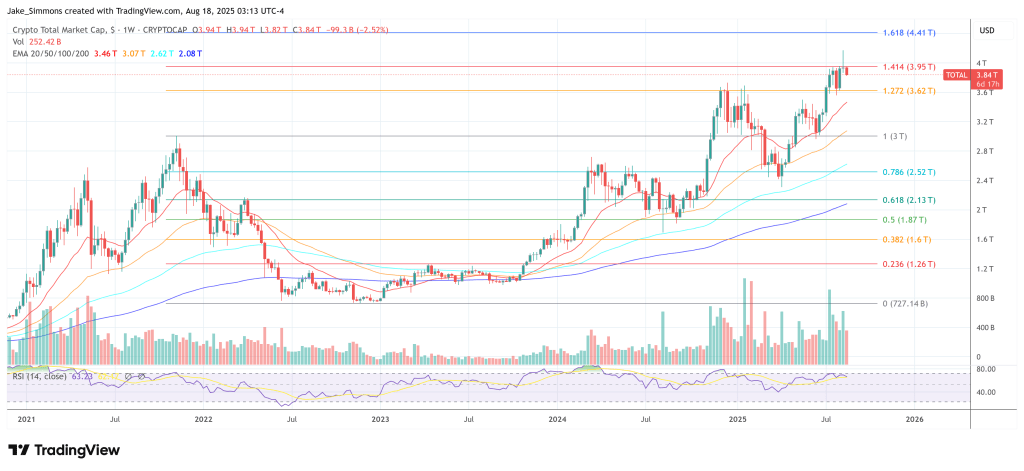
At press time, the total crypto market cap fell to $3.84 trillion.
Total crypto market cap
Total crypto market cap rejected at the 1.414 Fib, 1-week chart | Source: TOTAL on TradingView.com
Featured image created with DALL.E, chart from TradingView.com
Editorial Process for bitcoinist is centered on delivering thoroughly researched, accurate, and unbiased content. We uphold strict sourcing standards, and each page undergoes diligent review by our team of top technology experts and seasoned editors. This process ensures the integrity, relevance, and value of our content for our readers.

Jake Simmons has been a Bitcoin enthusiast since 2016. Ever since he heard about Bitcoin, he has been studying the topic every day and trying to share his knowledge with others. His goal is to contribute to Bitcoin's financial revolution, which will replace the fiat money system. Besides BTC and crypto, Jake studied Business Informatics at a university. After graduation in 2017, he has been working in the blockchain and crypto sector. You can follow Jake on Twitter at @realJakeSimmons.

İlgili Okumalar

You Use Claude and Codex Every Day, but Meta Has Restricted Internal Use

In May, Meta imposed internal restrictions on its engineers regarding the use of Claude Code and Codex, two widely used AI programming tools. Despite being a major client, Meta's guidelines, still in effect, prohibit these external models from being used for specific tasks to prevent potential "escalations with partners." The core concern is "distillation"—the risk that outputs from Claude or Codex could inadvertently contaminate the training data and evaluation processes for Meta's in-house AI coding assistant, MetaCode. If MetaCode is trained or evaluated using data generated by these external models, it risks learning their capabilities rather than developing its own, blurring the line of intellectual origin. The restrictions are precise: engineers cannot use the external models to generate test questions, debug source code, or suggest test cases. AI-generated content is also barred from environments accessible to MetaCode. However, AI can still assist with peripheral tasks like workflow setup and code organization, provided all outputs are manually reviewed. This caution reflects a broader industry dilemma. While distillation is a common technique, using a competitor's model output for training raises legal and ethical questions about the ownership of derived capabilities. Contractual terms from companies like OpenAI and Anthropic explicitly forbid using their outputs to build competing products, putting enforcement power in the hands of rivals. The move is also financially motivated, as Meta seeks to reduce its hefty internal AI spending, estimated in the billions this year. Meta's policy illustrates the delicate balance companies must strike: leveraging powerful external AI tools while safeguarding the integrity and independence of their own AI development. As AI systems increasingly help build other AIs, distinguishing the origin of capabilities becomes a fundamental challenge for the entire industry.

marsbit57 dk önce

You Use Claude and Codex Every Day, but Meta Has Restricted Internal Use

marsbit57 dk önce

Why Do We Need an AI Content Perspective Today?

The article "Why Do We Need an AI Content Perspective Today?" explores the complex and often contentious integration of AI into the cultural and creative industries, particularly film and television. It begins with the cancellation of Amazon's AI-generated animation "Punky Duck," highlighting the ethical debates surrounding AI content. AI's rapid advancement is transforming video production, enabling cost-effective, full-length AI films (e.g., "RAPHAEL," "Dreams of Violets") while sparking industry resistance over issues like "synthetic actors." The core debate has shifted from whether to use AI to how to use it responsibly. The article analyzes why AI's entry into film is uniquely unsettling. It distinguishes between "cultural fast food" (short-form, fast-paced content like micro-dramas) and "cultural main courses" (traditional, long-form film/TV). AI currently excels at the former, matching its fragmented narratives, shallow emotional needs, and free-to-consumer models. However, venturing into the latter challenges the human-centric essence of storytelling—creativity, emotional depth, and the unique value of human labor and experience. While AI can generate massive volumes of content and lower costs, it risks devaluing human creativity, leading to homogenized output, and creating unfair competition through potential intellectual property infringement. Its efficiency also amplifies content safety risks, making preemptive governance crucial. To counter these risks, the article proposes establishing clear boundaries guided by a human-centered AI content perspective. It outlines four principles: 1) Amplify, rather than displace, human creative space; 2) Respect and protect human creative output; 3) Ensure human creative control and responsibility remain paramount; and 4) Guarantee transparency and traceability in AI creation. The conclusion emphasizes that humans must act as the "helmsmen" of technology, steering AI development to enhance, not replace, the core human values at the heart of cultural expression.

marsbit1 saat önce

Why Do We Need an AI Content Perspective Today?

marsbit1 saat önce

Planck Retracted? The Father of Quantum Tripped by an Algorithm

The recent discovery that two articles (published in 1940 and 1942) by Max Planck, the Nobel laureate and founder of quantum theory, are marked as "retracted" on Springer's digital platform highlights a curious clash between historical publishing practices and modern automated systems. An investigation suggests these retractions are algorithmic errors, not due to fraud or misconduct. The papers, philosophical reflections on science published in *Die Naturwissenschaften*, were likely flagged by the platform's systems. One article, a republished lecture, may have been mistaken for duplicate publication. Another, sharing a title with a prior article by a different author (a common practice for continuing debates at the time), may have triggered a similar automated check. The digital versions have even been replaced with blank pages, contrary to normal practice of preserving retracted texts. This incident underscores how contemporary digital infrastructure, built around concepts like "self-plagiarism" and strict copyright, can misclassify and obscure legitimate historical scholarly communication. It serves as a warning that digital archives are not neutral mirrors of the past but are filtered by platform rules, potentially distorting the scientific record. As AI systems increasingly rely on such databases, such erroneous metadata could propagate, affecting how future tools interpret and access historical knowledge.

marsbit1 saat önce

Planck Retracted? The Father of Quantum Tripped by an Algorithm

marsbit1 saat önce

İşlemler

Spot
活动图片