Google Bows To Crypto Fury, Unbans Non-Custodial Wallets

bitcoinist2025-08-14 tarihinde yayınlandı2025-08-14 tarihinde güncellendi

Özet

A policy whiplash at Google set the crypto industry ablaze on Wednesday before ending in a rare and explicit climbdown:...

Trusted Editorial content, reviewed by leading industry experts and seasoned editors. Ad Disclosure

A policy whiplash at Google set the crypto industry ablaze on Wednesday before ending in a rare and explicit climbdown: non-custodial wallets are not covered by the Play Store’s new licensing regime.

The clarification, posted by Google’s official communications account on X late August 13, came after lawyers, developers, and high-profile Bitcoiners blasted an earlier interpretation of revised rules that appeared to force Anti-Money-Laundering and Know-Your-Customer checks on self-custody software in the United States and effectively box out indie wallet teams across the European Union.

“Non-custodial wallets are not in scope of Google Play’s Cryptocurrency Exchanges and Software Wallets Policy. We are updating the Help Center to make this clear,” Google wrote.

The initial backlash was swift. VP of Regulatory Affairs at Paradigm Justin Slaughter called it a “surprising move… amid [Google’s] antitrust litigation,” arguing that “pure coding should not require a federal license,” while Jack Dorsey summed up the mood with a one-word verdict: “terrible.”

By nightfall in the US, crypto analyst Pentoshi declared “Breaking news Google has unbanned self custodial wallets,” while Pierre Rochard praised the course correction: “All companies make mistakes, great companies listen to online feedback and course-correct. Google Play can’t afford to ban itself from Bitcoin.”

Google Bow To Crypto Community (Partially)

Under the policy actually taking effect, Google is synchronizing Play Store distribution with licensing in roughly 15 jurisdictions for custodial products—crypto exchanges and custodial “software wallets”—with enforcement to begin on October 29, 2025. In practice that means US developers must operate under a federal or state banking charter or register with FinCEN as a money services business and obtain state money transmitter license; in the EU they must hold authorization as a MiCA crypto-asset service provider.

France and Germany have transitional windows before MiCA fully displaces national licensing. Google’s own policy pages and the updated explainers published Wednesday night underline that non-custodial wallets—apps where users retain their private keys and no third party takes custody—are outside this licensing scope.

The pivot capped a confusing news cycle. Several outlets reported during the day that Google would require licenses for all wallets, custodial and non-custodial alike, before clarifications on X and in follow-up coverage reversed that reading. Google’s statement confirms that self-custody apps are exempt, while noting that the Play Store will still gate custodial apps and exchanges in the US, EU, UK, and other listed markets. The net effect: the compliance burden shifts squarely onto entities that hold user funds, not the open-source code that enables users to hold their own.

Even with Google’s clarification, edge cases remain. Francis Pouliot, CEO of Bull Bitcoin, pressed the company to explain whether the policy captures non-custodial wallets that embed optional gateways to regulated exchanges, with access controls enforced inside the app rather than via Play Store geo-targeting. That unresolved ambiguity matters to builders who have stitched together self-custody with fiat on-ramps through partner integrations, and who must now assess whether those features nudge a wallet into “custodial software wallet” territory for Play’s purposes.

Developers also reported inconsistent enforcement as the policy story evolved. Adam Simecka, founder of the self-custodial Manna Wallet, said the app was de-listed from Play search “with no warning, notice, or recourse,” then later observed that visibility differed across devices and regions: “Some people are able to see it in their Play Store… Out of our family’s 3 Android devices, it is showing on 1.” He added that positive reviews had disappeared alongside search visibility.

For users and developers, the path ahead is clearer but not frictionless. The Help Center’s country-by-country matrix now anchors distribution for custodial apps to local licensure—FinCEN MSB and state money transmission in the US; CASP authorization under MiCA in the EU; FCA registration in the UK; and comparable regimes in Switzerland, the UAE, Japan, South Korea, and others—with France and Germany granted interim national options before their MiCA deadlines.

Google states the blockchain content policy update becomes effective October 29, 2025, with additional Help Center links added to reflect the new requirements. In parallel, Google has reiterated—now on the record—that non-custodial wallets are outside the scope of these licensing checks.

At press time, the total crypto market cap stood at $4.11 trillion.
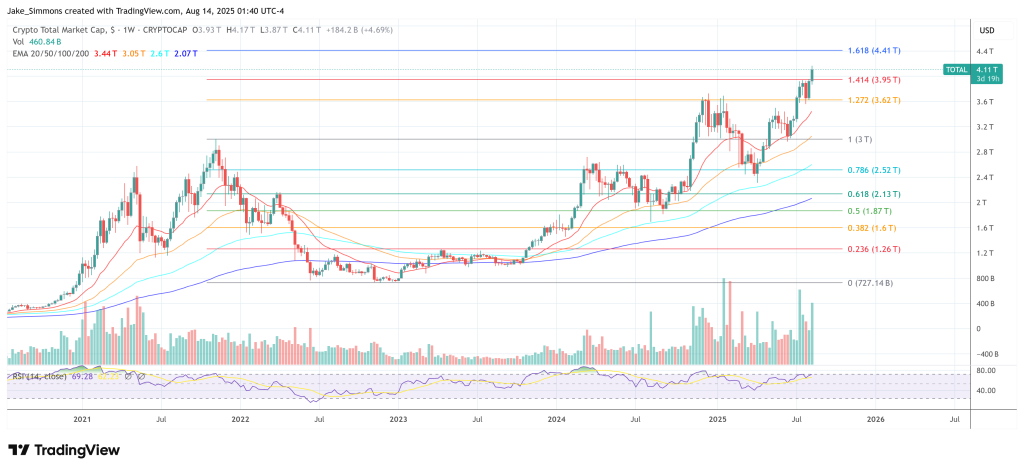
Total crypto market cap
Total crypto market cap, 1-week chart | Source: TOTAL on TradingView.com
Featured image created with DALL.E, chart from TradingView.com
Editorial Process for bitcoinist is centered on delivering thoroughly researched, accurate, and unbiased content. We uphold strict sourcing standards, and each page undergoes diligent review by our team of top technology experts and seasoned editors. This process ensures the integrity, relevance, and value of our content for our readers.

Jake Simmons has been a Bitcoin enthusiast since 2016. Ever since he heard about Bitcoin, he has been studying the topic every day and trying to share his knowledge with others. His goal is to contribute to Bitcoin's financial revolution, which will replace the fiat money system. Besides BTC and crypto, Jake studied Business Informatics at a university. After graduation in 2017, he has been working in the blockchain and crypto sector. You can follow Jake on Twitter at @realJakeSimmons.

İlgili Okumalar

Why Is the World Nervous About Japan Raising Interest Rates?

In June 2026, the Bank of Japan raised its policy rate to 1%, marking its first hike to this level since 1995. While this rate remains low compared to global peers like the US and Europe, the move signals a profound shift for a nation that has been a global source of ultra-cheap funding for decades. Japan's long-standing near-zero or negative interest rates had facilitated massive "yen carry trades," where international investors borrowed low-cost yen to invest in higher-yielding assets worldwide, such as US tech stocks and emerging market bonds. This made Japan a critical, often overlooked, source of global liquidity. Japan's ultra-loose policy stemmed from structural challenges post-1990s asset bubble: aging demographics, chronic low inflation/deflation, and high public debt. Recent shifts, including sustained wage growth (exceeding 5% in recent years) and inflation consistently above the 2% target, have created a "wage-price spiral" possibility, prompting the policy normalization. The global market's concern lies not in the absolute rate but in the potential unwinding of the yen carry trade. As Japanese borrowing costs rise, the economics of these leveraged global investments change, potentially triggering deleveraging and capital outflows from risk assets. Market anxiety focuses on the end of a thirty-year consensus that Japan would perpetually provide cheap funding. Ultimately, the global impact will depend on the interplay with US monetary policy. While Japan is tightening, the significant interest rate differential with the US remains. The key future dynamic is whether simultaneous Japanese hikes and eventual US rate cuts will narrow this gap, forcing a major recalibration of global capital flows and asset pricing built on an era of abundant, cheap yen liquidity.

marsbit3 saat önce

Why Is the World Nervous About Japan Raising Interest Rates?

marsbit3 saat önce

Research Report Analysis: MRVL's Optical AI Booming, Why High Valuation Keeps Morgan Stanley's Star Analyst Sidelined?

Report Recap: MRVL Optical AI Boom - Why High Valuation Led Morgan Stanley's Star Analyst to Stay Neutral? Morgan Stanley analyst Joseph Moore maintained an "Equal-weight" (Neutral) rating on Marvell Technology (MRVL) on May 28, raising the price target from $172 to $195, below the trading price. This stance comes despite Marvell reporting a record quarter and significantly raising its full-year outlook (FY27 revenue ~$11.5B, up ~40%). Moore's neutral view is based on valuation. The $195 target implies ~40x CY2027 P/E. He contrasts MRVL with NVDA: both trade near ~$200, but Nvidia's forward EPS is more than double Marvell's. For MRVL's valuation to hold, it needs consistent earnings upgrades, proof of networking market share gains, or certainty on large-scale custom AI chip shipments—none of which are confirmed yet. Growth is driven by two pillars: **1) Optical Interconnect** (the faster runner): Moore raised FY27 growth expectations to >70%, with the optical module product line nearing a $1B annualized run rate. **2) Custom AI Chips** (the climber): Confidence in FY28 is growing, but a major new customer project only ramps in FY28, with no current revenue visibility. Key risks are the underperforming Storage, Enterprise, and legacy Networking segments. Moore acknowledges the real AI opportunity but believes the current price already reflects it. For the stock to work from here, investors need to see the optical business hit its targets, custom chips ramp as planned, and a recovery in the weaker business units.

marsbit4 saat önce

Research Report Analysis: MRVL's Optical AI Booming, Why High Valuation Keeps Morgan Stanley's Star Analyst Sidelined?

marsbit4 saat önce

İşlemler

Spot
Futures
活动图片