[Key interpretation] BTC's long-term investors fled with 100% profits, and ETH's long positions increased

Huobi Research2022-06-27 tarihinde yayınlandı2022-06-28 tarihinde güncellendi

Özet

The data supports BTC and eth short-term changes and focuses on trading signals.

1、 BTC is on the eve of disk change

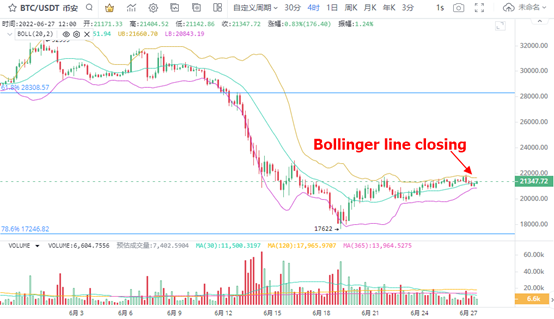
In the 4-hour K-line chart, as the short-term amplitude of BTC price narrows, the direction selection signal is further strengthened. At this time, there is a high possibility of short-term changes in BTC, but it is still necessary to confirm the breakthrough direction after the shock is completed.

From the BTC price performance, the price rebound intensity has not expanded, and the trading volume began to shrink gradually in the same period, which means that the market is on the eve of change. Next, the trading direction can be confirmed in combination with the main trend.
2. BTC has realized cost up

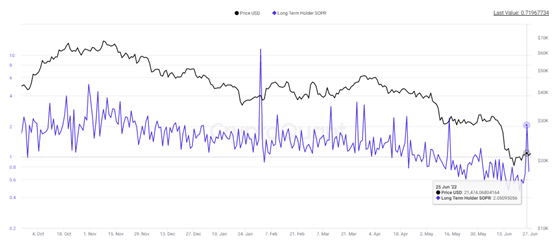
The recent low rebound space of BTC is limited, but there are signs of profit taking flight. In particular, the long-term cash holding investors have recently traded BTC with obvious profits, which has to make people suspect the negative impact on the market.

On June 26, the SOPR index value of long-term investors rebounded to the high position of 2.05, which means that the profits of these investors can be as high as 100%, that is, it is 100% higher than the closing price of $21038 on June 26, and its holding cost may be as low as $10500. According to this judgment, the adjustment expectation of BTC may still be strong. A large number of low-priced currency investors fled, and the market was on the eve of a downward change.
3. Eth rebounds to short line pressure level

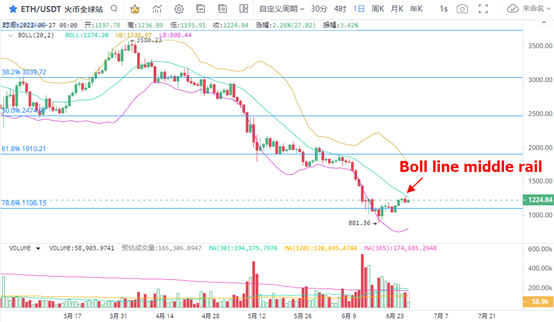
Eth shrinkage rebounded to near the middle rail of brin line. At present, the pressure on the middle rail of brin line is large. As an important pressure line to continuously limit the price increase, the medium gauge of brin line has played a repressive role since March 2022. The last drop in pressure level occurred in May and is currently an important rebound resistance level. Trading volume chips: the daily trading volume of eth shrank below the equivalent line, which means that the trading heat of investors tends to shrink, gradually approaching the previous period. Therefore, cash holding investors can pay attention to the selling pressure.
4. Eth long short ratio recovery

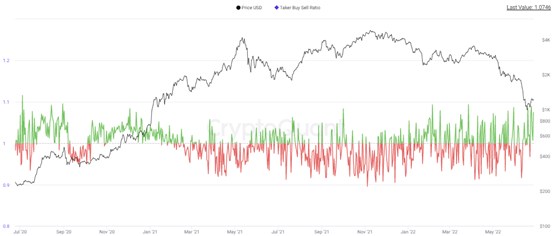
After investors' enthusiasm for contract trading in eth gradually increased, not only the positions rebounded, but also the long short ratio continued to rise significantly. From a numerical point of view, the recent long to short ratio has remained below 1.1, near the highest level in the past year. At the same time, the current long short ratio remains above 1 on most trading days, which indicates that eth has attracted more buyers in the low price zone, and the long short strength is leaning towards multiple parties. Therefore, in judging the rebound height of ET, if the recent situation of a large number of long positions has not continued, the price rise will continue.

It is worth noting that the longer the long duty cycle of eth is maintained above 1, the stronger the defense line built by bulls will be, and the higher the possibility of price bottoming will be.

İlgili Okumalar

What's the Connection Between Pinduoduo's Huang Zheng and Blockchain?

This text explores the unexpected connection between Pinduoduo founder Colin Huang and blockchain, as suggested in his article *Turning Capitalism Upside Down*. Huang argues Pinduoduo's core business is about managing "uncertainty." He posits that wealth flows to the rich because they absorb life's uncertainties (e.g., illness, job loss) that devastate the poor, who pay a premium for certainty through insurance or stable prices. Pinduoduo's model attempts a "reverse insurance": by aggregating consumer demand via group-buying and flash sales, it creates a large, predictable order for manufacturers. This certainty allows factories to remove risk premiums, passing savings back as lower prices, thus partially reversing the wealth flow. The key obstacle, Huang notes, is that an individual's buying intent is an unreliable promise. He then asks if blockchain is the natural solution for this "reverse insurance." The text elaborates that blockchain, through smart contracts with binding deposits, could transform casual intent into a costly-to-break, enforceable commitment. This replaces interpersonal trust with coded rules, making promises credible, pricable, and resistant to fraud. Finally, the author draws a parallel to Bitcoin, framing two paths to creating certainty: the "Pinduoduo path" of aggregating decentralized will into scale, and the "Bitcoin path" of locking rules into immutable code. Both sacrifice something—personal freedom or system flexibility—to manufacture trust and predictability.

链捕手1 saat önce

What's the Connection Between Pinduoduo's Huang Zheng and Blockchain?

链捕手1 saat önce

The Storage Magnate Who Conquered a Trillion-Dollar Kingdom, Yet Ultimately Could Not Become the Richest

**Summary:** "The Memory Magnate Who Built a Trillion-Dollar Empire, Yet Never Became the Richest" explores the journey of Zhu Yiming, founder of GigaDevice (603986) and co-founder of the soon-to-IPO ChangXin Memory Technologies (CXMT). The article positions GigaDevice, a fabless chip designer now valued at ~¥340 billion, as a prequel to the massive IDM (Integrated Device Manufacturer) venture, CXMT. Starting in 2005 with minimal capital, Zhu strategically "picked up the pieces" by focusing on niche markets like NOR Flash and microcontrollers (MCUs), areas major players were exiting. This allowed GigaDevice to grow into a diversified semiconductor company, maintaining robust profitability even during industry downturns by controlling costs. However, the piece argues that in the highly cyclical and capital-intensive memory chip industry, the fabless model has limits. True resilience and scale require the ability for "counter-cyclical expansion" – investing heavily during downturns – a tactic only possible for IDMs like Samsung or SK Hynix. This insight led Zhu to partner with the Hefei city government in 2016 to establish CXMT, an IDM focused on DRAM. Zhu's symbolic moves, like forfeiting salary and diluting his equity, were crucial in securing the massive state and bank funding needed. CXMT's equipment base is now valued even higher than that of BYD's vast auto manufacturing empire. Despite the potential for CXMT to reach a market cap of ¥1-2 trillion upon its IPO, Zhu's indirect stake in both companies is estimated below 3%, placing his personal wealth far below that of China's top billionaires. The article concludes that his strategic vision built a trillion-yuan memory landscape, but the capital structure necessary to achieve it precluded a personal fortune of similar scale.

marsbit1 saat önce

The Storage Magnate Who Conquered a Trillion-Dollar Kingdom, Yet Ultimately Could Not Become the Richest

marsbit1 saat önce

XRP Ledger Daily Fees Drop Below $400 As Network Activity Question Returns

The XRP Ledger is drawing attention as daily network fees have fallen below $400. While low fees align with XRPL's design for affordable transactions and are often seen as a strength, the metric can also serve as an indicator of network demand and paid transaction volume. This data point of around $3,100 in weekly fee burn highlights the stark contrast with higher-fee chains like Ethereum and Bitcoin. The development fuels an ongoing debate. Proponents view low fees as a sign of efficiency and accessibility, while critics may question if the network is generating sufficient high-value activity relative to its market cap and payments-focused narrative. The article cautions against overstating the finding, noting a single low-fee day does not signify network failure. It instead adds context to discussions about XRPL's usage, especially alongside Ripple's broader initiatives in stablecoins (RLUSD), AI payments, and enterprise infrastructure. The report recommends monitoring for a fee rebound, checking transaction counts for a fuller picture, and confirming the trend via native explorers like Bithomp. It frames the story within a larger market shift where on-chain data, protocol updates, and infrastructure developments are becoming crucial alongside price action. The editorial stance is to present the verified data, explain its significance for assessing network activity, and avoid hype, positioning it as part of the daily crypto conversation.

bitcoinist5 saat önce

XRP Ledger Daily Fees Drop Below $400 As Network Activity Question Returns

bitcoinist5 saat önce

İşlemler

Spot
Futures
活动图片