义乌外贸商家大规模、合规使用稳定币可行吗?

marsbit2025-08-08 tarihinde yayınlandı2025-08-09 tarihinde güncellendi

最近几个月,稳定币绝对是金融圈、币圈的当红炸子鸡!美国、中国香港相继通过支持稳定币的立法,互联网巨头、老牌金融机构纷纷下场,要么囤币,要么申牌,仿佛忽如一夜春风来,千树万树梨花开。反观中国内地,目前来看政策仍然未见松动,颇有稳坐钓鱼台的感觉。这其中,一则稳定币在义乌大规模使用的新闻在网络广为传播,援引的消息来源主要是两个:华泰证券研报显示稳定币已成为义乌跨境支付的重要工具,区块链分析公司Chainalysis估算2023年义乌市场链上稳定币流动超百亿美元。

不过有意思的是,当有记者实地走访调研时,大多数商户表示没听说过稳定币、不了解,少数商户表示对稳定币的合规性、成本有疑问,只有极个别的商户明确表示使用过稳定币收款。现场颇有点楼下老大爷回答夏洛特“马什么梅”“马东什么”“什么冬梅”玄学。真实情况如何呢?我们来挖一挖消息的两处来源。

华泰证券研报

依据公开的信息,笔者未能发现有媒体附上华泰证券这份研报的具体名称和来源。不过在小伙伴的帮助下,笔者找到了华泰证券在6月25日发布的一份名为《稳定币将如何影响全球货币体系?》的宏观证券研究报告,在这份共31页的研报中,华泰证券通过8个章节对稳定币在全球的发展前景和风险进行了系统阐述。在报告第8页有这样一处关于稳定币使用场景的表述:

“除直接用于加密资产的交易之外,稳定币在全球商品和服务交易中的占比、作为价值存储的手段、以及居民持有渗透率等维度快速发展。具体看,在世界小商品中心中国义乌,稳定币已成为跨境支付的重要工具。区块链分析公司Chainalysis估算2023年义乌市场链上稳定币流动超百亿美元。”

但是与报告的其他观点论述有数据图表支撑不同的是,这处观点并没有附上数据支撑。

总体来说,报告的可读性还是很高的,以下是笔者摘选的部分观点:

1. 以美国(美元霸权)、欧盟(统一市场)、中国(潜在市场)为代表的货币总量大、立法推动诉求更强的国家,稳定币的市场规模巨大;以韩国为代表的数字经济和虚拟经济发达的国家,以及以新加坡为代表的对外开放程度高对外依赖强的国家,稳定币的渗透率会很高;以土耳其、阿根廷、尼日利亚等新兴市场经济体为代表的货币稳定性低、银行系统不发达、地下经济占比较大、资本流动受限甚至被制裁的国家,稳定币的渗透率也会很高。

2. 面对稳定币发展带来的挑战,主要经济体通常采取发行数字货币或加强对稳定币的监管这两种应对方式。对于中国内地来说,早在2014年就开始对数字货币立项研究并于2019年启动试点。随着稳定币的快速发展,尤其是中国香港今年8月份即将生效的稳定币法案,可能标志着中国转向“两轨并行”的发展路径。今年6月18日央行一把手在陆家嘴论坛的发言也明确表示,区块链和分布式账本等新兴技术推动央行数字技术、稳定币蓬勃发展,也显示出中国央行对稳定币的重视程度明显提升。

3. 香港稳定币立法有望加速港币、离岸人民币乃至人民币稳定币的发展,人民币有进一步升值的动力。做大港币和离岸人民币的“资金池”,丰富其可以投资的利率债等高流动性资产,大力发展跨境业务、数字经济、虚拟经济,增加稳定币使用场景等措施,是香港稳定币成功的关键,也将再度激活人民币国际化的进程。

4. 稳定币对跨境金融监管提出挑战,同时面临一定程度的兑付风险。当储备资产价值出现波动、发行主体的信用受到挑战、甚至是发行主体破产的情况下,法币稳定币也可能出现价值脱锚。随着稳定币规模的扩大、对传统金融体系的影响加深,最终可能需要以接受更加严格的监管,甚至部分国有化为代价,换取真正的稳定。

Chainalysis的数据分析

遗憾的是,笔者通过检索内外网,查阅Chainalysis发布的2023年、2024年《加密货币地理报告》,并未发现关于义乌商家使用稳定币的相关表述或数据支撑。

笔者同样对Chainalysis两则报告中关于中国内地与香港的一些数据和观点进行了摘选:

1. 长期以来,稳定币在香港用户收取的加密资产价值占比一直在40%以上,而随着香港关于稳定币立法将于今年8月份正式生效,预计这一比例还会进一步上升。
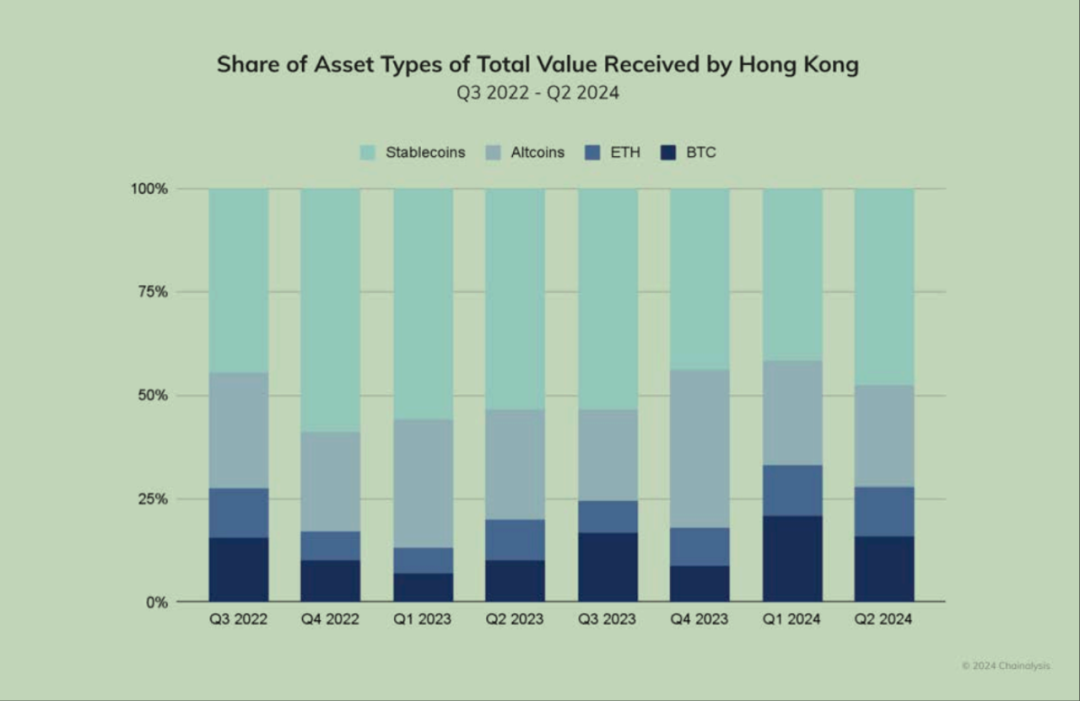
香港

图1 香港收取的加密资产中稳定币占比高-Chainalysis

2. 数据表明,中国用户利用加密资产来实现财富的保值增值。
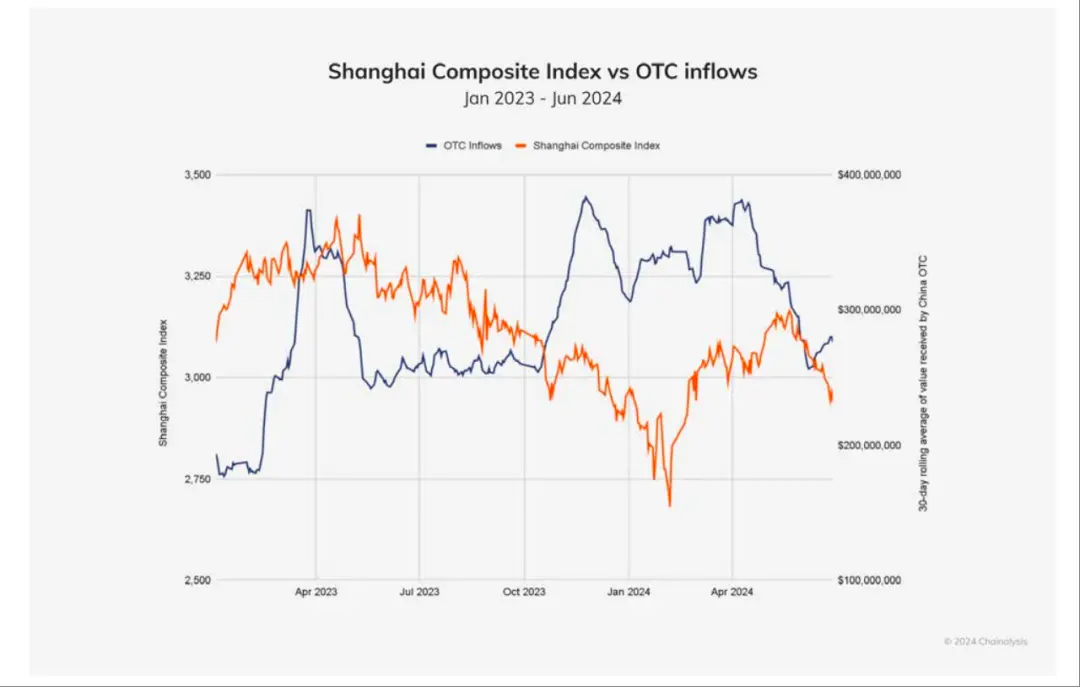
香港

图2 2023年1月至2024年6月上证综合指数与OTC流入量比较-Chainalysis

在笔者看来,稳定币是否在义乌大规模使用可能缺乏准确的数据求证,但外贸与稳定币的结合确实具备天然的优势,稳定币支付的即时到账、价值稳定、费率低等特点,解决了广大中小外贸商家的诸多业务痛点。

但是另一方面,考虑到中国内地对于稳定币等加密资产的监管政策,内地外贸商家在交易过程中如果直接使用稳定币存在较为严重的合规问题,甚至有涉刑事风险的可能。

而且,考虑到我国目前的出口退税政策实施往往需要提供银行的结汇单,如果使用稳定币则意味着无法提供这项凭证,进而享受不了出口退税,这对于商家的利润来说是致命的。另一方面,诸如广交会等展会的参展资格通常将出口企业的银行流水记录作为重要参考标准,还有商业银行的放贷审核标准也看重出口企业的银行流水。这些因素都决定了目前来说,稳定币在义乌出口商家的使用规模不会太大。

那么,作为内地的外贸商家,可以如何合规利用稳定币来降本增效呢?目前相对来说比较合规的一种方式是,通过香港公司与内地公司的联动,利用香港的对外贸易便利性和对加密资产的开放性政策,实现传统外贸与加密支付的合规衔接。

港元稳定币及可行的合规利用稳定币外贸模式

8月1日,香港《稳定币条例》将会正式生效,香港政府也将开始受理在香港发行稳定币的牌照申请,这意味着受到香港官方认可的稳定币将会正式上线,港元稳定币将被视为合法的支付手段,港元稳定币与法币之间的兑换也将更加便捷和合规。

1. 港元稳定币100%兑付的硬性要求

香港《稳定币条例》规定,稳定币的发行人必须确保其发行的稳定币有足够的储备资产支撑,确保储备资产的市值不低于已发行流通稳定币的面值。

稳定币发行人应保证稳定币的持有人有赎回的权利,不得阻碍或限制稳定币的赎回,在稳定币赎回时不得收取除合理手续费之外的其他费用。

2. 港元稳定币满足反洗钱、反恐怖融资等合规要求

香港《稳定币条例》规定,港元稳定币的发行方应遵循严格的反洗钱与反恐怖融资要求。

在5月26日香港金管局发布的一份咨询文件中,金管局概述了相关反洗钱与反恐怖融资要求,核心要求包括:

  • 客户尽职调查。以8000港币为基准,达到或超出该基准的购买或赎回交易的客户均需进行尽职调查,包括验证钱包的所有权;
  • 非托管钱包严监管。对非托管钱包的交易行为实施严格监控、限额交易等措施,降低钱包被不法分子利用的风险;
  • 持续监控。利用区块链分析跟踪交易历史并检测非法活动,上报可疑交易活动;
  • 对托管钱包提供商进行尽职调查;
  • 将非法钱包地址列入黑名单。

3. 内地外贸商家合规利用港元稳定币的要点

考虑到目前内地与香港之间关于稳定币的政策差异,笔者认为,内地外贸商家在利用港元稳定币时,把握好以下三个关键点,可以避免大多数的合规风险:

  • 利用香港或其他境外公司主体收取和支付稳定币;
  • 稳定币与法币的合规兑换在香港完成;
  • 法币合规结汇回内地母公司;


İlgili Okumalar

Why More AI Agents Does Not Equal Higher Productivity?

Editor's Note: As AI Agents become cheaper and easier to use, a new constraint emerges: the cost isn't in launching more Agents, but in the human attention required to manage, judge, and integrate their outputs. This hidden cost is called the "orchestration tax." The article argues that a developer's cognitive bandwidth is the key bottleneck—a serial, non-parallelizable resource akin to a Global Interpreter Lock (GIL). While many Agents can run concurrently, their results ultimately require human judgment for review, conflict resolution, and final integration. Therefore, more Agents don't automatically mean higher productivity; they can simply create longer queues, lead to cognitive fatigue, and create the illusion of busyness without real output. The core solution is to design workflows around this scarce human attention. Key strategies include: scaling the number of Agents to match review capacity (not UI capacity), categorizing tasks (delegating independent ones, keeping complex judgment-heavy ones serial), batch reviewing results to minimize context-switching costs, automating verifiable checks to reserve human judgment for critical decisions, and protecting focused, uninterrupted thinking time. Ultimately, the critical skill is not launching many Agents, but architecting systems that respect the fundamental limit of human attention. Unpaid "orchestration tax" accumulates as both technical and cognitive debt, undermining system understanding and quality. True productivity comes from thoughtfully managing the single-threaded resource—your focus.

marsbit1 saat önce

Why More AI Agents Does Not Equal Higher Productivity?

marsbit1 saat önce

Three Years Later: Looking Back at My Predictions About ChatGPT in 2023

Three Years Later: Revisiting My 2023 Predictions on ChatGPT In March 2023, shortly after ChatGPT's launch, I made 20 predictions about its future. Now, in mid-2026, I've used AI agents to fact-check each one against the latest data. Overall, most major directional forecasts were correct, with only one outright error (incorrectly stating GPT-4 had 100 trillion parameters). Key successes included predicting that RAG and retrieval architectures would become the standard for handling knowledge and hallucinations, that natural language interfaces (LUI) would create a massive new industry layer beyond the models themselves, and that China would develop viable large language models, significantly closing the performance gap with Western counterparts within about three years. Predictions about the absence of mass unemployment, the rise of a new "robot network" for agent communication, and ChatGPT not possessing consciousness also held true in their core arguments. However, the "devil was in the details." Errors frequently involved specific numbers, timelines, or overlooking distributional effects. I tended to overestimate the speed of adoption (e.g., for agent networks) while underestimating the ultimate scale of capabilities or costs (e.g., AI winning IMO gold without tools, or the extreme capital required for frontier models). Other misjudgments included: underestimating how AI would reinforce, not dissolve, information filter bubbles; incorrectly assuming AI-generated content would easily circumvent copyright (it has instead triggered record-breaking settlements); and misidentifying where value would be captured (it accrued overwhelmingly to the compute layer, like Nvidia, not just the application or model layers). Key lessons from reviewing these predictions are: 1) Directional and mechanistic insights are far more reliable than precise numbers or absolute statements. 2) There's a consistent bias to overestimate short-term speed but underestimate long-term magnitude. 3) Errors often lie in missing distributional impacts within a generally correct aggregate trend. 4) Predictions phrased with nuance and caveats aged the best. 5) Some fundamental debates (e.g., on machine consciousness or the ultimate value chain) remain unresolved even after three years. This exercise is less about scoring the past and more about establishing rules for clearer thinking about the next three years of AI.

marsbit7 saat önce

Three Years Later: Looking Back at My Predictions About ChatGPT in 2023

marsbit7 saat önce

Three Years Later: Looking Back on My 2023 Predictions for ChatGPT

Looking Back After Three Years: Revisiting My 2023 Predictions on ChatGPT In March 2023, shortly after ChatGPT's debut and before GPT-4's release, I made over twenty predictions about AI's future based on limited information and intuition. Now, in May 2026, I revisited those forecasts using an AI-driven analysis with 41 Opus 4.8 agents to cross-reference them with the latest data. The assessment used symbols: ✅ Correct, 🟢 Mostly Correct, 🟡 Partially Correct, ❌ Incorrect. Overall, the directional judgments held up well, with only one major factual error regarding GPT-4's rumored parameter size (incorrectly cited as 100T). However, nuances and degrees of accuracy revealed more. **What Was Largely Correct:** Predictions about mechanisms and directions proved accurate. The rise of RAG (Retrieval-Augmented Generation) as the standard architecture for combating AI hallucination was confirmed, as was the transformative potential of LUI (Language User Interface) in creating a new industry layer atop GUIs. The emergence of "robot networks" (agent-to-agent communication protocols) and China's rapid catch-up in developing capable large models (closing the performance gap with top models to ~2.7%) were also on point. The analysis affirmed that LLMs lack consciousness and that the Turing Test merely measures perceived intelligence. **What Was Off Target:** Errors often involved specific numbers, over-optimistic timelines, or misjudged distributions. The prediction that value would primarily accrue to the application layer was half-right but missed NVIDIA's dominance as the profitable infrastructure layer. Forecasts about AI circumventing copyright issues and fostering a "global common ground" by averaging human viewpoints were incorrect; instead, major copyright settlements occurred and AI personalization is increasing. Estimates for model training costs ("$5-10 billion cap") were significantly off, underestimating frontier costs and overestimating replication costs. The notion that LLMs could never do complex math without tools was disproven by later models winning IMO gold. **Key Patterns from the Review:** 1. **Direction over precision:** Judgments about mechanisms and trends were more reliable than specific numbers or definitive statements. 2. **Timing bias:** There was a tendency to overestimate short-term speed but underestimate long-term magnitude and transformation. 3. **The distribution blind spot:** Aggregate-level correctness often masked uneven impacts (e.g., on young professionals' employment). 4. **The value of qualifiers:** Predictions framed with caution (e.g., "reportedly," "for now," "prototype in 2-3 years") aged better. 5. **Some debates continue:** Issues like the nature of "emergent abilities" or machine consciousness remain unresolved. This three-year review highlights that while seeing the big picture is crucial, humility regarding specifics, timelines, and disparate impacts is essential for future forecasting.

链捕手10 saat önce

Three Years Later: Looking Back on My 2023 Predictions for ChatGPT

链捕手10 saat önce

AI Bubble Warning: AI Investments Are Negative Returns for Most Tech Giants

The article issues a stark warning about a potential AI investment bubble. It notes that while the AI boom shares similarities with the TMT bubble of the late 1990s, its scale is vastly larger, currently driving 93% of U.S. GDP growth. Major hyperscale cloud providers like Microsoft, Alphabet, Amazon, Meta, and Oracle are planning to invest trillions in AI data centers over the coming years. However, calculations based on analyst projections for 2025-2030 reveal a concerning math problem: expected capital expenditure growth far outpaces projected revenue growth. Even under an extremely optimistic scenario of zero costs, the implied return on investment for most of these tech giants (except Amazon) is deeply negative. This suggests that the current trajectory could lead to one of history's largest shareholder value destruction events. The piece outlines two potential escapes: AI generating vastly more revenue than currently anticipated—a near-impossible task—or a significant cutback in the planned investment splurge. The latter scenario could trigger a domino effect, severely impacting the entire tech supply chain (from Nvidia to TSMC), potentially pushing the U.S. economy into recession, and causing a major stock market downturn. The author suggests upcoming high-profile IPOs by companies like OpenAI and Anthropic might represent a transfer of risk from early investors to public market participants. While the peak of the hype cycle might sustain investment through 2026, the fundamental financial dilemma remains unresolved, setting the stage for a potential market correction in 2027 or 2028, similar to the years following Alan Greenspan's "irrational exuberance" warning.

marsbit11 saat önce

AI Bubble Warning: AI Investments Are Negative Returns for Most Tech Giants

marsbit11 saat önce

İşlemler

Spot
Futures
活动图片