木头姐又赢了:靠“币股”抄底逃顶,ARK Invest2个月大赚2亿美金

比推2025-08-07 tarihinde yayınlandı2025-08-07 tarihinde güncellendi

原文作者:Prathik Desai

原文编译:Luffy,Foresight News

原标题:2个月盈利逾2亿美元,ARK Invest的加密择时术


过去几个月,我一直在追踪ARK Invest对加密公司的每日交易情况。这家美国基金公司管理着几只 ETF 和一支风险基金旗下的资产。他们的买卖策略揭示了一个有趣的现象:在这个看似难以把握时机的领域,他们是如何精准择时的。

一次操作可能是巧合,两次或许是直觉,但 ARK 的加密交易展现出一种不同寻常的时机感。这是刻意为之,而非被动反应。证据就是,仅在 6 月和 7 月通过交易 Coinbase 和 Circle 的股票,他们就斩获了超过 2.65 亿美元的利润。

再仔细观察会发现,ARK 正将资金从交易所和交易平台撤离,转向基础设施、资产储备等。

ARK 近期交易让我们得以一窥,这家最受关注的机构投资者之一,如何通过快速且往往精准的进出时机,为其加密投资者优化回报。这与加密领域 「钻石手」(长期持有)的论调截然不同,且更为复杂精妙。

2025 年 6 月 5 日,最大的合规稳定币 USDC 的发行方Circle在纽交所上市,发行价 69 美元。ARK 作为基石投资者,通过旗下基金购入 449 万股,总价值约 3.73 亿美元。

6 月 23 日 Circle 股价触及峰值,收于 263.45 美元,这意味着 Circle 的市值约为 600 亿美元,相当于其当时管理资产规模的 100%。这可能是因为市场对稳定币的未来持乐观态度,并试图按当前资产管理规模(AUM)的 10 倍来预估 Circle 的远期收入。但与传统资产管理公司的估值相比,这显得过于夸张。参考一下:贝莱德管理着 12.5 万亿美元资产,市值却仅略超 1800 亿美元,约为其资产管理规模的 1.4%。这对 ARK 而言,是一个信号。

每日交易文件显示,随着 Circle 股价溢价飙升,ARK 通过多只基金系统性地抛售其股票。
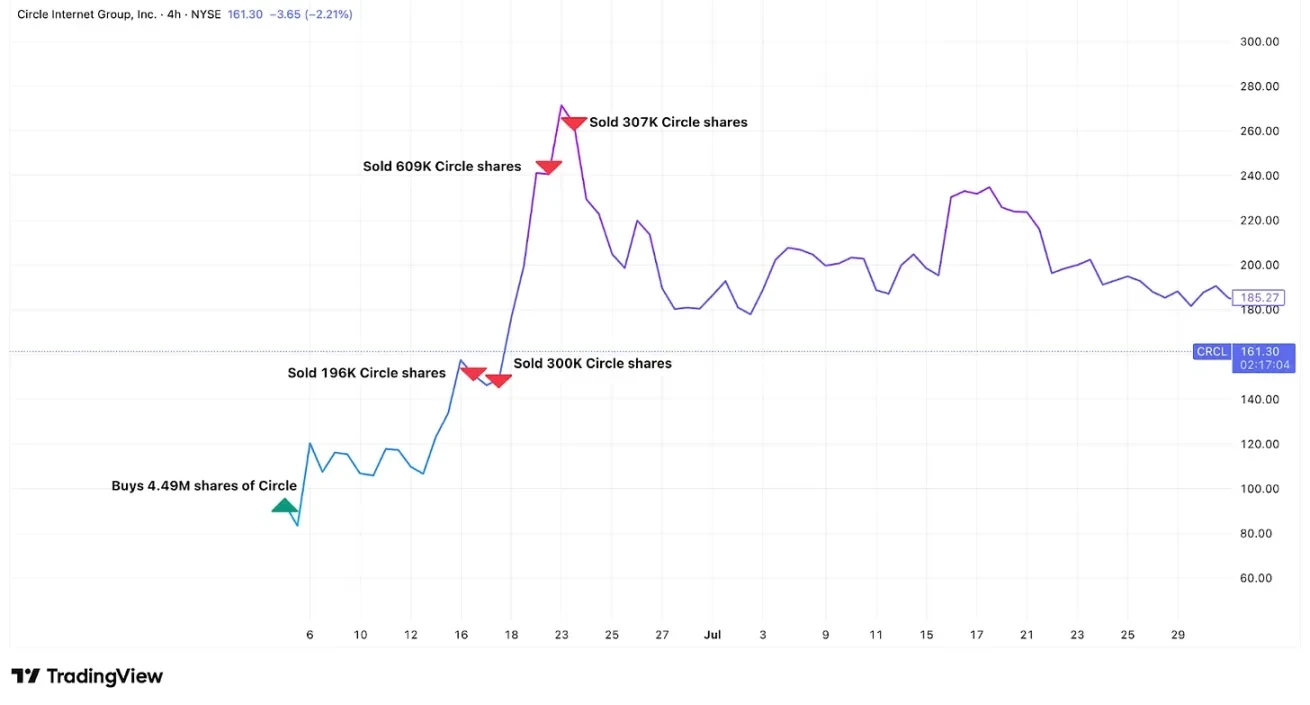
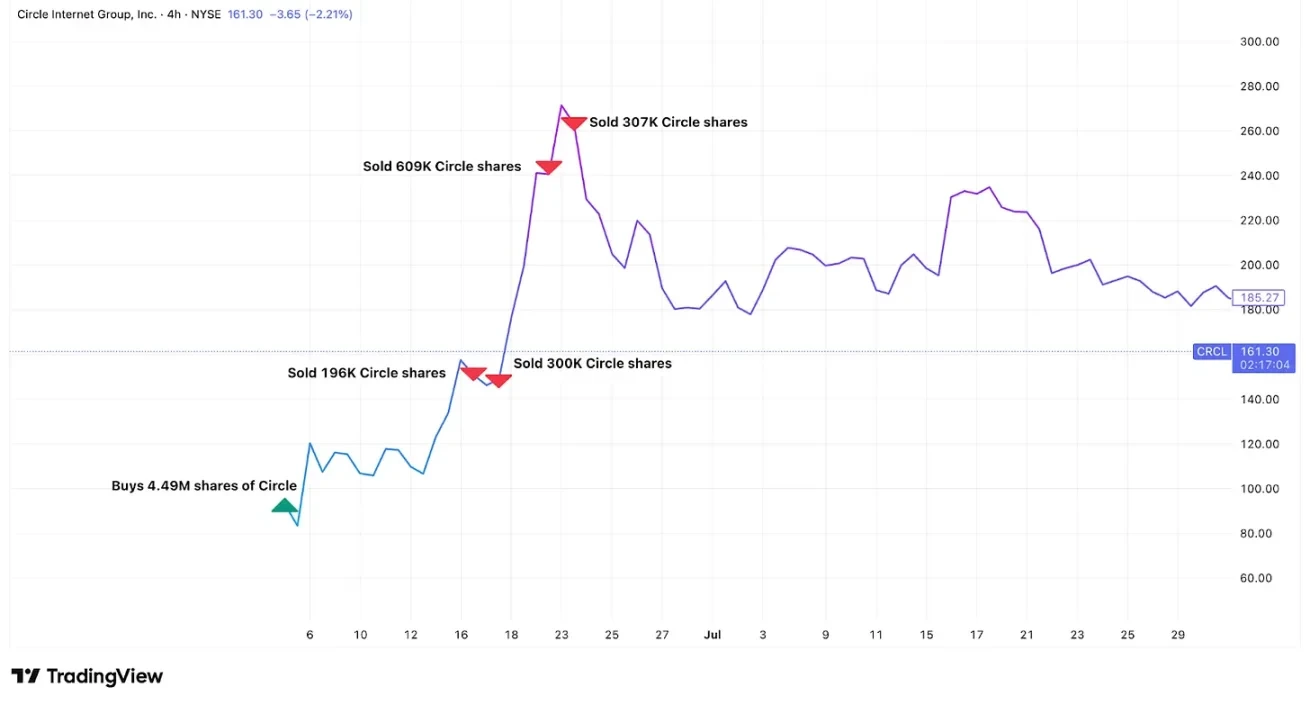
ARK 在 Circle 股价见顶前一周就开始抛售,总计卖出约 150 万股(占总持仓的 33%),在股价抛物线式上涨期间套现约 3.33 亿美元。这与 ARK 建仓时相比,实现了超过 2 亿美元的利润,回报率达 160%。

ARK 对热门 IPO 的兴趣不止于此。

上周,他们在 Figma 上市首日购入 6 万股。这家总部位于旧金山的设计软件公司在 SEC 文件中透露,其持有 7000 万美元的比特币 ETF,并获批再购入 3000 万美元。

Figma 股价上市首日飙升逾 200%,收于 115.50 美元,涨幅达 250%。第二天,Figma 股价又上涨了 5.8%。

ARK 近期对 Coinbase 的交易,进一步揭示了其系统性的获利了结模式。

截至 2025 年 4 月 30 日,ARK 持有这家美国最大加密交易所 288 万股股票。此后,他们在 7 月底前系统性地获利了结。

与此同时,随着比特币创下逾 11.2 万美元的历史新高,Coinbase 股价也同步上涨,一度突破 440 美元,创下自身历史高点。7 月 1 日,ARK 抛售了价值 4380 万美元的股票;7 月 21 日(Coinbase 股价见顶当天),ARK 通过三只基金减持了 9310 万美元的股票。在 6 月 27 日至 7 月 31 日期间,ARK 总计卖出 528,779 股(约占总持仓的 20%),价值超 2 亿美元,平均卖出价为每股 385 美元。相比之下,ARK 四年来累积买入 Coinbase 的加权平均成本约为 260 美元,这些交易带来的利润超过 6600 万美元。

过去两个月,Coinbase 在 ARK 的基金组合中不再是头号重仓股。

7 月 31 日收盘后,Coinbase 公布的第二季度业绩令投资者失望,次日股价暴跌 17%,从约 379 美元跌至 314 美元。8 月 1 日(暴跌当天),ARK 买入了价值 3070 万美元的 Coinbase 股票。

这些交易并非孤立事件,而是战略转变的一部分,将资金从过热的加密交易所生态,转向刚刚开始引发广泛关注的领域。

在抛售 Coinbase 股票的同时,ARK 也减持了其竞争对手 Robinhood。这两项减持动作,都与 ARK 将大量资金投入 BitMine Immersion Technologies 的时间相吻合,后者被称为 「以太坊版的微策略」。由华尔街资深人士 Tom Lee领导的 BitMine 正在构建以太坊储备库,目标是持有并质押 5% 的以太坊总量。

7 月 22 日,ARK 通过大宗交易向 BitMine 投资 1.82 亿美元。但他们并未就此止步,而是在每次显著回调时都系统性地买入,仅两周内就累积投入超 2.35 亿美元。
这些交易表明,ARK 正从加密交易所和支付公司转向所谓的加密基础设施领域。Coinbase 和 Robinhood通过人们的加密交易获利,而 BitMine 则通过直接持有加密货币盈利。这两种方式都能获取加密货币普及的红利,但风险特征不同。

交易所受益于市场波动性和投机行为。当加密货币价格剧烈波动时,交易活动增加,交易所收入上升,但这具有周期性。而 BitMine 等储备型公司直接受益于加密货币价格上涨,若以太坊上涨 50%,BitMine 的资产也会同步上涨 50%,不依赖于交易量或用户行为。即便没有显著的资本增值,通过在网络上质押以太坊也能产生稳定收入。

但高回报伴随高风险:储备型公司也面临直接的下行风险。当以太坊价格下跌时,BitMine 的资产价值也会成比例缩水,这使得储备策略的 beta 值(风险系数)更高。

ARK 的交易体现了其对加密货币的信念:加密货币正从投机性交易市场走向成熟,更接近永久性金融基础设施。在这样的世界里,持有底层资产可能比持有交易这些资产的平台更有价值。

这些交易的有趣之处在于时机的精准性。他们在 Circle 的梦幻涨势中一路抛售,直至见顶;他们抓住了 Figma IPO 250% 的涨幅;他们在 Coinbase 见顶时卖出,又在其业绩不及预期暴跌后加仓;他们在 BitMine 多次回调时买入。

ARK 方法论融合了传统价值投资原则与精准择时:当 Circle 的市值达到其管理资产规模的 100% 时,可能已被高估;当 Coinbase 因业绩不及预期单日下跌 17% 时,可能已被低估。ARK 似乎还会围绕可预测事件(财报发布、监管决策、市场波动)进行择时交易。

这里还有一个更关键的问题:这些股票为何会相对于其底层资产存在如此巨大的溢价?Circle 的市值一度与其管理的资产规模持平,BitMine 的股价也较其持有的以太坊价值存在倍数溢价。这种溢价的存在,很大程度上是因为大多数投资者无法轻易直接购买加密货币;即便可以,对散户投资者而言,入金和出金平台的体验也不够流畅。如果你想在养老金中配置以太坊以获取其增值收益,买入持有以太坊的公司股票,远比直接购买以太坊容易。

这为持有加密资产的公司创造了结构性优势。ARK 的交易表明,他们深谙这一现状:在溢价合理时买入,在溢价过高时卖出。

ARK 的策略证明,投资加密股票未必是简单的买入并持有,尤其是当你想优化回报时。对任何试图追踪 ARK 加密交易的人而言,仅知道他们买了什么还不够,还需要理解他们买入的原因、可能卖出的时机,以及接下来会转向什么标的。


Twitter:https://twitter.com/BitpushNewsCN

比推 TG 交流群:https://t.me/BitPushCommunity

比推 TG 订阅: https://t.me/bitpush

说明: 比推所有文章只代表作者观点,不构成投资建议

İlgili Okumalar

Huang Renxun and Marvell CEO Discuss on Stage: The Future of AI Competition is Not Computing Power but Connectivity, 'Use Copper Where You Can, Use Optics Only Where You Must'

Summary: At Computex 2024, NVIDIA CEO Jensen Huang joined Marvell CEO Matt Murphy on stage, highlighting the strategic partnership between their companies. The core theme was that the next decisive battleground for AI infrastructure is not compute or memory, but connectivity. As AI models evolve into vast agent-based systems, the ability to connect millions of processors efficiently is becoming the critical bottleneck. Huang announced NVIDIA's strategic $20 billion investment in Marvell, reflecting the deep integration between their technologies for AI data centers. A key discussion point was the transition from copper to optical interconnects within racks. The guiding principle, articulated by Huang, is: "You use optics wherever you must, you use copper wherever you can." While copper remains cost-effective for short distances, its physical limits are being reached as bandwidth demands double. When moving to 400Gbps, copper can no longer fully connect an entire rack. This shift necessitates innovations like Co-Packaged Optics (CPO), which integrates optical engines directly into the chip package to solve density and power challenges. Marvell demonstrated its 51.2T CPO-based switch, eliminating copper traces on the PCB. The future vision is a "distance-free data center," where optical connectivity removes physical constraints. This allows for fully disaggregated, dynamic architectures where compute, memory, and storage pools can be combined on-demand based on workload requirements, rather than being limited by connection boundaries. Marvell, positioned as a neutral "Switzerland" in the ecosystem with a comprehensive portfolio across all connectivity distances, is central to enabling this next era of AI infrastructure.

marsbit4 dk önce

Huang Renxun and Marvell CEO Discuss on Stage: The Future of AI Competition is Not Computing Power but Connectivity, 'Use Copper Where You Can, Use Optics Only Where You Must'

marsbit4 dk önce

TaiJi Secures $3.5 Million Strategic Funding with Participation from Castrum Capital, Becker Ventures, and Coinvestor Ventures

TaiJi Secures $3.5 Million Strategic Funding TaiJi has announced the completion of a $3.5 million strategic funding round, with participation from Castrum Capital, Becker Ventures, and Coinvestor Ventures. The investment will support product development, upgrades to its AI inference engine, the construction of a multi-agent analysis system, improvements to market data infrastructure, global community expansion, and the advancement of ecosystem partnerships. Operating within the BSC ecosystem, TaiJi is building an AI-driven on-chain market intelligence network. The platform integrates market data, on-chain fund flows, liquidity changes, social media sentiment, news events, and project developments into a unified AI inference system. This approach aims to transform fragmented information into structured event inferences, impact pathways, risk assessments, and follow-up indicators, helping users navigate the increasingly complex and event-driven Web3 market. Unlike traditional market tools, TaiJi is constructing an intelligent analysis framework. It continuously aggregates real-time data to form a native market data network and builds a dataset of post-event market reactions for review. A core component is its multi-agent inference framework, where specialized agents—for markets, on-chain activity, sentiment, risk, and events—collaborate to analyze signals and generate insights. The first phase of TaiJi's product will focus on several key modules: Market Intelligence for real-time data aggregation; a Scenario Engine for AI-driven event inference; an Impact Map visualizing effects on assets and narratives; Risk Signals for identifying potential threats; and My TaiJi for personalized tracking and historical analysis. With this new funding, TaiJi plans to accelerate product development and testing, gradually rolling out its core features while expanding its presence within the BSC ecosystem and the broader global Web3 market.

链捕手19 dk önce

TaiJi Secures $3.5 Million Strategic Funding with Participation from Castrum Capital, Becker Ventures, and Coinvestor Ventures

链捕手19 dk önce

Eight Global Central Banks Enter the Fray, Aiming to Claim a Piece of the Stablecoin Pie?

The article discusses the Agorá project, a global cross-border payment system initiative led by the Bank for International Settlements (BIS) with participation from eight major central banks (including the Federal Reserve Bank of New York, Bank of England, and Bank of Japan) and over 40 private financial institutions like JPMorgan and SWIFT. Agorá aims to create a unified platform for the instant settlement of cross-border transactions using tokenized commercial bank deposits. A key feature is its strict "permissioned" design, where funds are pre-labeled by country and smart contracts enforce AML and sanctions checks. This contrasts with the "permissionless" ideal suggested by its ancient Greek namesake. The system employs a two-tier architecture: central banks retain full control over sovereign reserves on separate ledgers, while private entities manage a shared ledger for multi-currency clearing. The project, which completed a prototype in May 2026, seeks to streamline the slow, multi-step process of traditional cross-border payments. It is positioned as a centralized, regulatory-compliant alternative to decentralized stablecoins like Tether, targeting large-scale institutional transfers. The analysis highlights a potential future market split: projects like Agorá could dominate wholesale institutional payments, while public blockchain-based stablecoins retain their role in retail, remittance, and emerging market use cases. This represents an effort by traditional finance to establish boundaries for decentralized networks. The upcoming integration of the EU's Pontes framework with its core settlement system will test this dynamic.

marsbit38 dk önce

Eight Global Central Banks Enter the Fray, Aiming to Claim a Piece of the Stablecoin Pie?

marsbit38 dk önce

İşlemler

Spot
Futures
活动图片