Base宕机33分钟,为什么利好LINK?

marsbit2025-08-05 tarihinde yayınlandı2025-08-06 tarihinde güncellendi

2025年8月5日,对于整个Layer 2赛道而言,是一个值得复盘的时刻。由Coinbase倾力打造、在“链上之夏”(Onchain Summer)活动中吸引了无数目光的明星网络Base,其区块生产毫无征兆地中断了33分钟。在Base承载着数十亿美元资产、日交易量屡创新高的背景下,这次中断不啻于在高速公路上的一次“引擎熄火”。然而,当我们将视线从故障的混乱中移开,聚焦于其在生态系统层面引发的连锁反应时,一个出乎意料的赢家浮出水面。这次看似与Chainlink无关的L2网络事故,却为其提供了一次无可比拟的、覆盖全行业的价值展示,深刻地回答了“为什么在多链时代,LINK至关重要”这一问题。

一场“优等生”的自动化失灵

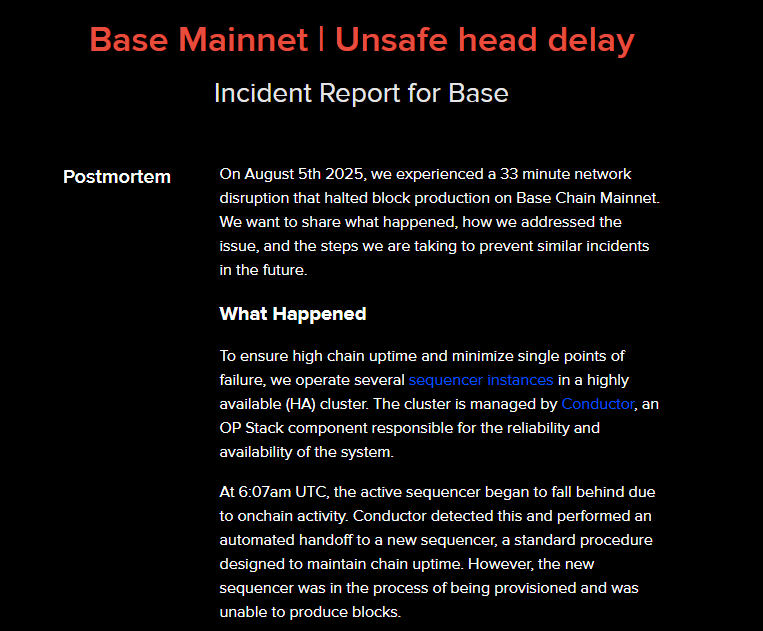
要理解这次事件的深层影响,我们必须先精准复盘故障本身。Base的设计初衷是成为一个高可用的网络,为此,它采用了一套由主备排序器(Sequencer)构成的高可用性集群。当主排序器因故失效,一个名为op-conductor的自动化管理组件会立即将工作切换至备用节点,理论上可以实现用户无感的平稳过渡。

事发当天,正是由于Base生态的极度活跃,链上交易量激增,导致主排序器不堪重负,出现了显著的交易处理延迟。这触发了op-conductor的自动切换机制。然而,这个旨在提供安全保障的自动化系统,却成为了事故的引爆点。官方事后分析指出,系统尝试切换的目标备用排序器,其自身尚未完成全部的上线配置流程。通俗地说,它是一个“软件已启动,但状态未同步”的半成品。这个节点不仅无法承担领导者的角色,更致命的是,它也无法启动新一轮的切换,将领导权交给集群中其他健康的节点。

这造成了一个危险的死锁局面:主节点已根据指令放弃领导权,而指定的“继任者”却无力接管。为了防止出现两个排序器同时出块的“脑裂”灾难,整个网络只能陷入停滞,直至工程师团队进行紧急手动干预,强行指定一个健康的排序器,区块生产才得以恢复。
 Chainlink

将这次事故置于行业背景下,其独特性愈发凸显。它与2021年9月Arbitrum的宕机事件形成了鲜明对比。当时Arbitrum是因其排序器软件自身存在一个未被发现的Bug,在面对瞬时交易洪流时代码崩溃。那是一个典型的“软件健壮性”问题。而Base的问题,则是一个“自动化流程可靠性”的失败。这揭示了在复杂的分布式系统中,旨在提升可靠性的机制本身,也可能成为最脆弱的一环。它完美诠释了L2在追求性能、安全和去中心化这个“不可能三角”时所面临的深刻挑战:为了效率而中心化的排序器,其运营风险远比想象中更复杂。


从底层风险到生态的“生存考验”

33分钟的网络停摆,对部署其上的DeFi协议构成了实实在在的生存威胁。这不仅是交易无法进行的“不便”,而是可能导致数百万美元资产损失的“危机”。最大的风险点,在于价格预言机的数据流中断。

让我们设想一个具体的场景:在这33分钟里,加密市场的价格发生了剧烈波动,例如比特币价格下跌了10%。当Base网络恢复运行时,如果DeFi协议读取的仍然是33分钟前的、已经过时的价格数据,会发生什么?一个用户的抵押品真实价值可能已经远低于清算线,但在链上数据看来依然安全。此时,嗅觉敏锐的套利机器人可能会利用这短暂的价格差进行攻击,或者,正常的清算交易会因价格错误而失败,最终给协议留下无法弥补的坏账。

在DeFi协议总锁仓价值(TVL)动辄数十亿的今天,任何一个主流协议的崩溃都可能引发连锁反应,造成市场恐慌。Base的宕机,将这种潜在风险活生生地展现在所有开发者和投资者面前。它迫使行业思考一个根本问题:当底层区块链这条“公路”本身出现问题时,行驶在上面的“车辆”(dApp)如何自保?


Chainlink的角色:从数据提供商到风险管理者

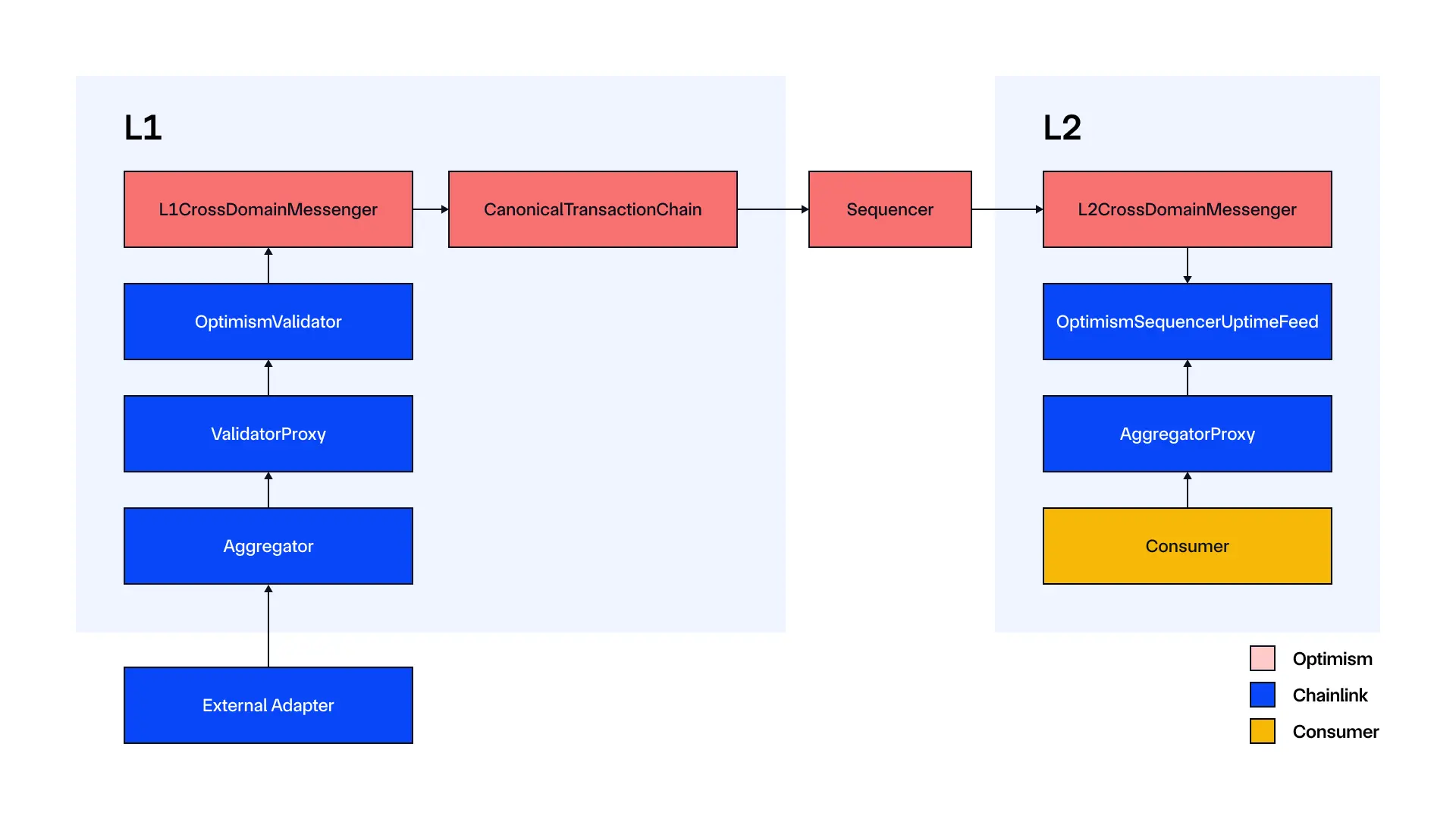
正是在这个生死存亡的关头,Chainlink展示了其超越“价格喂价”的核心价值。在这次事件中,Aave和Moonwell等集成了Chainlink服务的头部借贷协议之所以能安然无恙,得益于一个此前并未被广泛关注的关键功能:Chainlink排序器正常运行时间源(Sequencer Uptime Feed)

 Chainlink

这个机制本质上是一个由预言机驱动的“自动化电路熔断器”(Oracle-Activated Circuit Breaker, OACB)。其工作原理堪称模块化区块链安全的典范:

  1. Chainlink的去中心化节点网络,在安全、可靠的以太坊主网(L1)上,独立、持续地监控着Base排序器的健康状况。
  2. 当节点网络侦测到Base停止出块时,它们会在L1上达成共识并广播一条“排序器宕机”的消息。
  3. 根据OP Stack的架构设计,这条来自L1的官方消息在Base网络恢复后,会以极高的优先级被排序器首先处理。
  4. 这意味着,Aave和Moonwell的智能合约会先于任何潜在的恶意清算交易,接收到“网络刚刚中断过,价格数据可能已失效”的官方警告。收到警告后,协议自动暂停了所有清算功能,从而完美地避免了因使用陈旧价格而导致的灾难性损失。

Base的宕机,无意中为Chainlink上演了一场价值千金的现场产品演示。它清晰地证明,Chainlink不只是一个“喂价”工具,而是保障链上经济安全、管理跨链风险的关键基础设施。


技术验证如何转化为LINK的价值?

这次成功的实战验证,对LINK的价值逻辑构成了深刻且长远的利好,其逻辑链条清晰而有力:

首先,它创造了真实且迫切的市场需求,并可能将其变为行业标准。 在此之前,集成一个额外的安全组件可能被视为锦上添花。但经过这次事件,对于任何一个管理着上亿美元资产的DeFi协议而言,部署一个能抵御底层链风险的“熔断器”已成为刚需。未来,DeFi协议审计公司和加密保险公司,很可能会将“是否集成排序器正常运行时间源”作为评估项目安全等级的关键指标。这将直接转化为对Chainlink服务需求的爆炸性增长,不仅在Base上,更会在所有L2上。

其次,它极大地强化了LINK的核心价值叙事,即“加密经济安全”。 Chainlink的根本价值,来自于其去中心化网络提供的信任和安全保证,而LINK代币正是这一经济安全模型的基石。通过质押(Staking)等机制,LINK的市值直接支撑着整个网络所能担保的价值上限。当DeFi协议为Chainlink服务付费时,它们购买的不仅是数据,更是由LINK经济安全模型所支撑的风险保障。Base宕机事件,让这份“安全保单”的价值变得前所未有的具体和清晰。随着Chainlink网络保护的价值越来越高,对其原生代币LINK的价值捕获和需求也将水涨船高,形成一个正向飞轮。

总而言之,Base的33分钟宕机,对Base自身是一次需要严肃对待的技术挫折和运营教训。但对于整个行业,尤其是对于LINK而言,这是一次价值非凡的“黑天鹅”营销事件。它以最真实、最有力的方式,向市场证明了Chainlink在日益复杂的跨链世界中的核心地位和不可替代性,为其在通往“Web3信任层”的宏大愿景中,注入了最强劲的现实动力。


İlgili Okumalar

GitHub Empire on the Brink of Collapse: Source Code Leak, 18-Year Veteran Leaves, Microsoft Loses 1.5 Billion Developers

GitHub is facing an unprecedented crisis, marked by a massive exodus of developers and severe operational failures. The tipping point came when Mitchell Hashimoto, creator of Ghostty and an 18-year GitHub user, publicly severed ties, citing persistent platform outages that made serious work impossible. This departure highlights a broader pattern of user frustration. The platform's instability has drawn complaints from major corporate clients like Citibank and Intel, forcing Microsoft to issue substantial service credits. A critical incident last month saw an accidentally triggered, unreleased feature cause widespread repository rollbacks, erasing recent code changes and pushing enterprises to migrate. Security has catastrophically breached. In May 2026, hackers infiltrated over 3,800 of GitHub's internal repositories via a poisoned VS Code extension installed by a developer, leading to the attempted sale of core source code for $50,000. This follows the discovery of a critical zero-day vulnerability in March that threatened access to millions of repositories. Internally, GitHub's autonomy has collapsed. After the resignation of CEO Thomas Dohmke in mid-2025, Microsoft eliminated the CEO role, folding GitHub into its CoreAI division under the unpopular leadership of Jay Parikh. This triggered a talent drain, with key executives and engineers leaving. A disruptive migration of GitHub's infrastructure to Azure servers, pushed by CTO Vladimir Fedorov, is blamed for the recurring outages. Competitively, GitHub Copilot is under "existential threat" from superior AI coding tools like Cursor (now owned by SpaceX) and Claude Code, which offer more advanced contextual coding and automation. Ironically, Microsoft's own engineers reportedly preferred Claude Code, forcing management to revoke licenses. Financially, GitHub is a loss leader. Despite Copilot surpassing 4.7 million paid users and $3 billion in annual revenue, the AI inference costs for free services massively outstrip subscription income, hurting Microsoft's cloud margins. The recent shift from a flat fee to a pay-as-you-go model for Copilot has further alienated developers. The core question for Microsoft is whether a centralized code repository remains essential in the AI agent era. The erosion of trust, developer culture, and platform reliability threatens the very ecosystem Microsoft spent decades building.

marsbit1 saat önce

GitHub Empire on the Brink of Collapse: Source Code Leak, 18-Year Veteran Leaves, Microsoft Loses 1.5 Billion Developers

marsbit1 saat önce

SEC Promotes Tokenized Stocks, Is the Traditional Finance Industry Starting to Worry?

The U.S. Securities and Exchange Commission (SEC) is preparing to formally release an "innovation exemption" framework this week. This framework would allow third parties to tokenize U.S. stocks like Apple and Tesla without approval from the listed companies. The move, rooted in a deregulatory vision proposed by pro-crypto commissioners earlier this year, could accelerate the migration of traditional stock markets to blockchain. This development poses a structural threat of "fragmentation" to traditional finance. Core concerns are liquidity fragmentation—where trading volume disperses across multiple blockchains and platforms, leading to price disparities and reduced market efficiency—and revenue fragmentation—where trading fees and intermediary income shift away from domestic exchanges to overseas or competing platforms. The report compares the traditional stock market to a monopolistic "supermarket." Tokenization enables countless "street stalls" to operate outside this system, threatening the exchange's dominance, diluting liquidity for large orders, and slicing into revenue streams. Evidence of this capital fragmentation is already emerging. On the same day the SEC signaled the framework, decentralized platform Hyperliquid saw its RWA (real-world asset) open interest hit a record $2.6 billion, driven by demand for 24/7 on-chain trading of traditional assets. Traditional institutions face a dilemma: either collaborate to build tokenization infrastructure proactively or lobby regulators to block innovation. Regulators must balance controlling the pace of innovation with preventing domestic revenue from being captured by offshore platforms. Key future battles will revolve around defining shareholder rights for tokenized assets and regulating platforms that have grown in regulatory gray areas. In the digital asset era, inaction risks the permanent loss of long-held fee monopolies and financial leadership as capital continues to disperse.

marsbit1 saat önce

SEC Promotes Tokenized Stocks, Is the Traditional Finance Industry Starting to Worry?

marsbit1 saat önce

A Comprehensive Analysis of On-Chain Pre-IPO: Why is the Pricing Power of SpaceX and OpenAI Moving On-Chain?

This podcast episode explores the rise of on-chain pre-IPO price discovery and trading, focusing on companies like SpaceX, OpenAI, and Anthropic. Key trends include the recent launch of a SpaceX pre-IPO perpetual contract on Hyperliquid, the secondary market trading of AI company shares, and a new partnership between Nasdaq Private Market and Polymarket. Dio Casares explains why AI companies like OpenAI and Anthropic actively deny the legitimacy of secondary trades. Primary reasons are to protect their primary funding rounds (as secondary trades don't provide cash to the company) and to avoid complex legal and administrative responsibilities associated with settling these transactions. He argues that on-chain **derivatives** (like perpetuals) are a more viable solution than **tokenized spot markets**, as they better navigate U.S. regulatory holding period requirements, provide effective hedging, and avoid antagonizing the companies themselves by competing with their primary raises. The discussion covers the risks and methods of gaining pre-IPO exposure, from direct investments and SPVs to riskier, layered structures that can lead to legal complications and settlement issues. Casares also maps the landscape of key players, differentiating between traditional secondary brokers (like Forge, Hiive, and Setter) and on-chain derivatives protocols (like Trade.xyz/Ventuals on Hyperliquid) and tokenization platforms (often on Solana). He positions Patagon as a facilitator for access to private market deals but clarifies it avoids on-chain tokenization to maintain good relations with portfolio companies. Looking ahead, the convergence of a historic IPO pipeline (with potential trillion-dollar valuations), the 24/7 nature of crypto markets, and the strategic use of pre-market perpetuals as a "loss leader" suggest continued growth and competition in the on-chain pre-IPO space.

marsbit1 saat önce

A Comprehensive Analysis of On-Chain Pre-IPO: Why is the Pricing Power of SpaceX and OpenAI Moving On-Chain?

marsbit1 saat önce

Token Packages Are Here, Are Telecom Operators in a Hurry?

Major Chinese telecom operators are launching token-based AI computing packages, sparking public debate and highlighting a strategic shift amid slowing traditional revenue growth. In May, Shanghai Telecom introduced token plans (e.g., 9.9 RMB for 10 million tokens), quickly followed by nationwide offerings from China Telecom, China Mobile, and China Unicom. While priced higher than major AI firms like DeepSeek, these packages allow users to access multiple AI models via API using their phone bills, similar to purchasing universal mobile data. The move reflects operators' anxiety as traditional voice, SMS, and data services stagnate. With revenue growth hitting multi-year lows in 2025, AI and computing power represent a critical new frontier. However, current C端 offerings, such as AI photo editing or virtual pets, are seen as non-essential and highlight operators' role as "pipes" or integrators rather than creators of compelling AI products. Beyond consumer packages, operators aim to become key infrastructure players in China’s national computing power network. They position themselves as the "power grid" delivering AI算力, leveraging their vast network of base stations to ensure low-latency, reliable coverage, especially for applications like autonomous driving. This infrastructure role, coupled with unified national调度, could make算力 a ubiquitous utility, driving new consumption scenarios even if mass adoption of token packages remains uncertain.

marsbit1 saat önce

Token Packages Are Here, Are Telecom Operators in a Hurry?

marsbit1 saat önce

İşlemler

Spot
Futures

Popüler Makaleler

LINK Nasıl Satın Alınır

HTX.com’a hoş geldiniz! ChainLink (LINK) satın alma işlemlerini basit ve kullanışlı bir hâle getirdik. Adım adım açıkladığımız rehberimizi takip ederek kripto yolculuğunuza başlayın. 1. Adım: HTX Hesabınızı OluşturunHTX'te ücretsiz bir hesap açmak için e-posta adresinizi veya telefon numaranızı kullanın. Sorunsuzca kaydolun ve tüm özelliklerin kilidini açın. Hesabımı Aç2. Adım: Kripto Satın Al Bölümüne Gidin ve Ödeme Yönteminizi SeçinKredi/Banka Kartı: Visa veya Mastercard'ınızı kullanarak anında ChainLink (LINK) satın alın.Bakiye: Sorunsuz bir şekilde işlem yapmak için HTX hesap bakiyenizdeki fonları kullanın.Üçüncü Taraflar: Kullanımı kolaylaştırmak için Google Pay ve Apple Pay gibi popüler ödeme yöntemlerini ekledik.P2P: HTX'teki diğer kullanıcılarla doğrudan işlem yapın.Borsa Dışı (OTC): Yatırımcılar için kişiye özel hizmetler ve rekabetçi döviz kurları sunuyoruz.3. Adım: ChainLink (LINK) Varlıklarınızı SaklayınChainLink (LINK) satın aldıktan sonra HTX hesabınızda saklayın. Alternatif olarak, blok zinciri transferi yoluyla başka bir yere gönderebilir veya diğer kripto para birimlerini takas etmek için kullanabilirsiniz.4. Adım: ChainLink (LINK) Varlıklarınızla İşlem YapınHTX'in spot piyasasında ChainLink (LINK) ile kolayca işlemler yapın.Hesabınıza erişin, işlem çiftinizi seçin, işlemlerinizi gerçekleştirin ve gerçek zamanlı olarak izleyin. Hem yeni başlayanlar hem de deneyimli yatırımcılar için kullanıcı dostu bir deneyim sunuyoruz.

867 Toplam GörüntülenmeYayınlanma 2024.12.13Güncellenme 2025.03.21

LINK Nasıl Satın Alınır

Tartışmalar

HTX Topluluğuna hoş geldiniz. Burada, en son platform gelişmeleri hakkında bilgi sahibi olabilir ve profesyonel piyasa görüşlerine erişebilirsiniz. Kullanıcıların LINK (LINK) fiyatı hakkındaki görüşleri aşağıda sunulmaktadır.

活动图片