链上透视:预测 Coinbase 收入的新范式,告别华尔街分析垄断时代

深潮2025-07-31 tarihinde yayınlandı2025-08-01 tarihinde güncellendi

随着区块链数据日益精细化,即使是非内部人士现在也能做出机构级别的预测——这曾经是华尔街分析师独有的优势。

作者:Kevin Li

编译:深潮TechFlow

我们的分析师 Kevin Li 使用公开的区块链数据估计 Coinbase 第二季度的收入为 14.95 亿美元,与华尔街估计的 15.94 亿美元相比下降了 6.2%。

7 月 31 日收益更新

作者预估值:14.95亿美元(-200万美元)

华尔街预期:15.94亿美元(+9700万美元)

实际值:14.97亿美元

关键要点:

使用链上数据进行实时收入预测:我们估算 Coinbase 第二季度营收为 14.95 亿美元,低于华尔街预期的 15.94 亿美元,并基于公开的区块链数据进行分析。

尽管市场下滑,交易收入仍占主导地位:交易收入预计达到 7.10 亿美元,仍是 Coinbase 的最大收入来源,但随着 Memecoin 行情逐渐冷却,第二季度机构和零售交易量均有所下降。

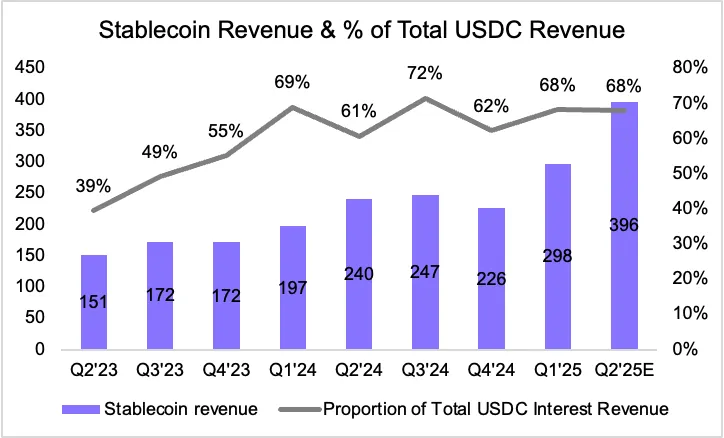
稳定币的爆炸式增长推动收入:USDC 供应量增长 36.7% 达到 600 亿美元,稳定币收入激增至预计 3.96 亿美元,成为第二大收入贡献者。

Layer 2和利息收入带来显著提升:Base 网络预计带来 5782 万美元,包括链上手续费和推测的非手续费收入;区块链奖励(主要为 ETH 质押)贡献了 1.59 亿美元;利息收入和订阅服务分别带来 7200 万美元和 1.17 亿美元。

加密货币/区块链的一大核心优势在于其透明性,这使得我们能够实时估算与区块链相关业务的营收。

在传统金融(TradFi)中,分析师无法提前了解一家公司的季度业绩表现,除非该公司与消费者支出相关,此时可以借助信用卡面板数据进行分析。然而,在加密领域,一切都记录在链上并可公开验证。这使得任何人都可以分析区块链数据,并实时预测公司的基本面。在本文中,我们将详细讲解如何利用链上活动预测 Coinbase 的营收。

Coinbase 的收入分为几个主要部分:

  • 交易收入

  • Base 网络收入

  • 区块链奖励收入

  • 稳定币收入

  • 其他及订阅收入

  • 利息收入

交易收入

Coinbase 的交易活动可以通过链上数据观察,因此估算与交易相关的收入相对简单。在第二季度,Coinbase 的总交易量为 2320 亿美元,较第一季度下降了 41%。这一回落反映了加密市场的整体降温,尤其是在与特朗普选举叙事相关的 Memecoin 行情失去动力后。交易量在第二季度后半段尤其显著下降。零售交易一直占总交易量的 18%–20%。对于第二季度,我们采用 20% 的上限进行估算。
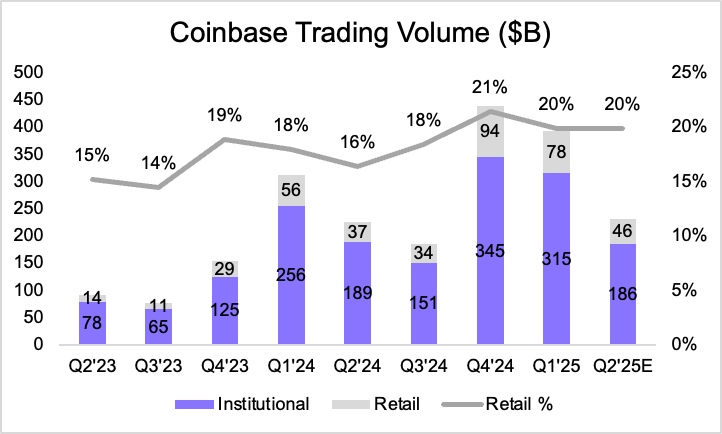
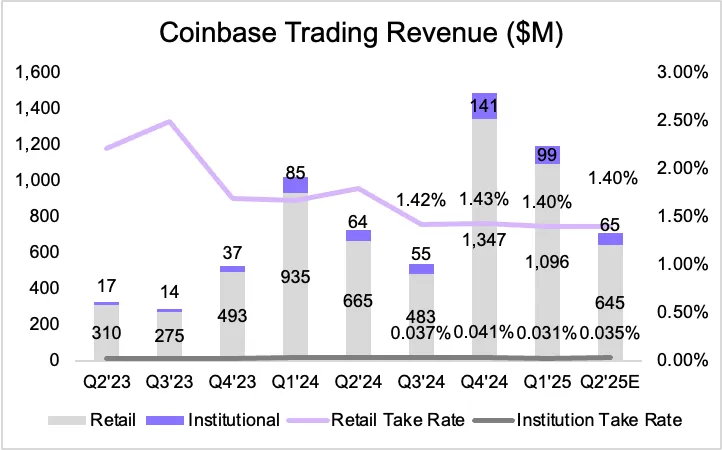
对零售交易部分应用 1.4% 的手续费率,我们估算零售收入为 6.45 亿美元。对于机构客户,我们假设手续费率略增至 0.035%,以反映 Coinbase 的衍生产品服务,预计收入约为 6500 万美元。综合来看,总交易收入预计达 7.10 亿美元。
Base 网络收入

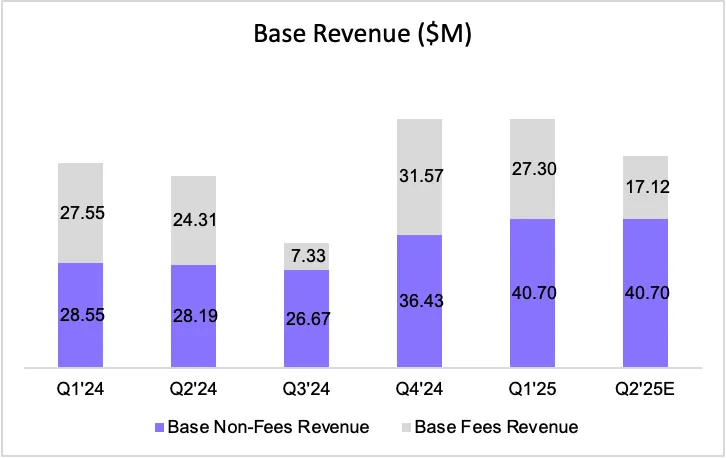
Coinbase 的 Layer 2 网络 Base 通过交易费以及其他可能的非手续费收入来源赚取收入。链上数据使我们能够直接追踪手续费收入,我们估算第二季度的手续费收入为 1712 万美元。然而,Base 报告的收入一直高于链上手续费总额,这表明其可能来自 B2B 合作或基础设施支持。假设非手续费收入维持在 4070 万美元(基于最近几个季度的数据),第二季度 Base 的总收入预计为 5782 万美元。
区块链奖励收入

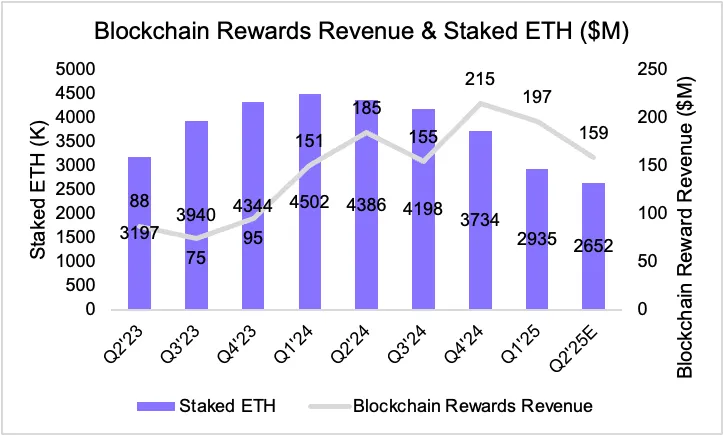
Coinbase 为多种资产提供质押服务。为简化分析,我们使用质押的 ETH 作为估算区块链奖励收入的代表。链上数据显示,Coinbase 的质押 ETH 数量在第二季度从 293.5 万枚下降至 265.2 万枚,这可能是由于赎回和质押重新平衡所导致。

基于此 ETH 价格区间和平均奖励假设,我们估算区块链奖励收入约为 1.59 亿美元。虽然这只是一个近似值,但这种方法捕捉到了该收入流的趋势。
稳定币收入

通过 USDC 开展的稳定币业务是第二季度的主要增长动力。USDC 的市值飙升至 600 亿美元,环比增长 36.7%。为了估算准备金收益率,我们使用了 52 周美国国债收益率,该收益率从 3.97% 小幅下降至 3.88%。尽管利率有所下降,但 USDC 供应量的激增足以抵消利率下降的影响。
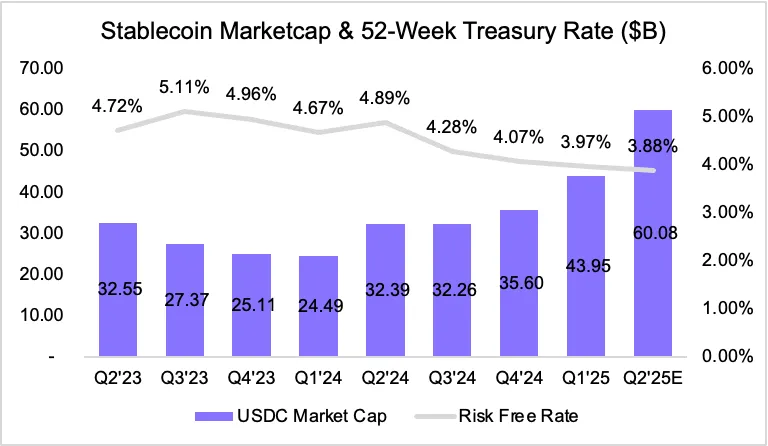
Coinbase 在 USDC 总收入中的占比在最近几个季度间波动于 62% 至 72% 之间。以中位数 68% 作为基准,我们估算第二季度与稳定币相关的收入为 3.96 亿美元。
其他订阅和服务收入

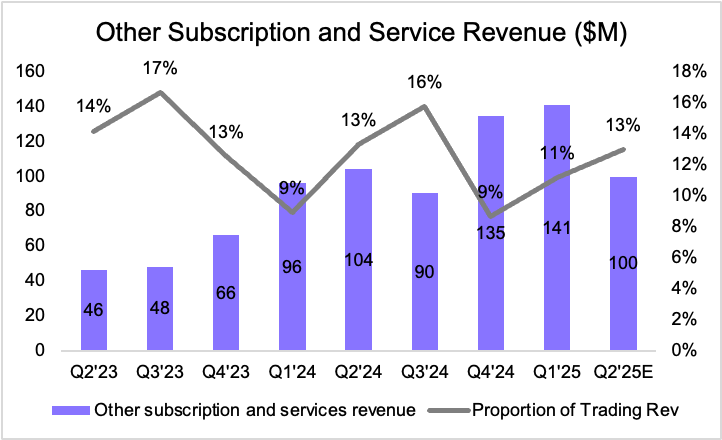
这一部分收入包括 Coinbase One(其高级订阅产品)和托管费用——尤其是为 ETF 客户提供的服务。我们将此收入视为总交易活动的函数。将其乘以 13% 的交易收入,我们估算第二季度收入为 1 亿美元,与整体交易量下降一致,环比下降 29%。
利息收入

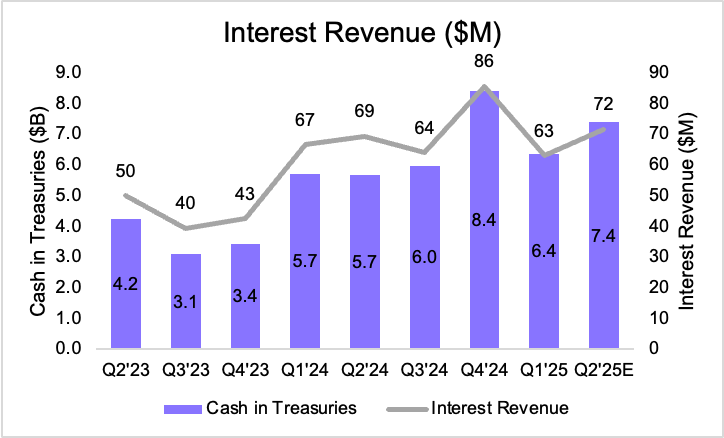
最后,Coinbase 持有的现金和国债可赚取利息。以相同的 52 周美国国债收益率为基准,我们估计第二季度的利息收入为 7200 万美元。这比上一季度增长了 12%,主要是由于 Coinbase 国债头寸的增长,而非收益率的变化(收益率仍然略有下降)。
结论:综合分析

通过利用链上数据,我们能够在官方财报发布之前,构建对 Coinbase 季度收入的详细且及时的估算。汇总所有关键业务板块:

  • 交易收入:7.10 亿美元

  • Base 网络收入:5782 万美元

  • 区块链奖励收入:1.59 亿美元

  • 稳定币收入:3.96 亿美元

  • 其他订阅与服务收入:1.17 亿美元

  • 利息收入:7200 万美元

这使得我们对 Coinbase 第二季度总收入的预测达到 14.95 亿美元,相较于华尔街预期的 15.94 亿美元略低。

虽然部分指标依赖于代理和假设,但整体模型展现了链上透明度的强大力量。随着区块链数据日益精细化,即使是非内部人士现在也能做出机构级别的预测——这曾经是华尔街分析师独有的优势。

本文作者以及 Artemis Analytics 的关联公司可能对所提及的协议或代币拥有经济利益。本文不构成投资建议或购买、出售或持有任何资产的建议。所提供的信息仅供参考,不应作为财务、法律或税务决策的依据。读者在做出任何财务选择之前,应评估自身情况。本文表达的观点可能随时更改,恕不另行通知,Artemis Analytics 对因使用本文内容而造成的任何损失概不负责。


 

İlgili Okumalar

Earning 1000 Trillion in Half a Year, 'Pocketing' 20 Million per Capita: This Round of Wealth Creation in the Korean Stock Market is Unprecedented in Scale

The South Korean stock market is experiencing an unprecedented wealth surge in 2026, with household equity and fund asset values soaring by over 1,000 trillion KRW (~$730bn) year-to-date. This translates to an average per capita wealth increase of roughly 20 million KRW, fueled by a historic 109% rally in the KOSPI index. The boom is driven by three converging forces: an AI-driven semiconductor supercycle boosting giants like Samsung and SK Hynix; the government's "Value-Up" market reforms addressing long-standing corporate governance issues; and aggressive real estate regulations that have locked capital within financial markets, preventing profits from flowing back into property. This has triggered a wealth effect, boosting high-end consumption significantly. However, the gains are highly concentrated. The two semiconductor behemoths account for over half the index's value, but retail investors own relatively low stakes in them, systematically missing the biggest rallies. Wealth and consumption benefits are skewed towards luxury goods and imported cars, bypassing mainstream retail. Further risks stem from excessive leverage, with high trading volume in leveraged ETFs, and a market sentiment heavily reliant on the AI sector's fortunes and speculative rumors. While this cycle marks a potential shift from real estate to equities as a primary wealth generator for Koreans, its sustainability, amid structural imbalances and leverage, remains a critical test.

marsbit3 dk önce

Earning 1000 Trillion in Half a Year, 'Pocketing' 20 Million per Capita: This Round of Wealth Creation in the Korean Stock Market is Unprecedented in Scale

marsbit3 dk önce

imToken's 10th Anniversary Unveils Strategic Direction for the Next Decade: Evolving from a Trusted Main Wallet to a Personal Digital Hub

On its tenth anniversary, decentralized wallet imToken announced its strategic vision for the next decade: evolving from a "trusted main wallet" into a "personal control interface." This new direction aims to help users manage not only digital assets but also identity, permissions, and AI agent actions in an increasingly open and intelligent internet. imToken outlined that while the past decade focused on Store, Send, and Stake—securing assets, enabling transfers, and facilitating network participation—the future introduces a fourth core proposition: Sign. This expanded concept goes beyond transaction signing to encompass expressing intent, granting permissions, setting rules, delegating actions, and revoking authorizations. As AI agents gain autonomy, imToken emphasizes the need for clear, verifiable, and revocable user control over their actions. CEO Ben He stated that imToken's mission is shifting from enabling ownership of digital assets to ensuring user sovereignty over their entire digital world in the AI era. The company's core principle has been upgraded from "Digital Assets, Under Your Control" to "Your Digital World, Under Your Control." Future development will focus on three areas: upholding self-custody principles, extending security from transactions to authorizations and automated actions, and building product capabilities for managing permissions, delegations, policies, and revocations. imToken views the wallet's role as expanding into a trusted control interface for human-AI collaboration, where managing keys, signatures, and permissions forms the infrastructure for personal digital sovereignty. Founded in 2016, imToken serves millions of users across 150+ countries, providing non-custodial wallet services supporting over 50 blockchain networks.

marsbit6 dk önce

imToken's 10th Anniversary Unveils Strategic Direction for the Next Decade: Evolving from a Trusted Main Wallet to a Personal Digital Hub

marsbit6 dk önce

With 300 Million Financing to Accumulate ETH, the Hidden Concerns Behind BitMine's High-Yield Preferred Shares

BitMine, led by Thomas Lee, plans to raise up to $300 million through an initial public offering of 3 million shares of perpetual Series A preferred stock on the NYSE (ticker: BMNP). The stock offers a fixed 9.5% annual dividend. The funds are intended to further the company's accumulation of Ethereum, expand its staking node operations, and for general corporate purposes. This move comes as BitMine faces significant challenges. Its massive Ethereum holdings, over 5.3 million ETH (roughly 4.5% of circulating supply), are currently at an unrealized loss exceeding $8.5 billion due to the crypto market downturn. The company's core business model relies on staking these ETH holdings to generate yield, which it presents as the primary means to cover the new, substantial annual dividend obligation of approximately $28.5 million if the offering is fully subscribed. While the model is similar to MicroStrategy's bitcoin-focused strategy of using capital markets to fund crypto acquisitions, BitMine's product differs with its fixed, non-adjustable dividend rate. The company acknowledges risks, stating dividend payments could also come from cash reserves, asset sales, or future financing, and warns that staking yields may underperform or be illiquid during market stress. The 9.5% fixed rate reflects the higher risk premium demanded from investors for a company heavily exposed to Ethereum's volatility.

Foresight News9 dk önce

With 300 Million Financing to Accumulate ETH, the Hidden Concerns Behind BitMine's High-Yield Preferred Shares

Foresight News9 dk önce

A Year of Observing Agent Payments: The Cold Reality Behind the Hot Narrative

A Year in Agent Payments: The Cold Reality Behind a Hot Narrative This article examines the current state of "Agent payments," a year after it became a major trend at the intersection of AI, payments, and crypto. Despite significant investments from major players like Stripe, Visa, and Google, the author—having built products and spoken with merchants and developers—finds genuine, large-scale demand still lacking. Key findings across several hyped scenarios reveal structural challenges: * **Agent-to-Merchant Commerce:** For most product categories (e.g., clothing, electronics), AI shopping via chat is inferior to traditional visual e-commerce. Merchant interest is largely defensive, focused on future-proofing rather than current consumer demand. True potential exists only in specific, high-frequency/low-decision scenarios (like food orders) or for simplifying broken checkout experiences, but these require massive consumer distribution, favoring incumbents. * **Agent-to-API/Machine Commerce:** While stablecoin micropayments are touted for API calls, developers already solve small-value payments via prepaid credits and subscriptions. Large SaaS providers prefer enterprise contracts over fragmented micro-pricing. The market exists for long-tail services outside the top providers but is inherently smaller than the hype suggests. * **Agent-to-Agent Payments:** This remains a theoretical long-term vision with negligible real transaction volume. The core challenges—discovery, trust, negotiation, dispute resolution—are unsolved. While the potential for a new, high-speed settlement layer is real, it is not the current market. * **Agent Finance:** This is the sole area with existing, paying customers (fund managers, DeFi users). AI enhances real-time monitoring and autonomous rebalancing, offering real capability gains. However, competition favors established, regulated institutions with existing licenses and client relationships. The author concludes that the core deficiency in the Agent economy is not merely a payment layer, but a more complex **coordination** capability—figuring out how Agents and humans work together, verify task completion, and settle outcomes. Payment is just one component of settlement, which is itself part of coordination. For large companies, investing now is a defensive, long-term bet with minimal cost. For startups, however, the imperative is to find markets that exist today, not wait for a future wave that remains on the horizon.

marsbit11 dk önce

A Year of Observing Agent Payments: The Cold Reality Behind the Hot Narrative

marsbit11 dk önce

İşlemler

Spot
Futures
活动图片