Взломщика X-аккаунтов Beeple и Louis Vuitton приговорили к году тюрьмы

cryptonews.ru2025-08-22 tarihinde yayınlandı2025-08-22 tarihinde güncellendi

22-летнего канадца Кэмерона Редмана приговорили к 12 месяцам и одному дню тюрьмы за взлом учетных записей в соцсети X и кражу цифровых активов на сумму около $794 000.

Согласно материалам Окружного суда Вирджинии (США), хакеру также назначили три года условно. Он должен возместить $248 257 пострадавшим и выплатить $60 400 в качестве штрафа.

Мужчину признали виновным по трем пунктам: сговор с целью совершения мошенничества с использованием электронных средств связи, мошенничество с использованием электронных средств связи и сговор с целью совершения тяжкого преступления, связанного с кражей личных данных.

В материалах дела сказано, что преступник и его неназванные сообщники обманули более 200 жертв за несколько дней, используя украденные X-аккаунты известных цифровых художников и брендов для публикации фишинговых ссылок.

Конкретные взломанные страницы в документах не указаны, но по скриншотам и описанию можно догадаться, кому они принадлежат. Среди них есть учетные записи NFT-артиста Майка Винкельмана, известного как Beeple, модного дома Louis Vuitton и проекта Nouns. Всего в деле фигурируют пять аккаунтов.
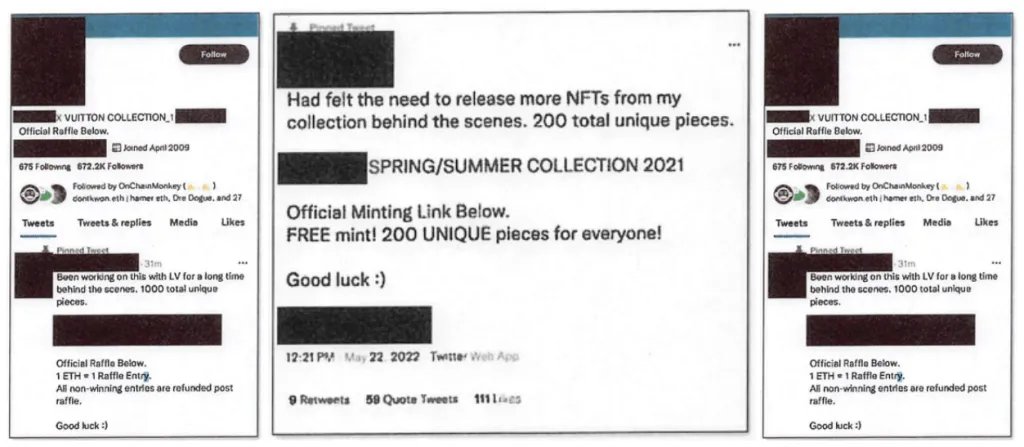
Скриншоты мошеннических постов Редмана. Источник: courtlistener.

Преступники заманивали пользователей с помощью розыгрышей криптовалют или бесплатной раздачи токенов.

«Хотя жертвы думали, что авторизуют транзакцию по получению NFT на свои цифровые кошельки, они неосознанно позволили заговорщикам похитить криптовалюту и невзаимозаменяемы токены», — заявили федеральные власти.

Прокуроры охарактеризовали Редмана как умелого хакера. В несовершеннолетнем возрасте он отсидел год в тюрьме за кражу более $40 млн в криптовалюте через атаку с подменой SIM-карт.

«Обвиняемый зарекомендовал себя как опытный и успешный рецидивист-киберпреступник. […] В течение как минимум года после освобождения обвиняемый обосновался в подвале дома своего отца, выискивая и находя новые способы нажиться на преступной деятельности», — говорится в судебных документах.

Напомним, в июле полиция Индии начала расследование кражи криптоактивов стоимостью $44 млн с биржи CoinDCX. По данным следствия, хакеры получили доступ к кошелькам компании через ноутбук сотрудника.


İlgili Okumalar

Upbit is Anxious: A Hasty Counterattack Aimed at Regaining Stablecoin Market Share

Title: Upbit's Rushed Counterattack to Reclaim Stablecoin Market Share Facing a dramatic shift in South Korea's stablecoin market, leading exchange Upbit launched a promotional campaign from July 26 to August 9, waiving the 0.05% trading fee for stablecoins paired with the Korean Won (KRW) and rapidly listing new stablecoins like RLUSD and USDG. This move is a direct response to its plummeting market share in this sector. Historically a duopoly with Bithumb, the market has been reshaped since October 2025 when Coinone permanently removed fees for USDC trading. By June 2026, Coinone led with 34.8% of stablecoin volume, followed by Bithumb (31.1%) and Upbit (30.1%). This contrasts sharply with the overall crypto market, where Upbit commands 60%. The data shows stablecoin demand is highly sensitive to fees, as users primarily buy them to transfer capital overseas for derivatives trading or forex arbitrage. South Korean exchanges have seen a net outflow of stablecoins for 18 consecutive months, totaling approximately 14.9 trillion KRW, underscoring their role as a cross-border capital conduit. Upbit's limited-time promotion initially boosted its daily stablecoin volume by 162%, but the surge was almost entirely in USDT (98.1% of volume). The newly listed stablecoins saw negligible, fleeting interest. Furthermore, the promotional effect quickly waned in the second week, with volume dropping 33% on weekdays. A concurrent weakening of the KRW also contributed to the trading spike, independent of the fee waiver. The analysis suggests that once the promotion ends, Upbit is unlikely to retain its temporary gains unless it matches Coinone's permanent zero-fee policy, forcing a choice between market share and fee revenue. Upbit's strategic push may be less about immediate profit and more about preparing for future regulatory shifts. With South Korea's *Digital Asset Basic Act* on the horizon, which will regulate KRW-backed stablecoins, and following Dunamu's (Upbit's parent) integration into Naver Financial to build a payment ecosystem, securing a dominant position in the dollar stablecoin distribution channel holds long-term strategic value. However, potential regulatory conflicts could prevent Upbit from listing a future Naver-issued KRW stablecoin, making the current fight for dollar stablecoin flow even more critical.

marsbit5 saat önce

Upbit is Anxious: A Hasty Counterattack Aimed at Regaining Stablecoin Market Share

marsbit5 saat önce

Michael Saylor Compares Bitcoin and Gold!

Michael Saylor, founder of MicroStrategy, argues that Bitcoin fundamentally changes how wealth is stored and transferred by transforming digital scarcity into economic value. He describes Bitcoin as the first digital monetary network, combining computers, digital networks, and cryptography. It digitizes monetary assets, allowing their supply to be controlled by public protocols rather than institutions, thus converting economic value into information transmissible over global networks. Comparing Bitcoin to gold, Saylor states that while increasing Bitcoin's supply is harder, its integration with software and transfer is easier. He highlights Bitcoin's proof-of-work mechanism, which ties it to the physical world by consuming real energy to secure the ledger, making past transactions immutable. This creates a shared security system involving miners, energy companies, and investors. Saylor suggests "digital monetary energy" is a more accurate term than "digital gold." He emphasizes that the Bitcoin network is an adaptive ecosystem of miners, nodes, developers, and users. Its core design is intentionally simple, focused on maintaining a secure ledger for scarce digital assets, with complex functionalities built in higher-layer applications. This architecture allows Bitcoin to serve as a foundation for transmitting value and fostering innovation in payments and financial services. Saylor notes Bitcoin's deeper impact lies in creating digital sovereignty, where private keys give individuals permissionless control over their economic power, with ownership verified mathematically, not by institutions. He concludes that while gold's physical scarcity makes it money, Bitcoin's digital scarcity does the same, characterizing Bitcoin as the monetary energy of the digital age.

cryptonews.ru6 saat önce

Michael Saylor Compares Bitcoin and Gold!

cryptonews.ru6 saat önce

İşlemler

Spot
活动图片



