美联储分歧之大,历史罕见

深潮2025-06-24 tarihinde yayınlandı2025-06-24 tarihinde güncellendi

德银表示,6 月点阵图反映出美联储官员的分歧程度创下十年新高,因为他们在如何平衡通胀控制与经济增长之间存在根本性分歧。

撰文:李笑寅,华尔街见闻

美联储内部分歧达十年之最,降息前景几何?

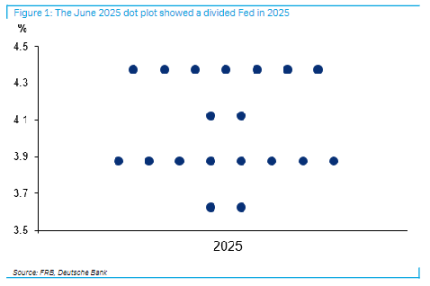
美联储最新发布的经济预测概要(SEP)显示,2025 年降息预期中值达到两次,但官员们的预测范围从不降息到降息 75 个基点不等,凸显了政策制定者之间的显著分歧。
更为关键的是,沃勒和鲍曼两位美联储理事率先「倒戈」,公开表示不排除 7 月降息的可能性,这进一步加剧了市场对政策转向的猜测。

据追风交易台消息,德意志银行首席美国经济学家 Matthew Luzzet 及其团队在最新发布的研报中表示,6 月 SEP 报告反映的官员分歧程度创下十年新高,这是因为官员们在如何平衡通胀控制与经济增长之间存在根本性分歧。

报告同时补充表示,尽管当前分歧显著,但美联储官员对 2025 年利率路径的不确定性并非史无前例,甚至低于去年同期的水平。预计随着经济数据逐步明朗,官员们的观点可能逐步收敛,但短期内分歧仍将持续。

美联储内部出现历史性分歧,但利率不确定性实际下降

通过对美联储 6 月 SEP 报告的深度分析,德银认为,美联储当前面临的主要问题不是「历史性不确定性」,而是「历史性分裂」。

根据德银的研究,6 月点阵图显示美联储官员对 2025 年联邦基金利率的预测呈现出高度的两极化分布,最常见预测与次常见预测之间的差距达到 50 个基点,为过去十年最高水平。

报告进一步指出,若按官员数量加权计算,这种双峰分布接近历史纪录,表明美联储内部已分裂为两大阵营。
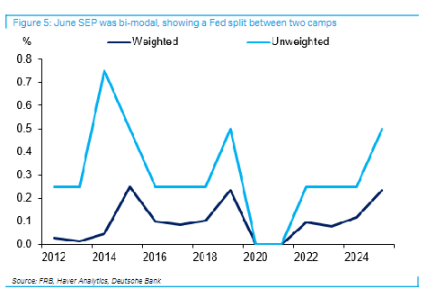
报告称,这种分歧程度预示未来数月委员会内部可能出现更多争论甚至异议。

尽管当前分歧显著,但报告显示,美联储官员对 2025 年利率路径的不确定性并非史无前例。

以点阵图的最大值与最小值之差衡量,6 月 SEP 的分散程度与过去十年许多年中期的预测相当,甚至低于 2023 年 6 月的水平。
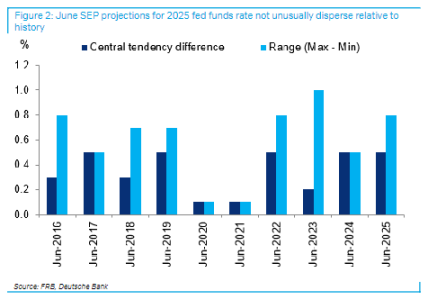
在通胀预测方面,尽管官员们对核心 PCE 通胀的分歧达到过去十年最高的 1 个百分点,但这并未转化为对联邦基金利率预期的历史性分歧。这部分得益于官员们对失业率前景的看法相对一致,分歧仅为 0.3 个百分点。

对经济前景和通胀风险

美联储内部的分歧源于对经济基本面的不同解读。

报告指出,尽管通胀不确定性较高,但官员对失业率前景的共识较高,这可能抑制了利率预测的进一步分散。

然而,6 月点阵图对政策路径的双峰分布表明,官员们在如何平衡通胀控制与经济增长之间存在根本性分歧。沃勒和鲍曼两位理事对 7 月降息的开放态度进一步凸显了这种分歧,可能反映出部分官员对当前经济放缓风险的担忧,而另一部分官员则更关注通胀的持续性。

展望未来,美联储内部的分歧是否会演变为实际的政策异议仍不明朗。报告预计,随着经济数据逐步明朗,官员们的观点可能逐步收敛,但短期内分歧仍将持续。
İlgili Okumalar

Unpacking the Truth Behind On-chain Assets: Leverage, Liquidity, and Risk

The article analyzes the concept of "real-world asset" (RWA) tokenization, arguing that while tokenizing assets on-chain is a useful step, it is far from transformative on its own. The author compares it to placing a barcode on a shipping container—it enables identification but does not build the necessary market infrastructure. The core argument is that true value emerges not from tokenization, but from integrating these tokens into DeFi systems where they can be valued, financed, hedged, traded, and liquidated under stress. Key challenges identified include: 1. **Multiple Time Clocks**: A fundamental tension exists between blockchain's 24/7 settlement and the slower, business-hour-dependent processes of traditional markets, custody, and redemption. This "duration mismatch" can create dangerous liquidity gaps during crises. 2. **Liquidity Misconceptions**: True liquidity is not measured by Total Value Locked (TVL) or trading pairs, but by the ability to exit a position within a required timeframe at an acceptable price. It requires analyzing multiple exit paths and stress-testing scenarios. 3. **Leverage and Risk**: Leverage unlocks economic utility (e.g., using tokenized assets as collateral) but also introduces fragility. Risk models must account for more than asset volatility, incorporating factors like legal enforceability, oracle freshness, and market structure. Paradoxically, a "safer" asset like tokenized Treasury bonds could require a higher collateral discount than ETH due to slower, less-proven liquidation mechanisms. 4. **A Risk Graph**: RWA risk should be modeled as a network of interconnected dependencies (e.g., issuers, custodians, oracles, stablecoin pools), not a single score. Failures can propagate through this graph, turning operational issues into systemic liquidity crises. The article states that tokenized government bonds are merely an entry point, while more complex frontiers like computing power and energy assets present greater challenges and opportunities. It also examines the interplay and risks between tokenized stocks and perpetual futures contracts. The conclusion is that the future lies not in "tokenizing everything," but in building robust market layers where tokenized rights become resilient financial primitives within a programmable capital system. The token is just the barcode; the market is the machine.

marsbit3 dk önce

Unpacking the Truth Behind On-chain Assets: Leverage, Liquidity, and Risk

marsbit3 dk önce

The End of Mathematics: 40 Top Mathematicians Gather at Secret OpenAI Meeting

In August 2026, OpenAI hosted a closed-door summit with approximately 40 leading mathematicians, including recent Fields Medalist Jacob Tsimerman and OpenAI researcher Sébastien Bubeck. The meeting, spurred by a series of recent AI breakthroughs in mathematics, grappled with the potential existential threat AI poses to the field. The backdrop includes several high-profile AI achievements: OpenAI models disproving long-standing conjectures like the unit distance problem, generating 10 new mathematical discoveries, and Anthropic's Claude aiding in constructing complex multidimensional objects. These results often bypass traditional academic pipelines, appearing directly on social media. The mathematical community is divided. Over 3000 researchers signed the "Leiden Statement," advocating for responsible AI use and verification. Others resist AI entirely to preserve human-centric mathematics. A key concern is AI's current inability to *explain* proofs, particularly the difficult steps, which is central to mathematical understanding. At the summit, Bubeck outlined four potential futures: mathematics becoming like collaborative software engineering, a compute-driven field like physics, a curatorial exercise where humans interpret AI output, or a mass transition of mathematicians into AI safety. While emphasizing that "mathematics only makes sense when mathematicians learn from it," no consensus was reached. The event highlights a profound moment of reflection. As AI demonstrates increasing competence in solving complex problems, mathematicians are forced to question their future role and the very meaning of their discipline.

marsbit8 dk önce

The End of Mathematics: 40 Top Mathematicians Gather at Secret OpenAI Meeting

marsbit8 dk önce

Anthropic's New Models 'Catch the Gossip', The Strongest Fable 5 Unexpectedly Falls Flat

Anthropic has been discovered working on two new, previously unknown models codenamed "Marshmallow" (claude-marshmallow-eap) and "Melon" (claude-melon-eap), with early tests showing Marshmallow potentially surpassing Claude Opus 5 in conversational naturalness. Their emergence coincides with surprising new data revealing that Anthropic's flagship Fable 5 model, released two months ago as its strongest and most expensive offering, is being largely ignored by the enterprise market. According to spending data from Ramp tracking over 70,000 US companies, Fable 5 accounts for only about 11% of total token spending on Anthropic's models. This pales in comparison to OpenAI's flagship GPT-5.6 Sol, which commands roughly 25% of token spending in the same period. The tepid adoption is largely attributed to Fable 5's extremely high cost—double that of Opus 4.8 and ten times that of Haiku 4.5—without delivering proportionally superior performance for most business applications. Compounding the issue, the later-released Claude Opus 5, priced at half the cost of Fable 5, has achieved comparable or even better results in key benchmarks like programming and knowledge work, quickly surpassing Fable 5 in enterprise spending share. Furthermore, the rapid rise of powerful, low-cost open-source models—whose token usage share surged from 11% in April to 62% in August while costing less than 4% of enterprise AI budgets—applies additional pressure. Analysts suggest the sudden appearance of Marshmallow and Melon may be an urgent move by Anthropic to address this gap in its lineup. The goal is to offer models that are not only powerful but also cost-effective enough for businesses to adopt widely and sustainably, moving beyond a flagship that serves more as a showcase than a workhorse.

marsbit8 dk önce

Anthropic's New Models 'Catch the Gossip', The Strongest Fable 5 Unexpectedly Falls Flat

marsbit8 dk önce

Three Months After the Passing of Little Dog Rosie, Her Medical Records Transformed into an AI Healthcare Company

Three months after the passing of his dog Rosie, AI entrepreneur Paul S. Conyngham secured $4 million in seed funding from Founders Fund for his new startup, Gamgee. The company aims to industrialize the experimental, AI-assisted process he pioneered to create a personalized mRNA cancer vaccine for Rosie, who suffered from mast cell tumors. With no formal biology background, Conyngham used AI tools like ChatGPT and AlphaFold to analyze Rosie's tumor DNA, identify target neoantigens, and design a custom mRNA vaccine sequence. Laboratory partners at UNSW produced the vaccine. Initial treatment showed tumor reduction, but Rosie's cancer later recurred and she was euthanized. Gamgee's goal is to streamline this "N-of-1" approach into a repeatable service for canine cancer patients, handling sequencing, vaccine design, production, and delivery. Clinical trials are planned in Australia in collaboration with research institutions. The company also eyes a longer-term vision of establishing personalized, mRNA-based medicine across species. The story highlights the broader challenge in personalized cancer treatment: compressing the entire timeline from design and regulatory approval to manufacturing and administration to match the patient's prognosis. While AI can accelerate target discovery, the remaining logistical and regulatory hurdles are significant. The article concludes by emphasizing that, for now, consulting qualified veterinary oncologists remains the responsible path for pet owners.

marsbit17 dk önce

Three Months After the Passing of Little Dog Rosie, Her Medical Records Transformed into an AI Healthcare Company

marsbit17 dk önce

İşlemler

Spot
活动图片