Dogecoin Volume Remains Low Despite Price Rebound, What’s Going On?

bitcoinist2025-06-12 tarihinde yayınlandı2025-06-12 tarihinde güncellendi

Özet

The Dogecoin price has been on the rebound, with Bitcoin barreling toward its all-time high levels once again. The break...

Trusted Editorial content, reviewed by leading industry experts and seasoned editors. Ad Disclosure

The Dogecoin price has been on the rebound, with Bitcoin barreling toward its all-time high levels once again. The break of $110,000 triggered an altcoin run after the Ethereum price moved 10% in a single day, and by extension, Dogecoin also followed with a more than 5% rebound already. However, the meme coin’s volume has not risen as high as expected, and this could suggest low market participation from investors during this time.

Dogecoin Volume Still Muted

Despite the rebound toward $0.2, the Dogecoin volume has not seen a notable jump during this time. In fact, the volume remains well below levels seen back in May and continues to trend at levels recorded during the market decline. This could mean that Dogecoin is merely following the market direction and not necessarily being driven by factors of its own.

According to data from Coinglass, the daily Dogecoin trading volume remains below $5 billion. This is low compared to the levels that the DOGE trading volume has risen to, especially during times of rapid recovery.

For context, back in February, the Dogecoin daily trading volume had risen above the $10 billion mark as the market struggled. Then, back in May 2025, the meme coin had crossed the $10 billion mark once again when the market had recovered and DOGE pushed above $0.25.
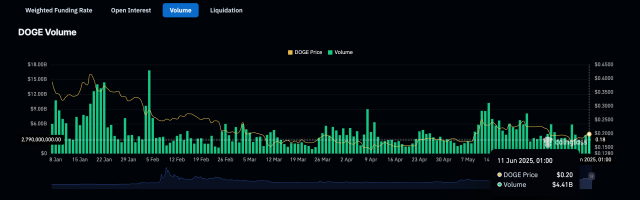
Dogecoin volume
Source: Coinglass

However, so far in the month of June, the Dogecoin trading volume is yet to cross the $10 billion mark, even after almost two weeks into the month. The highest daily volume recorded so far for the month is $5.89 billion on June 6, driven by shorters as the market tanked.

Open Interest Show No Notable Moves

In the same vein as the DOGE daily trading volume, the Dogecoin open interest has not recorded any notable movements during this time. Since the start of the month, open interest in the meme coin has remained rather steady, averaging around $2 billion on a daily basis.
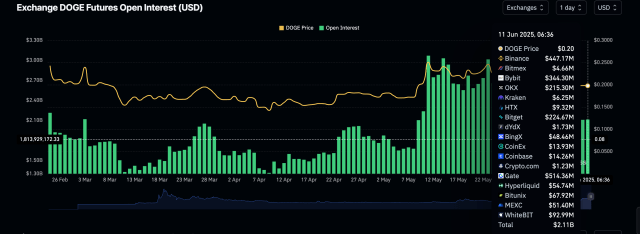
Dogecoin open interest
Source: Coinglass

This suggests that crypto traders are not making any moves and opening more positions at the same time. It also points to the fact that investors are waiting to see what the market does before making their moves. As of June 11, the Dogecoin open interest was sitting at $2.11 billion, a decline from the $2.5 billion average recorded toward the end of May.

Dogecoin price chart from TradingView.com
DOGE price moves back toward $0.18 support | Source: DOGEUSDT on TradingView.com
Featured image from Dall.E, chart from TradingView.com
Editorial Process for bitcoinist is centered on delivering thoroughly researched, accurate, and unbiased content. We uphold strict sourcing standards, and each page undergoes diligent review by our team of top technology experts and seasoned editors. This process ensures the integrity, relevance, and value of our content for our readers.

Scott Matherson is a leading crypto writer at Bitcoinist, who possesses a sharp analytical mind and a deep understanding of the digital currency landscape. Scott has earned a reputation for delivering thought-provoking and well-researched articles that resonate with both newcomers and seasoned crypto enthusiasts. Outside of his writing, Scott is passionate about promoting crypto literacy and often works to educate the public on the potential of blockchain.

İlgili Okumalar

Pantera Capital: As Perpetual Contracts Move Towards the Financial Center, Hyperliquid Aims to Be All-Encompassing

Perpetual futures ("perps"), once a crypto-native phenomenon, are becoming a dominant global financial instrument, evolving into a fundamental market structure shift that traditional finance can no longer ignore. This article outlines the advantages of perpetual contracts over traditional futures, highlighting their simplicity (no expiry/rollover), easier risk management, and native 24/7 operation. While the concept is not new, digital assets provided the ideal environment for its explosive growth. Initially dominated by centralized exchanges (CEX), perps have recently migrated significantly to decentralized exchanges (DEX), with Hyperliquid emerging as the leading DEX for perps, capturing ~40% of the on-chain volume. Hyperliquid, built on its own purpose-built L1 blockchain, has successfully expanded beyond crypto into traditional assets like stocks, commodities, and indices, driven by its permissionless listing framework (HIP-3) and 24/7 availability. It has become a crucial price discovery venue during off-hours and for pre-IPO companies, attracting attention from traditional hedge funds and major exchanges like ICE, which now views it as serious competition. The investment thesis for Hyperliquid's token, HYPE, rests on its large and growing total addressable market (TAM) across all finance, strong execution, superior user experience, and direct value accrual via aggressive token buybacks using 99% of protocol revenue. Key risks remain, primarily regulatory uncertainty in the U.S., though recent CFTC actions approving certain regulated crypto perp contracts signal a potential shift toward broader acceptance. The core question is no longer if perpetuals matter beyond crypto, but whether blockchain-based infrastructure like Hyperliquid can become the primary venue for pricing, trading, and discovering risk across all financial domains.

marsbit2 saat önce

Pantera Capital: As Perpetual Contracts Move Towards the Financial Center, Hyperliquid Aims to Be All-Encompassing

marsbit2 saat önce

Tiger Research: Zuckerberg Begins Betting on Prediction Markets, While Asian Nations Still View Them as Gambling

This article examines the rise of prediction markets, contrasting their growing institutional acceptance in the West with their restrictive regulation in Asia. It details how prediction markets, which originated from informal political betting and academic experiments like the Iowa Electronic Market, aggregate crowd wisdom into probabilistic prices through binary contracts. Their growth accelerated around 2020, reaching over $14 billion in monthly volume. A key driver is the "skin in the game" principle, where users risk their own capital, leading to high accuracy in predicting events like Fed rate decisions and elections, as demonstrated by platforms like Polymarket. Meta's entry, with Mark Zuckerberg reportedly leading the development of the Arena app, signals the market's maturation. In the U.S., court rulings have distinguished prediction markets from gambling, facilitating entry by traditional financial institutions. However, most Asian jurisdictions still classify them as gambling, focusing on social control rather than financial innovation. The article argues this stance creates three problems for Asia: 1) regulatory arbitrage pushes users to riskier offshore platforms, 2) loss of sovereign information infrastructure as valuable social sentiment data accumulates abroad, and 3) abandonment of user protection. It concludes that Asia needs a policy shift from prohibition to constructive regulation, integrating these markets into the formal system to harness their data as a national asset, as initiatives like Limitless Research are beginning to do.

marsbit5 saat önce

Tiger Research: Zuckerberg Begins Betting on Prediction Markets, While Asian Nations Still View Them as Gambling

marsbit5 saat önce

İşlemler

Spot
活动图片