With plans to list on the NYSE, stablecoin giant Circle has upsized its original IPO to a valuation of $7.2B. This signals significant momentum in the stablecoin market and strong investor appetite for crypto firms.
The New York-based fintech launched its IPO on May 27. Aiming to raise $624M and targeting a valuation of up to $6.7B, it initially planned to offer 24M shares of its Class A common stock, with a price range of $24 to $26 per share.
How will this reflect on the growing crypto market, and why would altcoins like Best Wallet Token be best positioned to leverage this potential? Let’s discuss that below.
What Is Circle Doing?
From a target of $624M, Circle has upped the size and price range of its upcoming IPO. It now wants to raise up to $896M by selling 32M shares, each valued at $27 to $28. This pushes Circle’s estimated valuation from $6.71B to $7.2B.
This comes after Circle competitor Ripple reportedly made a $4B to $5B acquisition offer, which was declined, according to Bloomberg.
The GENIUS Act, which is a bipartisan bill that focuses on stablecoin regulation, continues to gain traction in the US Senate, and is widely expected to be passed into legislation. An amended version of the bill is set to head back to the Senate for final floor debate.
However, there are fears that the addition of two unrelated credit card amendments could derail its progress, by dragging the debate into unrelated credit card issues.

This has prompted leaders of the Blockchain Association, Crypto Council for Innovation, DeFi Education Fund, and the Digital Chamber to issue a joint statement. It calls for ‘lawmakers to remain committed to its central goal: providing a targeted and comprehensive approach to stablecoin oversight.’
Are Stablecoins The Future?
Stablecoins are indeed gaining traction in traditional finance, having cemented themselves as the foundation of crypto markets. The sector’s total market cap now stands at $252B, with $61B of that held by Circle’s $USDC.
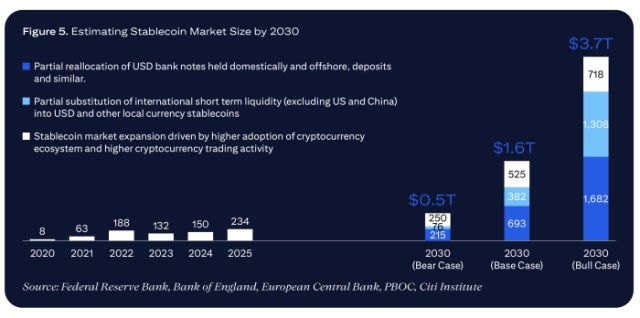
A report by Citi projects that the total supply of stablecoins could reach $1.6T by 2030 in a base case (neither bullish nor bearish). Its bull case puts that figure at $3.7B. With that increased adoption comes the need for crypto wallets. And that puts the Best Wallet Token ($BEST) in a very strong position.
What Can Stablecoins Do For $BEST?
There’s a good chance that the rise of stablecoins will spotlight Best Wallet and its native token, $BEST. The non-custodial hot crypto wallet has plans to dominate the global market by the end of next year, after all.
The crypto wallet market, by the way, is on track to be valued at $32.0B by 2030. That’s a CAGR of 23.5%.

Best Wallet is free to download and easy to use, which makes it ideal for all types of crypto investors. It’s also backed by Fireblocks’ MPC-CMP technology.
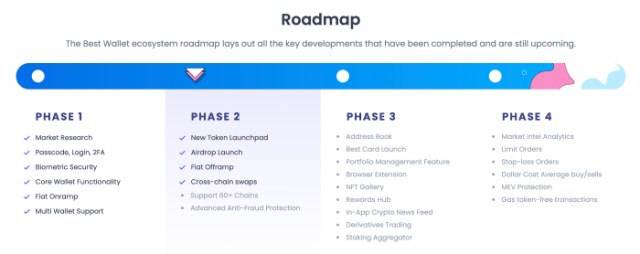
And with plans to support over 50+ blockchains and thousands of cryptocurrencies, it’s establishing its place among the best mobile crypto wallets on the market.
Reasons To Invest In $BEST
Wanting to be the market leader is not the same as actually being one. But that’s where the $BEST comes in. It’s set to power Best Wallet’s already impressive functionality and drive its mission to being number one.
Holding $BEST comes with exclusive perks too. These include higher staking rewards courtesy of a staking aggregator and lower transaction fees across the Best Wallet ecosystem. And in a market first, $BEST holders also have exclusive early-bird access to the best presales.
The Best Wallet Token is among those top new cryptos on presale. It was launched at the end of last year and strong investor interest has already seen close to $13M being raised. After the presale ends, $BEST will list on DEXs, closely followed by CEXs.
Those listings will likely pump the $BEST price. Our $BEST price prediction takes a closer look at this and is worth a read. Add to the equation the rapidly growing adoption of stablecoins and other digital assets, and the Best Wallet Token could pump far into the future.
That makes $BEST one of the best altcoins to buy now for potentially explosive gains. $BEST is currently priced at $0.025125 with a dynamic staking rate – for additional rewards – of 110%. Check out our guide to buying $BEST to invest in one of this year’s hottest cryptos.
Best Case Scenario
The demand for stablecoins is rapidly growing. Circle’s upsized IPO is a case in point. And the ripple effect of that will be a bigger demand for non-custodial crypto wallets. And that puts $BEST in a great position to pump.
The crypto market is unpredictable, though. That’s why we urge you to always DYOR before making any investment.

Related Posts