QCP Capital: биткоин сохраняет устойчивость несмотря на торговую войну США и Китая

cryptonews.ru2025-05-02 tarihinde yayınlandı2025-06-02 tarihinde güncellendi

Трейдинговая фирма QCP Capital опубликовала новый аналитический отчет, в котором оценивает устойчивость биткоина на фоне обострения торговых противоречий между США и Китаем. Несмотря на масштабные ликвидации и отток средств из ETF, первая криптовалюта продолжает удерживаться выше отметки $102 000.

Эскалация торговой войны ударила по рынкам

30 мая Трамп объявил о расширении технологических санкций против Китая и удвоении тарифов на сталь до 50%. Эти меры спровоцировали массовый отток средств с рисковых активов по всему миру, и криптовалютный рынок не стал исключением.

Последствия оказались серьезными — с 30 мая ликвидировано позиций почти на $1 млрд. Даже биткоин-ETF IBIT от BlackRock прервал рекордную 34-дневную серию притоков, зафиксировав отток в $430 млн. Такого оттока фонд не видел с момента запуска.
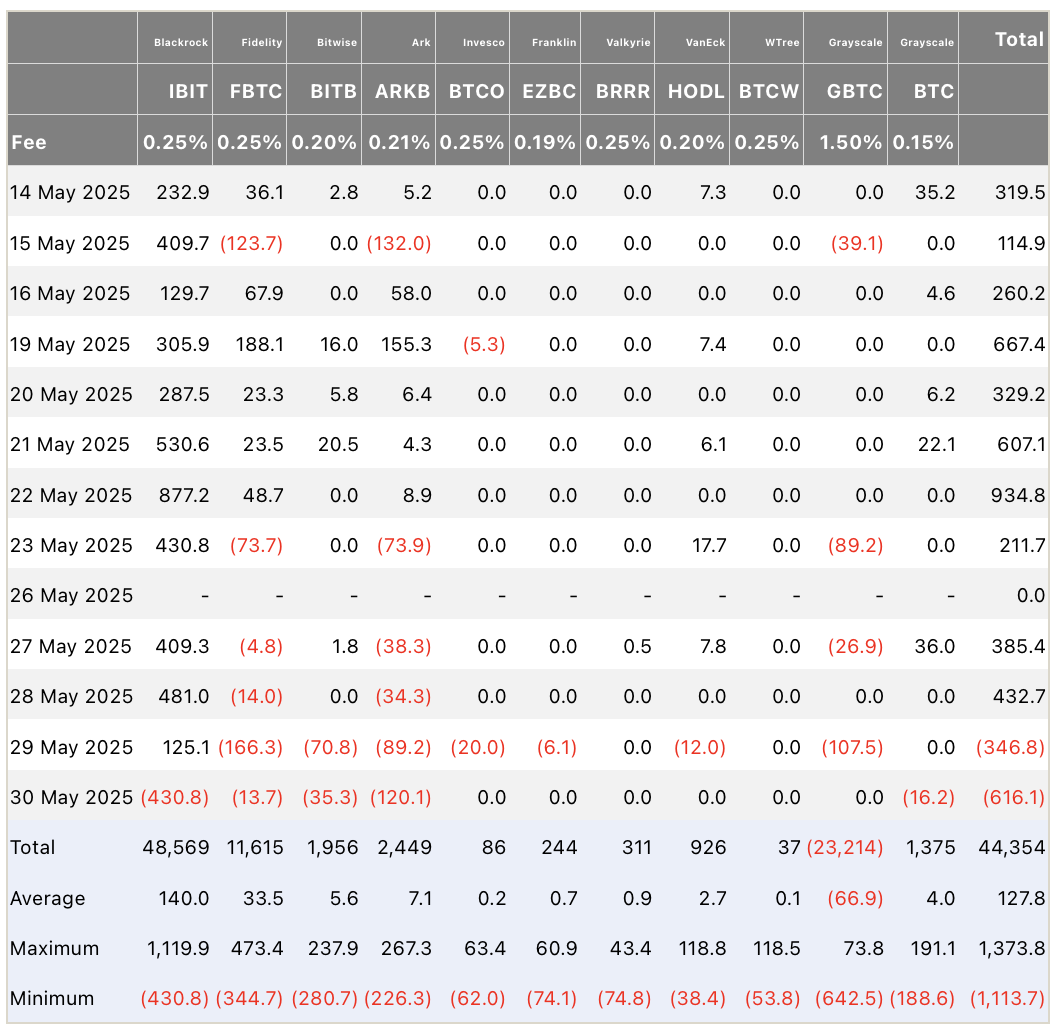
Движение средств в биткоин-ETF США. Источник: Farside Investors

Институционалы не сдаются

Пока одни инвесторы покидали рынок, другие наращивали позиции. Японская компания Metaplanet использовала падение для докупки биткоинов на $114 млн, доведя общие запасы до символичных 8 888 BTC. Подобная активность показывает, что институциональный интерес к первой криптовалюте остается высоким даже в условиях геополитической неопределенности.

Стратегия крупных игроков понятна — они рассматривают текущие колебания как возможность для накопления активов по более выгодным ценам. Такой подход контрастирует с поведением розничных трейдеров, которые чаще поддаются панике.

Технические показатели указывают на стабилизацию

Несмотря на бурные события, биткоин демонстрирует завидную устойчивость, удерживаясь выше психологически важной отметки $102 000. QCP Capital отмечает сжатие волатильности на ближайших сроках и восстановление баланса между опционами на рост и падение по всем временным интервалам — это говорит о том, что экстремальные настроения на рынке постепенно успокаиваются.

Фандинг по бессрочным контрактам вернулся к нулевым значениям, что отражает очистку рынка от избыточных заемных позиций. Этот фактор может способствовать более здоровому движению цены в ближайшей перспективе.

Аналитики фирмы ожидают ограниченного движения цены в краткосрочной перспективе. Ключевыми уровнями для наблюдения остаются $100 000 и $110 000 — именно на этих страйках сосредоточен наибольший открытый интерес по опционам на конец месяца.

Макроэкономический календарь недели

Напряженность вокруг тарифов, вероятно, будет доминировать в макроэкономических новостях до июня, поскольку значимые политические решения начнут приниматься только с 8 июля. В отсутствие свежих катализаторов биткоин может оставаться в боковом тренде.

На этой неделе внимание трейдеров будет приковано к ряду важных экономических публикаций:

  • Понедельник: индекс деловой активности ISM в производственном секторе, выступление главы ФРС Джерома Пауэлла (Jerome Powell)
  • Вторник: данные по вакансиям JOLTS
  • Среда: изменение занятости в частном секторе от ADP
  • Четверг: еженедельная статистика по заявкам на пособие по безработице
  • Пятница: данные по занятости вне сельского хозяйства и уровень безработицы

QCP Capital подчеркивает, что текущая ситуация демонстрирует зрелость биткоина как актива. Первая криптовалюта все чаще ведет себя как традиционный рисковый актив, реагируя на макроэкономические события, но при этом сохраняет собственную устойчивость.

İlgili Okumalar

The "Impossible Triad" Is Fundamentally a Pseudo-Problem

The article argues that blockchain's fundamental limitation is not the scalability trilemma (decentralization, scalability, security), which has been largely solved, but the lack of **privacy** and, until recently, clear **legitimacy**. Blockchain is described as a slow, expensive, globally shared computer whose core value is censorship resistance and verifiability. While ideal for native digital assets like money (e.g., stablecoins), its default transparency acts as a **tax**, exposing all transactions and enabling MEV extraction, which deters serious institutional capital. Simultaneously, its permissionless nature created regulatory ambiguity. The piece contends that **privacy** is the missing critical feature. It rejects the false choice between total transparency and complete anonymity. Modern cryptography (like zero-knowledge proofs) enables **compliant privacy**: users can prove facts (solvency, KYC status, compliance) without revealing the underlying sensitive data (specific holdings, identities). This preserves auditability for regulators and eliminates the leak of financial information. With recent regulatory progress (e.g., the GENIUS Act) addressing legitimacy, adding default, provably compliant privacy becomes a pure upgrade. It transforms blockchain from a costly, public ledger into a confidential settlement layer, finally bridging the gap to mainstream institutional and individual adoption of on-chain finance.

链捕手11 saat önce

The "Impossible Triad" Is Fundamentally a Pseudo-Problem

链捕手11 saat önce

Optical Chips: Collective Capacity Expansion

The global optical chip industry is experiencing a massive wave of expansion driven by surging AI data center demand. Major players across the US, Japan, Europe, and China are aggressively investing to ramp up production capacity. In the US, Coherent is expanding its 6-inch Indium Phosphide (InP) semiconductor fab in Texas, supported by CHIPS Act funding and a $2 billion strategic investment from NVIDIA. Lumentum is building a new factory for InP optical devices, and Nokia is scaling its advanced photonic chip packaging and testing capabilities. NVIDIA's investments aim to secure future supply of critical lasers and optical interconnect products for AI infrastructure. Japan's JX Advanced Metals, a leading InP substrate supplier, plans a multi-billion yen investment to increase its capacity 7-10 times, strengthening its grip on the crucial upstream materials market. In Europe, IQE and Tower Semiconductor settled a patent dispute and signed a multi-year InP epitaxial wafer supply agreement, highlighting that next-generation silicon photonics platforms will integrate high-performance InP components. STMicroelectronics and Sivers Semiconductors are also expanding silicon photonics production and partnerships. China is rapidly building out its domestic supply chain. Dongshan Precision's subsidiary, Source Photonics, announced a $12 billion project to expand optical chip and module production. Companies like Sanan Optoelectronics and Yunnan Germanium are scaling up InP chip manufacturing and substrate production, moving towards vertical integration from materials to modules. While debate continues around the exact future architecture—whether CPO (Co-Packaged Optics), NPO, or pluggables will dominate—analysts like Morgan Stanley argue the underlying driver is unchangeable: the explosive growth in bandwidth demand. This will inevitably increase the volume of optical engines, lasers, and related content per GPU, regardless of the final technical path. The competition for "more light" in the AI era has intensified into a global, full-chain capacity race.

marsbit13 saat önce

Optical Chips: Collective Capacity Expansion

marsbit13 saat önce

Stablecoins Finally Find Real Yield: An In-Depth Look at On-Chain Reinsurance Re | A Conversation with Re Founder Karan Saroya

Stablecoin Real Yield Found: A Deep Dive into On-Chain Reinsurance with Re's Karan Saroya As stablecoin supply exceeds $170 billion, the search for sustainable, non-speculative yield intensifies. Re, an on-chain reinsurance platform, provides an answer: connecting stablecoin capital to the trillion-dollar traditional reinsurance market. Re operates as a regulated reinsurer, accepting stablecoin deposits as collateral to back US insurance companies. These insurers pay premiums, generating yield that flows back to on-chain depositors. Currently supporting 35 insurers and underwriting $500 million, Re projects scaling to over $1 billion soon. Key insights from a Bankless podcast with founder Karan Saroya and investor Avichal of Electric Capital: 1. **Uncorrelated, Real-World Yield:** Re offers stablecoin holders access to reinsurance returns (targeting 12-14%+), an asset class entirely separate from crypto or equity markets. 2. **Operational Efficiency via Smart Contracts:** Re replaces traditional, labor-intensive capital fundraising with smart contracts, allowing a ~12-person team to compete with industry giants. 3. **Regulatory Leverage:** For every $1 of collateral, regulations allow backing $5-7 in written premiums. This leverage amplifies returns from the underlying risk-free rate. 4. **DeFi Integration:** Depositors receive receipt tokens, which can be used in protocols like Morpho for "looping," potentially pushing yields to 18-20%+. 5. **The "DeFi Mullet" Model:** A compliant front-end (regulated reinsurer) paired with a decentralized back-end (smart contracts, DeFi capital markets). 6. **RE Governance Token:** Modeled on Lloyd's of London, the token governs the central capital pool's allocation, counterparty acceptance, and parameters. 7. **Real Economic Impact:** Capital funds real-world productivity (factories, clinics, businesses) via insurance, moving beyond crypto's internal loops. The discussion highlights a pivotal moment: DeFi's supply-side infrastructure is now met by real demand for productive yield, potentially kickstarting a flywheel where vast on-chain stablecoin capital seeks these real-world returns.

链捕手14 saat önce

Stablecoins Finally Find Real Yield: An In-Depth Look at On-Chain Reinsurance Re | A Conversation with Re Founder Karan Saroya

链捕手14 saat önce

İşlemler

Spot
Futures
活动图片