Pi Network Price Crash Concerns Rise as Investors Deposit 2M Tokens

Coingape2025-05-27 tarihinde yayınlandı2025-05-27 tarihinde güncellendi

Özet

Explore why the Pi Network price may be at risk of a big dive as exchange inflows rise and it forms a bearish flag chart pattern.

Highlights

  • Pi Network price is at risk of a big crash as exchange inflows rise.
  • Investors moved a net 2 million Pi coins to exchanges in the last 24 hours.
  • Pi coin has formed a bearish flag pattern, pointing to further downside.

Pi Network price remains under intense pressure today, May 26, even as Bitcoin moved back above $110,000. The token trades at $0.7752, down by over 53% from its highest level this month, making it one of the worst-performing major coins. Pi Coin price is at risk of a big drop as investors move 2 million tokens to exchanges.

Pi Network Price Technical Analysis Points to a Deeper Dive

The eight-hour chart shows that the value of Pi has suffered a big reversal after soaring to a two-month high of $1.6692 on May 12. It has dropped by over 53% to the current $0.7773 even as Bitcoin hovers near its all-time high.

Pi Coin has moved slightly below the 50-period Exponential Moving Average (EMA) at 0.7910. It has also formed a bearish flag chart pattern, which happens after an asset crashes and then consolidates or moves upwards in a channel formation.

It has already moved below the lower side of the flag section of this pattern. Therefore, there is a risk that the coin will drop to $0.6584, its lowest point on May 17. A drop below that level will point to more downside, potentially to this month’s low of $0.5545, down by 30% below the current level.
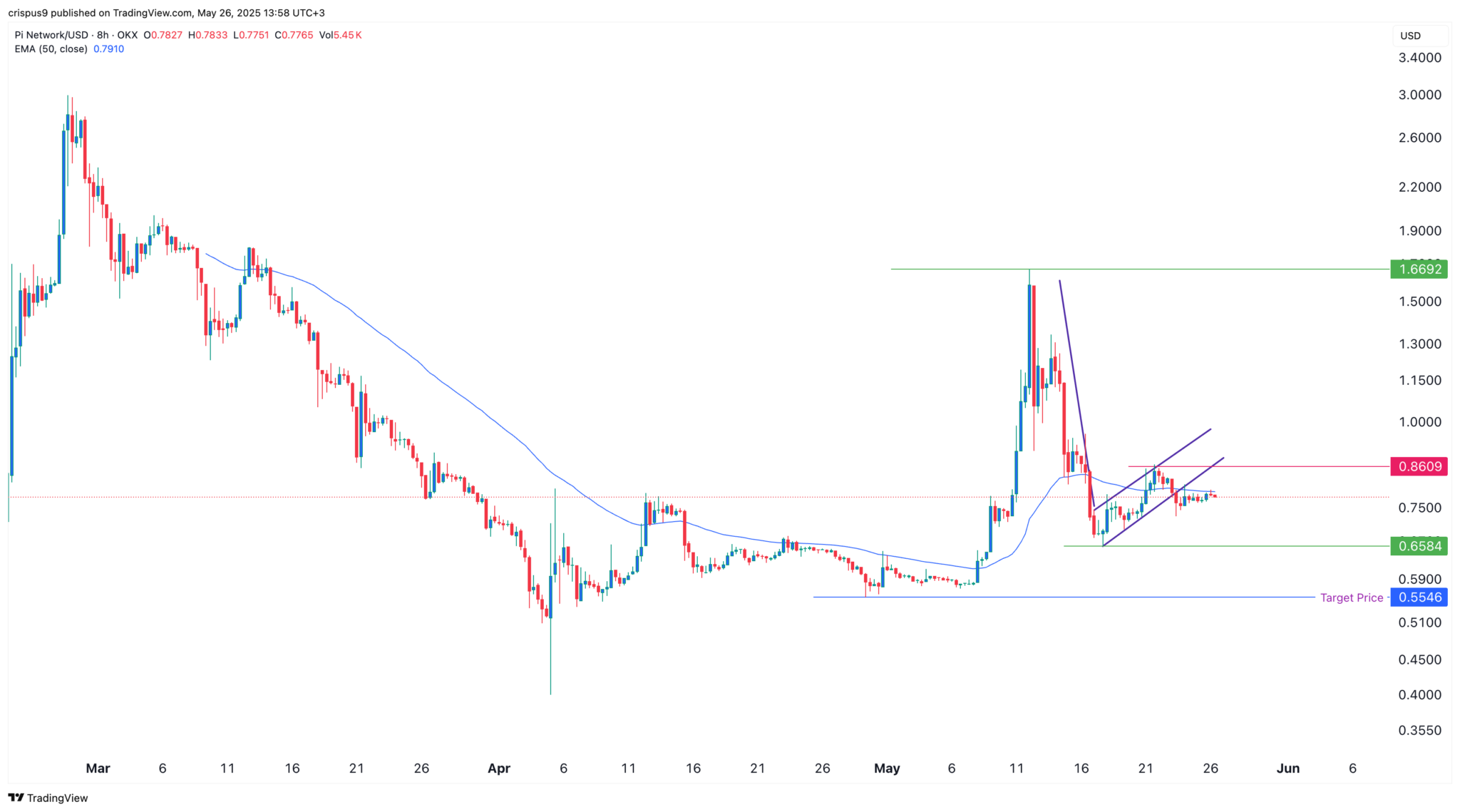
The bearish Pi Coin price forecast will become invalid if the coin rises above $0.8600, the highest point last week. A move above that level will point to more gains, potentially to the psychological point at $1.

Pi Coin Price Could Crash as Exchange Inflows Rise

PiScan data shows that Pi Network price may be at risk of a big crash as investors move tokens into exchanges. Investors moved 4.1 million coins into OKX in the last 24 hours, while withdrawals stood at 2.2 million, bringing the net flow to 1.88 million.

The netflow to Bitget was 712,097 coins, and on Pionex was 2,176. Only MEXC and Gate had net outflows in the past 24 hours. Altogether, the total inflows into exchanges stood at over 2.04 million.
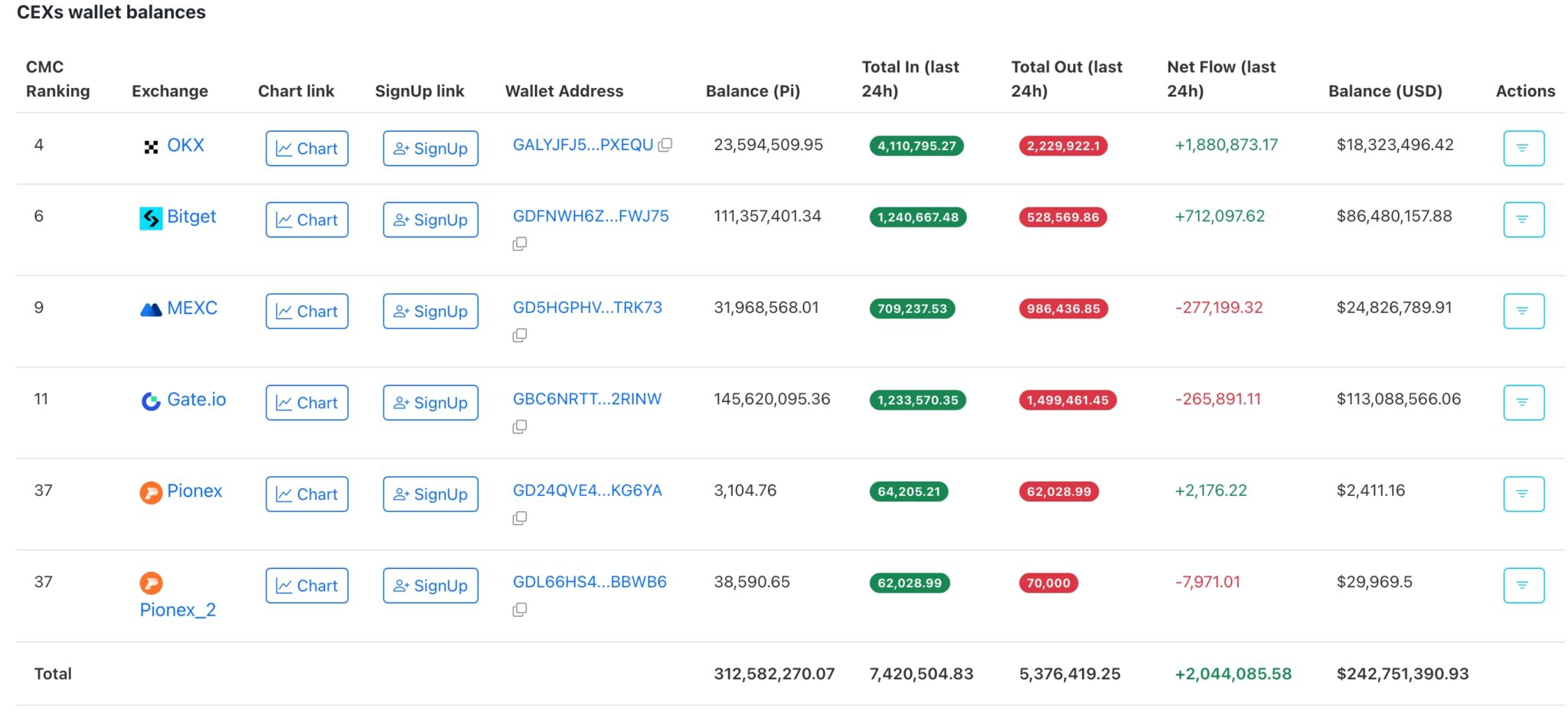
Exchange inflows are one of the top red flags in crypto analysis. That’s because they signal that investors are moving them from their self-custody wallets and selling them. This data is a sign that demand for the coin remains limited after its recent crash.

Pi Coin price crash could continue falling this week as more coins are set to be unlocked this week. 9.9 million coins will be unlocked today, while 12 million, 15.2 million, and 13.2 million will be unlocked in the next three days. Over 72 million coins valued at over $50 million will come online this week, and 280 million in the next 30 days.

This unlock trend will continue for a while since there are now 11.1 billion in circulation against a circulation cap of 100 billion. These unlocks may affect its price if there is no corresponding demand on the other side. For a detailed price prediction for Pi Coin 2025-2023 -


İlgili Okumalar

OpenAI Partners with PE Firms, Investing $4 Billion. Let's Talk About Silicon Valley's Hottest New Role: FDE.

The hottest new role in Silicon Valley is the Forward Deployment Engineer (FDE), a hybrid of engineer and business consultant whose core mission is to transform AI demos into native, practical workflows within client organizations. The recent surge in demand is driven by a strategic shift from leading AI companies. OpenAI, partnering with 19 private equity firms in a $4 billion investment, formed a Deployment Company and acquired Tomoro along with its 150 FDEs. Anthropic also announced a $1.5 billion joint venture with financial institutions like Blackstone. The article, based on interviews with industry experts Jove (FDE lead at Cresta) and Oliver (VP at Invisible Technologies, ex-McKinsey), explores the FDE role and the rise of deployment-focused companies. Key insights include: **The FDE Role:** Jove describes an FDE as a "Forward Deployed CTO"—a technically strong engineer who works intimately with clients to implement AI solutions, learn from the process, and feed those insights back to improve the core product. They require expertise in AI agents, client-facing experience, resilience, and the ability to handle complex, imperfect systems. While AI tools enhance their efficiency, the role's complexity makes full automation a distant prospect. **Industry Shift:** Model companies are moving beyond selling tools to ensuring real-world adoption. This blurs the line between model and application companies. Collaborations with private equity (PE) firms are key, providing access to large portfolios of traditional businesses needing AI transformation. For PE firms, these partnerships offer signal value to LPs, create tangible value in portfolio companies, and provide exposure to high-growth AI assets. **Consulting & Transformation:** AI deployment involves deep, customized workflow redesign, moving beyond simple tool augmentation. Companies like Invisible Technologies build modular platforms to create bespoke, AI-native workflows for clients. While traditional consulting will see growth in helping businesses rethink their models for AI, the real value is captured by firms that leave behind transformed, operational systems. Critical success factors include building robust data foundations and strategically deciding which workflow steps should be deterministic versus AI-driven. The ultimate goal shifts from pure cost-cutting to unlocking new revenue opportunities previously impossible without AI-scale capabilities.

marsbit5 dk önce

OpenAI Partners with PE Firms, Investing $4 Billion. Let's Talk About Silicon Valley's Hottest New Role: FDE.

marsbit5 dk önce

Why Is DeFi Insurance Unpopular?

The article explores the core reasons why DeFi insurance remains largely unutilized despite its potential to eliminate traditional insurance inefficiencies and malicious claim denials through automated smart contracts. Key points include: 1. **Low Adoption & Minimal Payouts:** Leading provider Nexus Mutual has paid only ~$18M in claims since 2019, dwarfed by single hack losses (e.g., Kelp DAO's $292M loss). 2. **High Correlation Risk:** Unlike traditional insurance (e.g., house fires), DeFi risks (oracle failures, bridge hacks) are systemic and can simultaneously impact multiple protocols, threatening to drain entire insurance pools. 3. **Prohibitive Cost vs. Reward:** For many protocols (Aave, Morpho, Compound), insurance premiums (1.5%-6%) consume a significant portion or even all of the native yield (3%-4%), leaving investors with meager returns. In some cases (Maple Finance, Ethena), premiums can even result in net-negative yields. 4. **Inadequate Capacity:** The total DeFi insurance pool (e.g., Nexus Mutual's $81.56M) is minuscule compared to the hundreds of billions in total value locked (TVL), creating a massive supply-demand gap. 5. **Structural Flaws:** The claims assessment model (e.g., Nexus Mutual's member voting) creates a conflict of interest, as voters bear the loss if a claim is paid. There is also no regulatory mandate forcing DeFi protocols to obtain insurance. The industry is adapting by focusing on preventative measures (e.g., bug bounty coverage) and seeking external capital via reinsurance. However, the fundamental issues of small pool size, correlated risk, and misaligned economic incentives persist. The article concludes that DeFi insurance, like a public lighthouse, provides shared security benefits, but if everyone relies on others to pay for it, no one will, leaving the ecosystem vulnerable.

Foresight News19 dk önce

Why Is DeFi Insurance Unpopular?

Foresight News19 dk önce

Ethlabs Founded, Treasury Companies to Fund Ethereum Post-EF

Former Ethereum Foundation (EF) core researchers Ansgar Dietrichs, Barnabé Monnot, Caspar Schwarz-Schilling, Josh Rudolf, and Julian Ma announced the launch of Ethlabs, an independent non-profit R&D lab focused on Ethereum core protocol research and institutional-grade infrastructure. The initiative, backed by over 50 community participants including ETH treasury companies BitMine and Sharplink, Joseph Lubin, Hayden Adams, and Jesse Pollak, aims to make Ethereum the global economic settlement layer. This move comes amidst significant pressure on the EF, which has seen key departures and a strategic narrowing of its focus. A critical funding gap of approximately $30 million annually for core client development, following the expiration of the client incentive program, poses a near-term risk to the network's development. The context includes the evolution of ETH's value narrative. While mechanisms like EIP-1559 and the Merge previously supported the "ultrasound money" thesis, the success of L2 scaling via EIP-4844 has drastically reduced L1 fee revenue, leading to net ETH issuance and challenging that narrative. Ethlabs has listed ETH monetary economics as a primary research focus. Backing from corporate ETH treasuries like BitMine and Sharplink represents a strategic alignment, as these entities' asset values are directly tied to Ethereum's health and adoption. Their support is an investment rather than a pure donation. Ethereum's governance is shifting from a centralized EF model to a distributed network of specialized "manager nodes," including Ethlabs and a streamlined EF. While this promotes efficiency and reduces single-point failure risk, it introduces new challenges in coordination, priority alignment, and filling critical funding gaps across the decentralized ecosystem.

Foresight News43 dk önce

Ethlabs Founded, Treasury Companies to Fund Ethereum Post-EF

Foresight News43 dk önce

İşlemler

Spot
Futures
活动图片