Dubai’s Land Department (DLD) has switched on the Middle East’s first government-backed tokenization of property title deeds, selecting the open-source XRP Ledger (XRPL) as the settlement layer for a pilot expected to reshape how domestic real-estate assets are bought, sold and financed. The live launch, developed under the DLD’s Real Estate Evolution Space Initiative (REES) and executed with tokenization specialist Ctrl Alt, synchronizes on-chain deed tokens with Dubai’s conventional land registry, creating a legally compliant bridge between the XRP Ledger and the emirate’s long-standing property system.
Dubai Turns To XRP Ledger
Ripple’s developer arm welcomed the choice. In a post on X, RippleX called the programme “a massive milestone for Dubai’s real estate market,” adding that the XRPL was picked “thanks to its decade-long reliability and stability in tokenizing and exchanging digital and real-world assets.”
Ctrl Alt’s infrastructure mints fractional title tokens, each representing a direct economic interest in a registered property. The company has integrated its stack directly with DLD databases so that any on-chain transfer instantly updates the government ledger, preserving legal finality while dispensing with paper conveyancing. Matt Ong, founder and chief executive of Ctrl Alt, said the team had “been working closely with the DLD … to bring real estate investment to a wider audience,” describing Dubai’s embrace of next-generation finance as “truly world-class.”
During the pilot phase, eligible UAE-ID holders can subscribe through PRYPCO Mint with a minimum ticket of AED 2,000 (about US$545). Transactions are settled in dirhams, not crypto, but ownership is recorded as bearer tokens on XRPL. The project targets cumulative fractional-deed issuance of roughly AED 60 billion ($16 billion) by 2033, equivalent to seven per cent of all property transactions forecast for that year, according to DLD projections.
For policymakers, the initiative advances two headline agendas: the Real Estate Sector Strategy 2033 and the broader Dubai Economic Agenda (D33), each of which mandates digital-first reforms to attract capital and sharpen regulatory competitiveness. Oversight is distributed: DLD governs the underlying physical asset, while the Virtual Assets Regulatory Authority (VARA) licenses Ctrl Alt as broker-dealer and issuer, ensuring that deed tokens meet the same provenance tests as the plots they represent.
XRPL’s selection gives the ledger its highest-profile government integration to date. Launched in 2012, the chain processes close to two million transactions per day, with finality in seconds and negligible network fees—features DLD cited as critical for scaling fractional real-estate markets without compromising retail-grade user experience.
Ctrl Alt arrives with a track record: as of 1 May 2025 the London- and Dubai-based firm had tokenized $295 million in alternative assets ranging from private credit to litigation finance. The real-estate deployment, however, places its infrastructure at the heart of an emirate whose property sector cleared more than $218 billion in deals last year, according to official statistics.
While authorities bill the sandbox as a gateway to broader participation, risk warnings accompany the launch. Ctrl Alt reminds prospective investors that “virtual assets may lose their value in full or in part, and are subject to extreme volatility,” and that fractional deed holders do not benefit from conventional investor-protection schemes.
If the pilot scales as planned, Dubai would become the world’s first jurisdiction to maintain mirror records of every property transfer on a public blockchain in real time—an architectural leap that could compress settlement cycles from weeks to minutes, widen access beyond high-net-worth buyers and generate transparent, machine-readable data streams for regulators and developers alike. For now, the ball is with early adopters: the PRYPCO Mint portal is live, the first apartments are tokenized, and every transaction settles irrevocably on XRPL’s consensus ledger—one more signal that the emirate intends to put real estate on-chain and on the map.
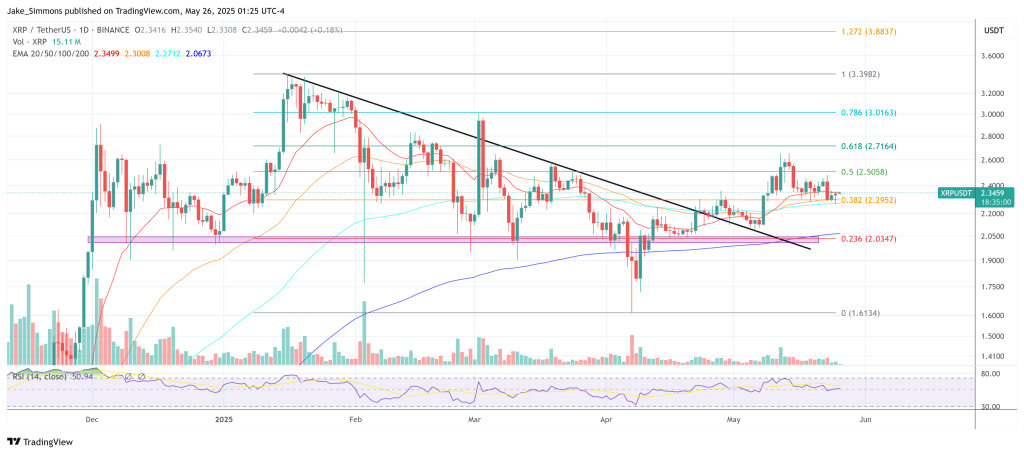
At press time, XRP traded at $2.34.

Related Posts