Crypto Scandal: Zerebro’s Co-Founder Allegedly Fakes Death While His Wallets Dump Tokens

bitcoinist2025-05-08 tarihinde yayınlandı2025-05-08 tarihinde güncellendi

Özet

The co-founder of the Artificial Intelligence (AI) crypto project Zerebro has been accused of faking his death and dumping on...

Trusted Editorial content, reviewed by leading industry experts and seasoned editors. Ad Disclosure

The co-founder of the Artificial Intelligence (AI) crypto project Zerebro has been accused of faking his death and dumping on investors after recent reports claim the developer pulled the stunt as an “exit liquidity strategy.”

Crypto Developer Allegedly Dies On Livestream

This week, the crypto community was hit with the shocking news of the apparent death of a developer due to mental health issues. Reports online announced the passing of Zerebro’s co-founder, Jeffy Yu, who had seemingly committed suicide during a Pump.fun livestream on May 4.

The video, which was later shared on X, showed the project’s co-founder smoking a cigarette while taking his own life with a gun. Seemingly confirming his death, an obituary for Yu was published on the obituary platform Legacy, claiming he died at the age of 22.

crypto

Yu's obituary on Legacy. source: Lookonchain on X


On Sunday, Yu introduced the concept of “Legacoins,” a term derived from “legacy memecoin,” in a Mirror blog post. As he explained, these tokens don’t promise returns, as they are not investments, but are an “interactive performance art” where “the chart is the canvas / you are the art.”

After his alleged passing, Zerebro’s official X account and Yu’s X account were deactivated. In a scheduled post, he stated, “If you’re reading this, it’s because my 72 hour deadman’s switch triggered so i’m not here, at least physically.”

The May 6 announcement unveiled Yu’s “final art piece,” the Solana-based LLJEFFY legacoin. The developer expressed his discontent with money, stating that the token was “my burning ritual / my hatred for money made manifest.”

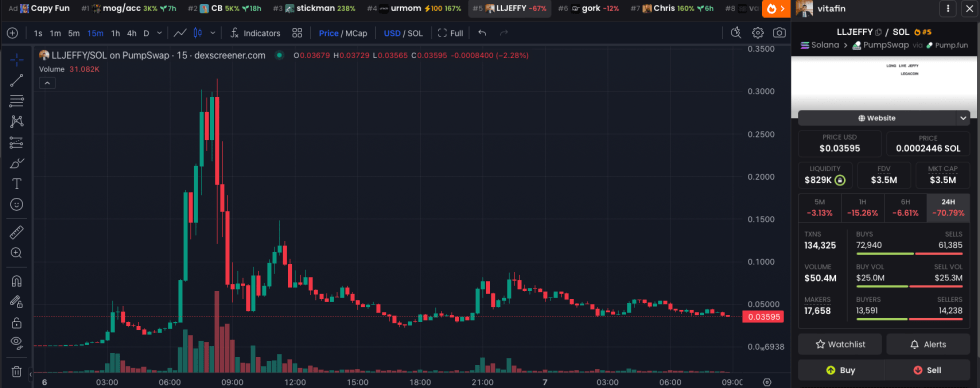
DexScreener data shows that LLJEFFY’s price skyrocketed over 1,000% after the news spread. However, the cryptocurrency’s price quickly plummeted by over 90%, resulting in losses for many investors.
crypto

LLJEFFY's price action over the past 24 hours. Source: DexScreener

On-chain analytics firm Lookonchain reported that the news of Yu’s death “caused the price of $LLJEFFY to soar and plummet in a short period, causing some traders who FOMO bought to suffer losses,” adding that one trader lost $93,000 in one hour.

Nonetheless, crypto community members started to question whether the co-founder had faked his death, as online reports suggested otherwise based on suspicious on-chain activity.

A ‘Calculated’ Exit Scam?

According to Bubblemaps’ timeline, the LLJEFFY creator wallet and several linked wallets began to trade and burn the token after Yu’s alleged suicide rumor started on X, with one of the addresses selling over $170,000 worth on ZEREBRO through multiple transactions by Tuesday afternoon.

On Wednesday, Lookonchain shared that a wallet likely linked to Yu sold 35.55 million ZEREBRO for 8,572 SOL, worth around $1.27 million, on Tuesday night. The address then transferred 7,100 SOL, valued at $1.06 million, to the LLJEFFY developer wallet “G5sjgj.”

Crypto influencer Irene Zhao also affirmed to have spoken to someone familiar with the matter, who confirmed that Yu had faked his death and was fine. Meanwhile, an X user claimed the developer was alive, and the crypto industry had “just witnessed its first pseudocide exit strategy.”

Per the post, “He sent a detailed letter directly to an early investor who round tripped it all,” with no remorse, “just a calculated exit.” The alleged letter states that Zerebro’s developer deliberately created a video simulating shooting himself, arguing that it was his “only viable exit” from constant harassment, blackmail, and threats after being doxxed.

He explained that publicly stepping away would have tanked the price of the ZEREBRO and OPAIUM projects, another reason for the stunt. The letter closes by stating that Yu is “physically and mentally sound,” and not seeking assistance.

Soon after, the Legacy obituary was deleted, fueling the speculation that Yu’s passing was false. As Lookonchain noted, “The official Zerebro team has made no public statement, and it remains unconfirmed whether Jeffy Yu is actually dead or faked his death. Be cautious with the news and don’t FOMO trade.”
crypto, Solana, SOL, SOLUSDT

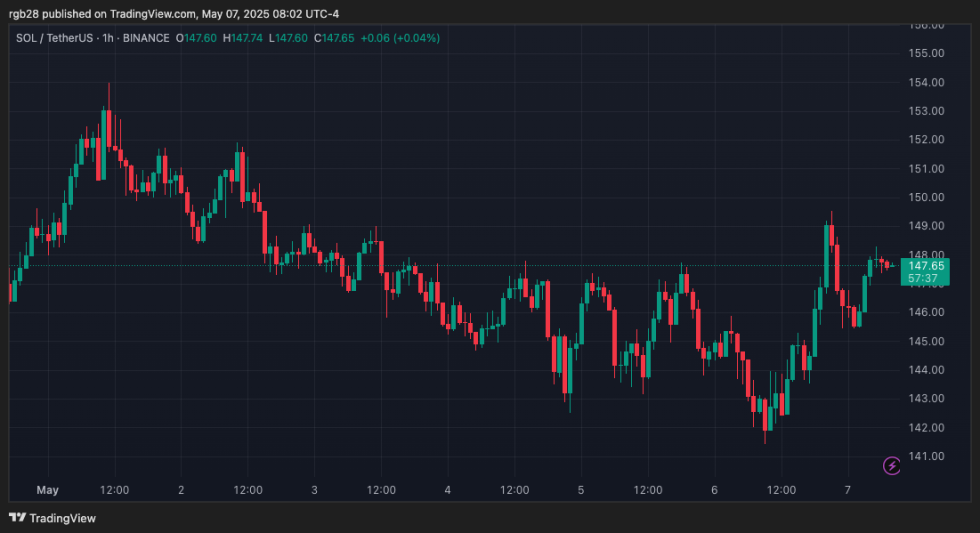
Solana (SOL) trades at $147.65 in the one-week chart. Source: SOLUSDT on TradingView
Featured Image from Unsplash.com, Chart from TradingView.com
Editorial Process for bitcoinist is centered on delivering thoroughly researched, accurate, and unbiased content. We uphold strict sourcing standards, and each page undergoes diligent review by our team of top technology experts and seasoned editors. This process ensures the integrity, relevance, and value of our content for our readers.

Rubmar is a crypto enthusiast who likes learning and improving constantly. She enjoys reporting on the latest news and developments in the crypto industry. Rubmar also enjoys scrapbooking, crafting, simulation games, and watching football.

İlgili Okumalar

Dalio's Latest Warning: Don't Get Carried Away by AI, Real Returns on US Stocks in the Next 5-10 Years Could Be -5% to -10%

Ray Dalio, founder of Bridgewater Associates, warns investors against excessive concentration in AI stocks. He argues the current market, dominated by a few AI giants, mirrors historical patterns where revolutionary new technologies lead to high risk, volatility, and uncertainty. While acknowledging AI's transformative potential, Dalio emphasizes that most investors fail at this stage of the cycle by over-concentrating in a handful of leading companies. He cites inherent risks: companies cannot accurately forecast investment needs or external shocks (e.g., monetary policy, geopolitics, taxes), face potential disruption from future technologies and international competition (notably from China), and experience significant price swings. Dalio's core advice is diversification, calling it his "Holy Grail of Investing." He presents a mathematical case that a well-diversified portfolio of 15-20 uncorrelated, good bets offers a superior risk-adjusted return compared to a concentrated position. Dalio also offers a cautious outlook, suggesting U.S. stocks may deliver real returns of -5% to -10% over the next 5-10 years based on valuation and bubble indicators. He concludes that in the face of high uncertainty, the prudent strategy is not to avoid betting entirely, but to avoid large, concentrated bets where one lacks sufficient informational edge. Instead, investors should build a strategically balanced, diversified portfolio.

marsbit51 dk önce

Dalio's Latest Warning: Don't Get Carried Away by AI, Real Returns on US Stocks in the Next 5-10 Years Could Be -5% to -10%

marsbit51 dk önce

Rain Valuation Approaches $20 Billion: The Battle for U-Cards Extends to Rewards Systems

Rain, a stablecoin payments infrastructure company, is shifting the competitive focus for U Cards from simple issuance to user retention and repeated usage. On June 15, Rain launched "Rain Rewards," an embedded loyalty program capability within its card-issuing infrastructure. This allows partner businesses—like fintech platforms and neobanks—to configure branded loyalty points, earning rules, redemptions, and merchant promotions directly within their card products. The system, built from the 2025 acquisition of Uptop, ensures points are only issued upon final transaction settlement, preventing liabilities from refunds. Trials, such as with Avalanche Card, reportedly boosted spending by 25% among enrolled users. Founded by Farooq Malik and Charles Yoo-Naut, Rain evolved from a tool for managing Web3 company expenses into a full-stack enterprise platform. It is a Principal Member of Visa and Mastercard, enabling partners to issue stablecoin-backed cards and wallets while leveraging traditional payment networks. Notably, the popular U Card Plasma One is issued by Rain under Visa's authority. Rain also integrates with Visa's stablecoin settlement pilot, using USDC for network settlement. Rain's rapid funding reflects growing institutional interest in stablecoin payment infrastructure. It raised a $245 million Series A in March 2025, a $58 million Series B in August 2025, and a $250 million Series C in January of this year, reaching a $19.5 billion valuation. Annualized transaction volume exceeds $3 billion, serving over 200 partners including Western Union and Nuvei. Beyond cards, Rain is expanding into programmable payments. Its June 2026 "Agent Control Layer" allows businesses to set spending rules—like merchant categories, amounts, and frequency—for AI agents before transactions occur. This positions Rain not as a single product but as an operating system for stablecoin payments, handling everything from card issuance and wallet management to rewards, on/off-ramps, and automated compliance. The goal is to enable seamless, often invisible, real-world spending of on-chain assets.

Foresight News54 dk önce

Rain Valuation Approaches $20 Billion: The Battle for U-Cards Extends to Rewards Systems

Foresight News54 dk önce

Google TPU Shipments Revised Up by 50%

Recent industry research indicates a significant upward revision in the shipments of Google's TPU (Tensor Processing Unit) chips. Previous expectations for 2027 were set at around 10 million units, but new estimates now point to 15 million units, a 50% increase. This substantial boost directly translates to higher demand across the entire supporting supply chain. Google's TPU clusters utilize a standardized all-optical interconnect architecture. Consequently, key hardware components are deeply integrated and scaled in fixed ratios with the chips. The 15 million TPU target will drive corresponding demand increases for NPO optical engines (roughly a 1:1 match), 1.6T optical modules, OCS optical switches, high-end server power supplies, fiber optics & MPO connectors, and liquid cooling solutions. Among these, liquid cooling is highlighted as the sector experiencing the most significant transformation and offering the most stable potential for excess returns. As next-generation TPU chips reach power levels where traditional air cooling is insufficient, liquid cooling becomes essential. 2026 is forecasted as the first year of substantial adoption for Google's liquid cooling solutions. This shift, coupled with delivery and capacity bottlenecks faced by incumbent overseas manufacturers, is creating a prime window for domestic Chinese suppliers to enter and secure Google's core supply chain. The market size for Google-specific liquid cooling is projected to potentially triple from a baseline of hundreds of billions to around 300 billion units by 2028. The logic for the fiber optic sector is also being rewritten. Once considered a cyclical commodity tied to telecom operator procurement, fiber is now a strategic and scarce resource for AI Data Centers (AIDC). A severe supply-demand imbalance, driven by the long lead time for preform production (18-24 months) and surging demand from cloud giants, is supporting strong performance. Chinese fiber manufacturers are well-positioned to capture a significant share of global AIDC demand, with exports potentially reaching 200-300 million core kilometers in 2026. Overall, the investment focus within the AI computing industry is shifting from pure "chip performance speculation" towards the more certain incremental growth in computing infrastructure and its supporting ecosystem. The upward revision in Google TPU shipments, along with the potential for further doubling by 2028, is seen as solidifying performance visibility for the entire supporting supply chain over the next two years.

marsbit2 saat önce

Google TPU Shipments Revised Up by 50%

marsbit2 saat önce

İşlemler

Spot
Futures

Popüler Makaleler

ZEREBRO Nasıl Satın Alınır

HTX.com’a hoş geldiniz! Zerebro (ZEREBRO) satın alma işlemlerini basit ve kullanışlı bir hâle getirdik. Adım adım açıkladığımız rehberimizi takip ederek kripto yolculuğunuza başlayın. 1. Adım: HTX Hesabınızı OluşturunHTX'te ücretsiz bir hesap açmak için e-posta adresinizi veya telefon numaranızı kullanın. Sorunsuzca kaydolun ve tüm özelliklerin kilidini açın. Hesabımı Aç2. Adım: Kripto Satın Al Bölümüne Gidin ve Ödeme Yönteminizi SeçinKredi/Banka Kartı: Visa veya Mastercard'ınızı kullanarak anında Zerebro (ZEREBRO) satın alın.Bakiye: Sorunsuz bir şekilde işlem yapmak için HTX hesap bakiyenizdeki fonları kullanın.Üçüncü Taraflar: Kullanımı kolaylaştırmak için Google Pay ve Apple Pay gibi popüler ödeme yöntemlerini ekledik.P2P: HTX'teki diğer kullanıcılarla doğrudan işlem yapın.Borsa Dışı (OTC): Yatırımcılar için kişiye özel hizmetler ve rekabetçi döviz kurları sunuyoruz.3. Adım: Zerebro (ZEREBRO) Varlıklarınızı SaklayınZerebro (ZEREBRO) satın aldıktan sonra HTX hesabınızda saklayın. Alternatif olarak, blok zinciri transferi yoluyla başka bir yere gönderebilir veya diğer kripto para birimlerini takas etmek için kullanabilirsiniz.4. Adım: Zerebro (ZEREBRO) Varlıklarınızla İşlem YapınHTX'in spot piyasasında Zerebro (ZEREBRO) ile kolayca işlemler yapın.Hesabınıza erişin, işlem çiftinizi seçin, işlemlerinizi gerçekleştirin ve gerçek zamanlı olarak izleyin. Hem yeni başlayanlar hem de deneyimli yatırımcılar için kullanıcı dostu bir deneyim sunuyoruz.

140 Toplam GörüntülenmeYayınlanma 2024.12.17Güncellenme 2026.06.02

ZEREBRO Nasıl Satın Alınır

Tartışmalar

HTX Topluluğuna hoş geldiniz. Burada, en son platform gelişmeleri hakkında bilgi sahibi olabilir ve profesyonel piyasa görüşlerine erişebilirsiniz. Kullanıcıların ZEREBRO (ZEREBRO) fiyatı hakkındaki görüşleri aşağıda sunulmaktadır.

活动图片













