Is It Time To Sell Off Dogecoin? Analyst Predicts Bullish Wave To $0.4

bitcoinist2025-05-07 tarihinde yayınlandı2025-05-07 tarihinde güncellendi

Özet

Dogecoin is currently trading at $0.169, continuing its pullback after it reached $0.19 in late April. However, price action over...

Trusted Editorial content, reviewed by leading industry experts and seasoned editors. Ad Disclosure

Dogecoin is currently trading at $0.169, continuing its pullback after it reached $0.19 in late April. However, price action over the last few days still shows some strength compared to the crash to $0.14 in early April. Despite this bit of hesitation in rally, the meme coin is building a structure that could be foundational for a larger move ahead. According to the chart shared by crypto analyst MasterAnanda, the ongoing consolidation may actually be a prelude to a significant breakout reminiscent of Dogecoin’s explosive rallies in prior cycles.

Dogecoin Chart Pattern Hints At Repeat Of Previous Bullish Phase

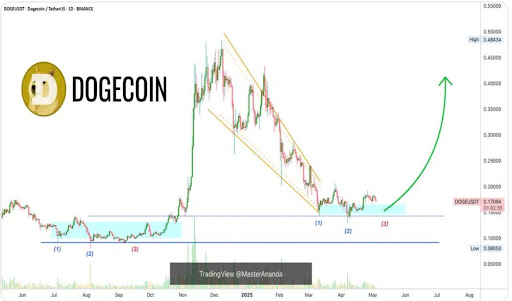
The core of MasterAnanda’s analysis lies in a repeating structure of three labeled lows on the Dogecoin daily candlestick timeframe chart. These lows are labelled (1), (2), and (3) and appear on both the left and right sides of the chart, as seen in the chart below. On the left side, these three lows developed between July and October 2024, each representing a stage of price corrections. The current pattern on the right side follows a strikingly similar trajectory, with the same labels denoting recent market lows in the ongoing 2025 price structure.

The formation of a higher low at point (3) in September 2024 led to a major bullish impulse that took Dogecoin towards the $0.50 level. According to the analyst, Dogecoin is now mirroring that same setup, where the current (3) low is also forming a higher low relative to (2). 
Dogecoin
Source: Master Ananda on Tradingview

Furthermore, a descending wedge pattern that spanned the February to April period has already been broken. However, although the $0.145 support zone has held firmly three times over the last two months, there’s a possibility it could be retested again around the third low.

Analyst Says Buy Aggressively And Hold Through Retracements

Based on this analysis, it is possible that Dogecoin retests the zone at $0.145 again to complete the formation of the third low before rebounding upwards. However, MasterAnanda’s advice is anything but conservative. In his TradingView post, he noted that this is not a time to sell Dogecoin. Instead, he called for a panic buy, insisting that Dogecoin is entering the strongest growth phase since the 2021 bull market. He urged readers to remove stop-loss orders and treat any short-term dip as a rare buying opportunity. If you can’t buy more, just hold.

The last of such formation in 2024 led to a 380% break to a multi-year high of $0.48. Should the same pattern play out again, a similar rally from $0.145 would project a price near $0.70, effectively bringing Dogecoin back to its all-time high range. While MasterAnanda did not explicitly call for such an extreme target, he did identify a move above $0.40 as the minimum expectation based on the current setup.

At the time of writing, Dogecoin is trading at $0.1695.

Dogecoin
DOGE trading at $0.167 on the 1D chart | Source: DOGEUSDT on Tradingview.com
Featured image from Getty Images, chart from Tradingview.com
Editorial Process for bitcoinist is centered on delivering thoroughly researched, accurate, and unbiased content. We uphold strict sourcing standards, and each page undergoes diligent review by our team of top technology experts and seasoned editors. This process ensures the integrity, relevance, and value of our content for our readers.

Scott Matherson is a leading crypto writer at Bitcoinist, who possesses a sharp analytical mind and a deep understanding of the digital currency landscape. Scott has earned a reputation for delivering thought-provoking and well-researched articles that resonate with both newcomers and seasoned crypto enthusiasts. Outside of his writing, Scott is passionate about promoting crypto literacy and often works to educate the public on the potential of blockchain.

İlgili Okumalar

Are the Frantic Acquisitions of Crypto Companies by Giants Good or Bad?

In a bear market, giants are actively acquiring crypto companies. Recent months have seen at least five major deals: Samsung Securities bought a 2% stake in Upbit operator Dunamu; Robinhood acquired WonderFi for $180 million to enter the Canadian market; Figure purchased Kiavi for $717 million to expand into on-chain real estate credit; Franklin Templeton bought 250Digital to launch Franklin Crypto; and Blockworks acquired data platform Messari at a steep discount—over 90% less than its 2022 $300 million valuation. These moves highlight a strategic shift. Cash-rich giants are consolidating resources at low cost, targeting companies with established compliance frameworks to navigate tightening global regulations. Acquisitions like WonderFi and the Upbit stake provide immediate market access and licensed user bases. Figure's deal signals real-world asset (RWA) tokenization moving from concept to large-scale implementation, with Kiavi's $7+ billion annual transaction volume being integrated into on-chain capital markets. Franklin Crypto's launch targets institutional investors like pension funds, offering them tailored, compliant crypto strategies. For these strategic players, bear markets present an ideal entry point: valuations are depressed, speculative noise is minimized, and they can acquire robust technology and compliance infrastructure at a fraction of the cost. This acquisition wave marks a transitional phase for crypto—from a wild frontier toward an institutional, regulated financial system. Giants are positioning themselves to capture future growth when macroeconomic conditions and liquidity improve, leaving latecomers behind.

marsbit38 dk önce

Are the Frantic Acquisitions of Crypto Companies by Giants Good or Bad?

marsbit38 dk önce

In the MiCA Era, Europe's New Cryptography Landscape: Why is Germany Taking Center Stage?

With MiCA's transitional arrangements concluding, Europe's crypto industry has undergone a regulatory consolidation. Post-MiCA, platforms must secure CASP authorization to operate compliantly within the EU. As of July 1st, only about 12% of crypto firms have received authorization, with Germany emerging as a key player, holding 57 authorizations (roughly 23% of the EU total). This positions Germany as a primary compliance gateway to the EU's unified market. Germany's advantage stems from its established, function-based regulatory framework, which integrated crypto activities into existing banking, securities, and payment systems pre-MiCA. This allowed a smoother transition and attracted both domestic platforms (like Bitcoin.de, BISON) and international ones (like Coinbase Germany). A distinctive trend is German banks becoming direct retail entry points for crypto services. Examples include DZ Bank integrating "meinKrypto" into its VR Banking App and the Sparkassen savings bank network planning to offer crypto trading via DekaBank. This mainstreams crypto access for ordinary users. Beyond trading, Germany is evolving into a digital asset infrastructure hub. Deutsche Börse Group's Clearstream is developing a next-generation platform for issuing, settling, and servicing both traditional and tokenized securities. Furthermore, German banks like DekaBank and DZ Bank are key participants in the Qivalis project, a European initiative for a regulated euro stablecoin, positioning Germany at the intersection of critical future capabilities like custody, settlement, and cross-border services.

marsbit1 saat önce

In the MiCA Era, Europe's New Cryptography Landscape: Why is Germany Taking Center Stage?

marsbit1 saat önce

İşlemler

Spot
活动图片