There has been a lot of talk about Celsius and its founder Alex Mashinsky over the past week. Some believe the situation is over-hyped, while others fear insolvency is unavoidable.
The lack of transparency around the entire ordeal is hugely troubling for both retail and institutional investors alike.
$20 million bounty
A $20 million bounty has reportedly been put out for anyone with information confirming there was a concerted attack on Celsius Network from a third party.
CryptoSlate has received reports from major crypto content creators that they have received requests asking if they have been paid to spread FUD about Celsius. None of the creators we have spoken to have been approached to do so, but the reports tie in with Plan C‘s announcement that a bounty is open for anyone with information.
The bounty would reward anyone with information proving that Celsius was the target of a coordinated attack from prominent institutional players. The market analyst asserted:
Any whistleblower willing to speak & provide definitive proof that there was a planned attack on #Celsius will never have to work another day in their life.
A verified reward put forward by a respected #Crypto group of over $20M. #Bitcoin
DM any information.
Please Retweet 🙏
— Plan©️ #CELShortSqueeze (@TheRealPlanC) June 19, 2022
CryptoSlate reached out to PlanC, who confirmed, “I know the money is real because I know the group. I talked directly to them, and they have a good reputation in crypto.”
The group allegedly wishes to remain anonymous, so we cannot report the organization’s name at this time. However, anyone with information can contact CryptoSlate’s investigative team via email or Twitter.
GameStop-like short squeeze
Plan C also believes there are “early signs of another GameStop situation” regarding a $CEL short squeeze. On June 14, CryptoSlate reported that the $CEL token spiked 500% in just 30 minutes. However, as the below chart from FTX shows, from its local low on June 13 to the top of the wick on June 14, there was a 2722% price spike. This spike could undoubtedly have resulted from a short squeeze on those shorting $CEL amid the uncertainty of its insolvency. Yet, Plan C believes there is more to come.
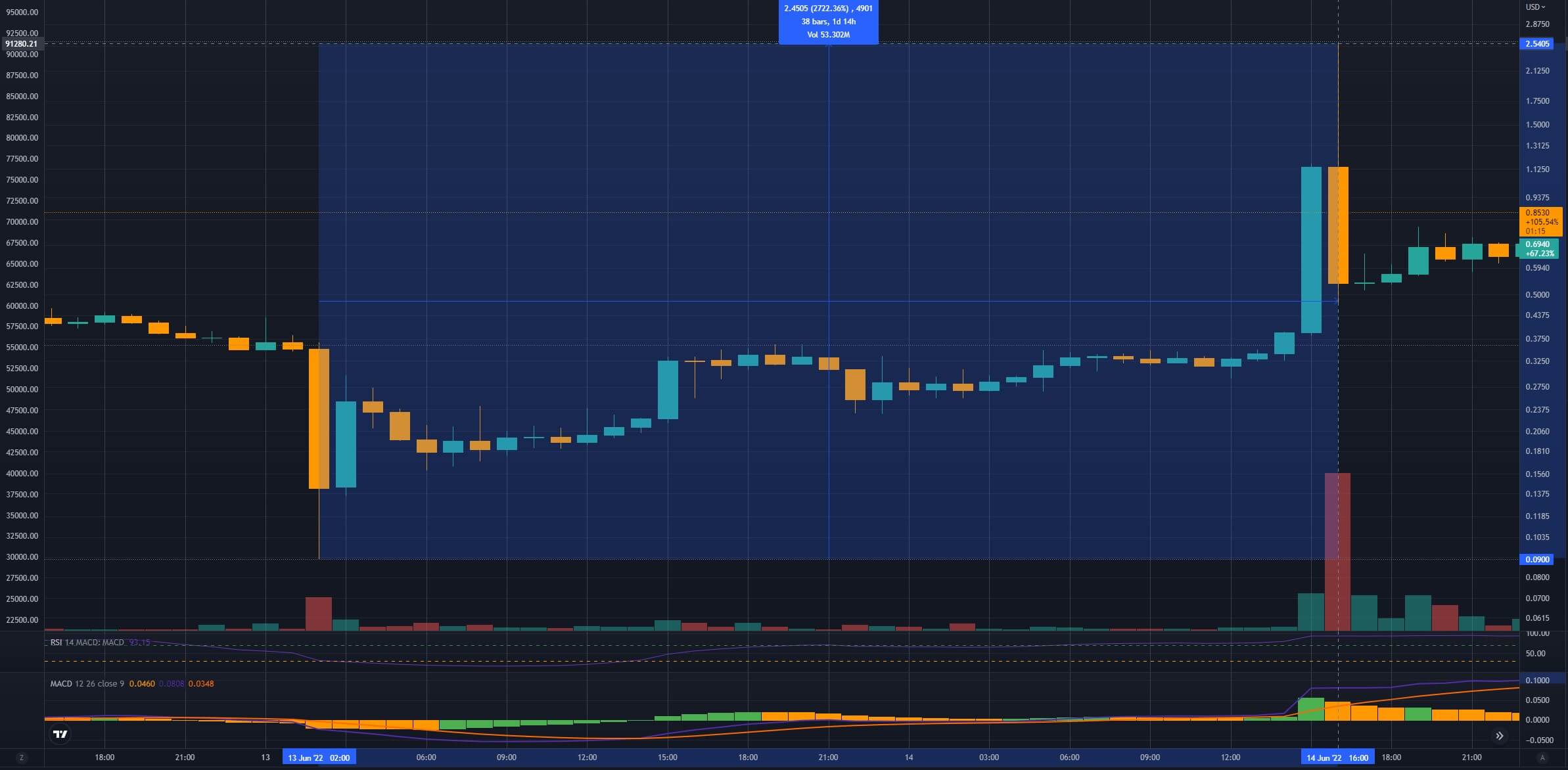

Source: TradingView
The current price of $CEL is up to 86% in the past 24 hours, which is still 89% down from its all-time high in June 2021. Plan C claims that an orchestrated attack on Celsius is to blame for its liquidity issues, and they are not alone. Celsius investor Simon Dixon announced,
“I smell a rat in the leverage boom & deleverage crash. it ends with banks buying up crypto companies & stripping them of their assets before CBDC rollout. Don’t get me wrong, the crypto sector fucked up doing all the things I teach investors to avoid, but I’m following the money.”
The hashtag #CelShortSqueeze has generated over 7,440 tweets within the last 24 hours as investors jump into the belief that the moon is in sight. Allegations have been brought to FTX CEO, Sam Bankman-Fried, claiming he is behind the downfall of Celsius. SBF responded directly to the allegations stating, “this is definitely false, we want to help those we can in the ecosystem and have no interest in hurting them — that just hurts us and the whole ecosystem.” The tweet received over 100 comments which were extremely mixed in their mistrust and support of SBF and FTX.
Some influencers within the crypto community have come out in support of SBF, stating, “FTX & Sam allegedly bailed out massive crypto companies to limit this crypto crash.” At present, SBF has not responded to our requests for further comment. One thing is for sure; there are a lot of unbalanced transactions related to $CEL and FTX. There are many small outflows of 10 – 100 $CEL and a few large inflows of 10,00+ $CEL. The inflows appear to be taking $CEL from other exchanges such as MEXC, 1INCH, OKEX, Gate.io, and Huobi to send to FTX. This in and of itself is not uncommon as traders move funds around to different accounts, yet the fact that a few large wallets are depositing $CEL onto FTX and almost nowhere else is strange. Interestingly, many of the known wallets for Celsius are still active even though withdrawals are suspended.
The downfall of Celsius
In a move toward further transparency, a video has come to light, including alleged commentary from a former Celsius employee who claims it made several “mistakes” in handling client funds. The video was released as a part of a video by YouTuber and investigator, Coffeezilla.
Coffeezilla comments how Mashinsky declared many times over the year that Celsius was different from a bank, yet it acted just like a bank. Further, the terms and conditions of the Celsius platform describe all crypto sent to it by users as “loans” rather than actual deposits. The unnamed “insider” also claimed that Celsius was
“engaging in some fairly risky practices, essentially taking borrowed assets and lending on them multiple times in order to maximise their yield.”
They continued by saying that describing Celsius as a “hedge fund that was playing with retail money is probably a fairly charitable way to describe it.” The former employee explained that Celsius had invested ETH with Stakehound. In June 2021, Stakehound was involved in an incident which resulted in the keys to 38,178 ETH being lost and thus trapping the staked ETH without recourse. The former employee suggested that some of these funds were client funds from Celsius users.
Coffeezilla asserts that Celsius grew “too fast” and tried to “scale too fast” and ultimately “paid the price.” He says they recklessly invested client funds and suffered a liquidity crisis due to a natural downturn in the crypto markets. Finally, Coffeezilla affirms that former Celsius employees described the company as “a story of incompetence.”
What is next for Celsius?
The jury is still out regarding the Celsius fiasco. Several influencer players are claiming, behind the scenes, that there was a coordinated attack against Celsius. Publicly, many are simply declaring that Celsius mismanaged funds and was the victim of its hubris. If you have any information regarding Celsius, you can contact CryptoSlate via Twitter or myself either by email or also on Twitter.