Diamond Hands Mentality Backfires as Locked Token Holders Face Major Losses

ccn.com2025-04-23 tarihinde yayınlandı2025-04-23 tarihinde güncellendi

Key Takeaways

  • Locked token holders are now sitting on nearly 50% average losses compared to May 2024 OTC valuations.
  • Despite strong OTC demand, many investors chose not to sell, often holding out for more gains that never came.
  • Newer tokens are struggling to hold value as secondary market pressure builds.

Early access to crypto projects might sound like a golden ticket, but for many locked token investors, that promise has become a painful lesson.

New data shows that locked token holders face average losses of nearly 50% compared to over-the-counter valuations from just a year ago.

Many had opportunities to exit at much higher prices but held on, expecting more upside. Now they’re dealing with the fallout.

Locked Token Holders Face Steep Losses

According to STIX founder Taran Sabharwal , there was no shortage of demand from OTC buyers in 2024.

The problem? Sellers were scarce, often unwilling to part with tokens that had already been marked up several times. That decision has come back to haunt them.

Even projects that once drew significant hype are now trading at deep discounts, raising questions about how investors price risk in early-stage deals and whether they truly understand the limits of illiquid positions.
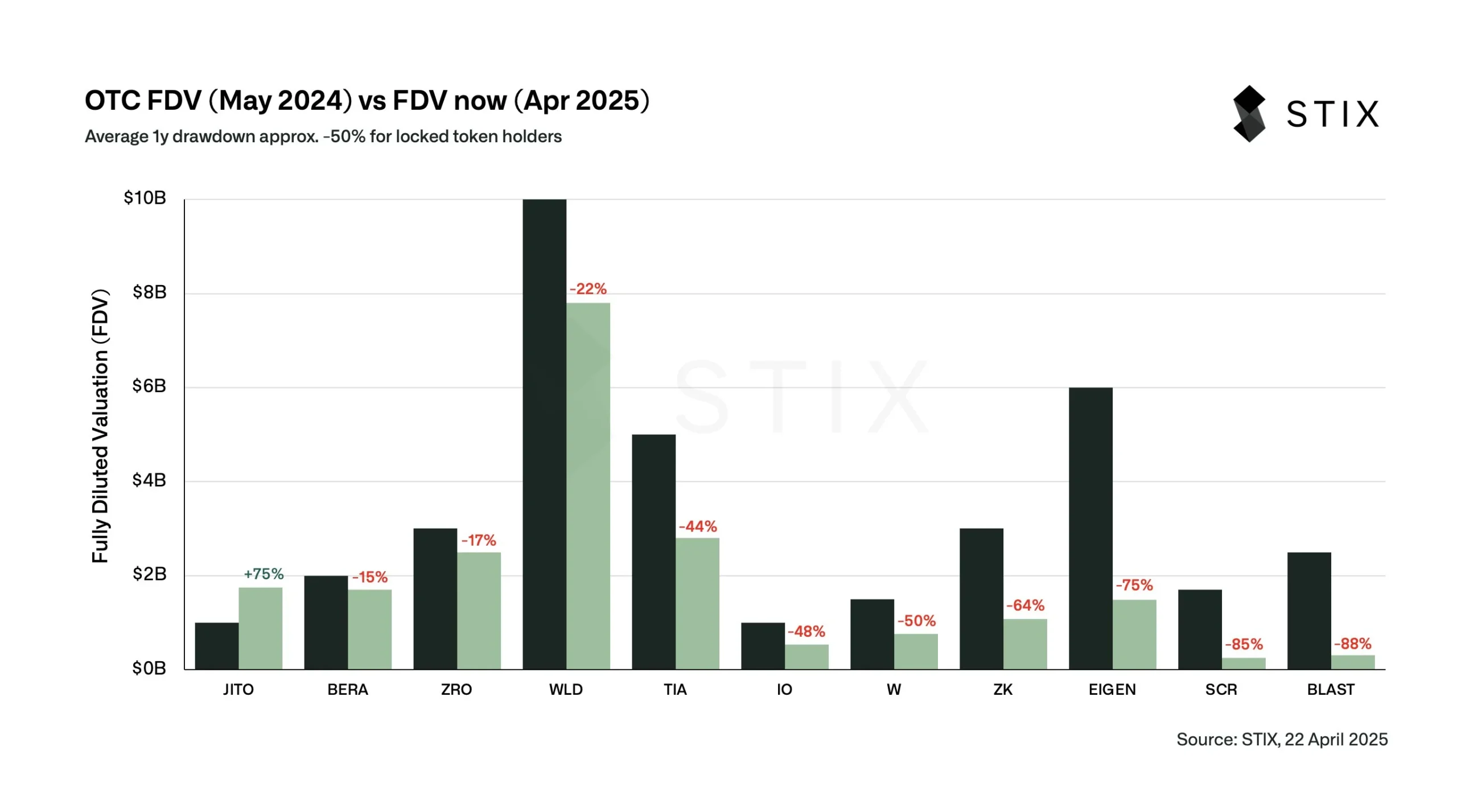
Locked token holders losses
Locked token holders have taken massive losses over the last 12 months. | Credit: STIX

Top Projects See Sharp Declines

These losses outpaced the broader crypto market , which saw an average sector-wide correction of 41% over the same period, even with Bitcoin (BTC) and Ethereum (ETH) factored in.

Among the worst performers:

  • SCR: -85%
  • BLAST: -88%
  • EIGEN: -75%
  • ZK: -64%
  • W: -50%
  • IO: -48%
  • TIA: -44%

Only one project, JITO, posted a gain over the last year, up +75%.

The Price of Illiquidity

The data tells a clear story: locked token rounds carry risks that aren’t always obvious on paper.

Illiquidity, vesting schedules, and speculative valuations create a minefield for early investors. When exit windows close, the downside comes fast.

Many are now rethinking their strategy, especially as fully diluted valuations (FDVs) continue to adjust downward across secondary markets.

The pressure is only growing for newer projects that are still in the lock-up phase.

Was this Article helpful? Yes No

İlgili Okumalar

Weng Li's New Blog Proposes 'Self-Evolution Should Start from Harness', DeepSeek's Cui Tianyi Endorses with Repost

Lilian Weng, former OpenAI security VP and co-founder of Thinking Machines Lab, has published a new blog post titled "Harness Engineering for Self-Improvement," proposing a pragmatic path for AI self-evolution. She argues that Recursive Self-Improvement (RSI) may practically begin at the "Harness" layer—the external runtime system governing how models use tools, manage context, and execute tasks—rather than directly from the model rewriting its own weights. The blog outlines a progression from optimizing prompts (Context Engineering) to designing workflows, and ultimately to Self-Improving Harness systems. These systems can identify their own weaknesses, propose targeted, verifiable modifications to the harness code, and validate improvements. Works like Self-Harness and Darwin Gödel Machine (DGM) demonstrate significant performance gains on benchmarks like SWE-bench through such automated harness evolution, rivaling handcrafted agents. DeepSeek researcher Tianyi Cui endorsed the view, noting harness-based self-evolution is as promising as model-based approaches. Weng emphasizes this is complementary to model training, with both reinforcing each other. However, key challenges remain: weak evaluators for subjective tasks, reward hacking, diversity collapse, managing long-term system health versus short-term success, and defining the human oversight role. The consensus is growing: the harness is a critical variable, as the same model can exhibit vastly different capabilities within different harness systems.

marsbit14 dk önce

Weng Li's New Blog Proposes 'Self-Evolution Should Start from Harness', DeepSeek's Cui Tianyi Endorses with Repost

marsbit14 dk önce

Odaily Editorial Department Tea Party (July 8)

Odaily Editorial Team Casual Chat (July 8) This is an informal column from Odaily's editorial team, sharing immediate thoughts on industry news, data, and hot topics from various angles. It presents investment ideas and opportunity hypotheses still under verification—which may not be direct wealth codes but questions in themselves—alongside observations from industry interactions and materials that genuinely enhance the team's understanding. The content is based on real investment and observation experiences, carries no advertising, and does not constitute investment advice. Its purpose is to broaden perspectives and supplement information sources, not to create consensus. Team Member Shares: * **Wenser (@wenser2010):** Noted a deeper correction (nearly 30%) in US and Korean stocks, including memory stocks, but remains bullish on DRAM due to perceived supply shortages. In prediction markets, personal small bets outperformed blind copying; favors France to win the World Cup. Views crypto-related stocks like STRK as bearish for now, while seeing Circle and Coinbase as potential rebound plays. Observes recent strength in software stocks like Microsoft but is unsure if it's a sustained recovery. * **Bcxiongdi (@bcxiongdi):** Discusses the recent "recovery training" in meme coin markets on Solana and BSC, characterized by small-scale PVP opportunities, admitting to having sold many assets too early. Suggests also watching the Robinhood chain. Found World Cup prediction markets challenging, advising to consider buying during matches rather than only before. * **Azuma (@azuma_eth):** Focuses on the US stock market, particularly the significant semiconductor correction. Believes demand fundamentals remain and considers buying the dip in DRAM stocks. Notes a potential rotation signal as hedge funds have recently concentrated buying in tech stocks. Plans to continue adding to RKLB (Rocket Lab) stock, seeing limited downside and high upside potential at current levels after its founder's share sale window closed.

Odaily星球日报30 dk önce

Odaily Editorial Department Tea Party (July 8)

Odaily星球日报30 dk önce

Former Huawei 'Genius Teen' Who Questioned DeepSeek Interview Lands in 'Crossfire' from Web3 Investor

Former Huawei "Genius Youth" Li Bojie recently drew public attention by criticizing his interview experience with DeepSeek. The controversy escalated when Du Jun, co-founder of Web3 investment firm ABCDE Capital, publicly accused Li of being "the founder with the least sense of contractual spirit" he had ever cooperated with, sparking a dispute over Li's startup project, Metagent. Li detailed a frustrating DeepSeek interview where he was accused of potential plagiarism, leading him to end the session. The spotlight then shifted to his venture, Metagent, a Web3+AI project aiming to tokenize AI agents. ABCDE invested $1.5 million, with an initial $500k disbursed. Du Jun claimed the project's progress was severely lacking, with a poor-quality demo and minimal social media activity. He alleged Li stopped communicating, deleted his Telegram, and failed to provide proper financial reporting. In response, Li argued the remaining $1 million was never received, crippling operations and forcing salary cuts. He stated he left Metagent in October 2024 due to family reasons and Web3 compliance concerns, with board approval. He claimed to have fulfilled disclosure duties and that his subsequent projects avoided conflicting fields. Other investors, including ArkStream Capital, shared negative due diligence experiences, citing unprofessional contracts and evasive answers on tokenomics. Metagent's social media went silent in June 2024, effectively stalling. Li has since moved to a new consumer AI agent platform, Pine AI (formerly Logenic AI), which has raised $25 million in Series A funding. He served as its Chief Scientist but recently left, clarifying he was not the founder and departed due to a shift in research interests.

Foresight News1 saat önce

Former Huawei 'Genius Teen' Who Questioned DeepSeek Interview Lands in 'Crossfire' from Web3 Investor

Foresight News1 saat önce

İşlemler

Spot
活动图片