Broader Than SEC’s Case: Oregon AG Lawsuit Against Coinbase Calls 31 Cryptocurrencies ‘Unregistered Securities’

bitcoinist2025-04-23 tarihinde yayınlandı2025-04-23 tarihinde güncellendi

Özet

Oregon’s Attorney General (AG) has listed XRP and 30 other cryptocurrencies as alleged “unregistered securities” in its state-level complaint against...

Trusted Editorial content, reviewed by leading industry experts and seasoned editors. Ad Disclosure

Oregon’s Attorney General (AG) has listed XRP and 30 other cryptocurrencies as alleged “unregistered securities” in its state-level complaint against Coinbase. The lawsuit follows the Securities and Exchange Commission (SEC)’s decision to drop its case against the crypto exchange, which has led industry figures and investors to call the move an unlawful and “politically motivated” action.

XRP, SOL, And ADA Called ‘Unregistered Securities’

Oregon Attorney General Dan Rayfield filed a complaint against Coinbase on April 18, alleging the US-based crypto exchange had violated the Oregon securities law by facilitating the sale of unregistered cryptocurrencies to the state’s residents.

The court document, filed in in Multnomah County Circuit Court, states that the crypto exchange “has continuously and repeatedly violated the Oregon Securities Law, which ascribes liability to persons ´who [s]ell[] or successfully solicit[] the sale of a security … in violation of the Oregon Securities Law’ (ORS 59.115(1)(a)), as well as to persons who ‘participate[] or materially aid[] in the sale’ (ORS 59.115(3)).”

On Monday, Paradigm’s Vice President of Regulatory Affairs, Justin Slaughter, highlighted that the Oregon AG’s complaint is a “true kitchen sink lawsuit,” covering significantly more tokens than the Securities and Exchange Commission (SEC)’s case.

The lawsuit claims that the crypto exchange offered and sold 31 cryptocurrencies as investment contracts. The list of alleged “unregistered securities” includes AAVE, ADA, ALGO, AMP, APE, ATOM, AVAX, AXS, CHZ, COMP, DASH, DDX, EOS, FIL, FLOW, ICP, LCX, LINK, MATIC, MIR, MKR, NEAR, POWR, RLY, SAND, SOL, UNI, VGX, WLUNA, XRP, and XYO.

coinbase

Excerpt from Oregon AG's complaint agaisnt Coinbase. Source: Justin Slaughter on X

Journalist and Podcast host Eleanor Terret noted that Rayfield’s complaint names 18 more cryptocurrencies than the SEC originally named in its case, which listed 13 tokens: SOL, ADA, MATIC, FIL, SAND, AXS, CHZ, FLOW, ICP, NEAR, VGX, DASH, and NEXO.

For context, the SEC sued Coinbase in June 2023, claiming the platform was an unregistered securities exchange. The regulatory agency argued that the exchange operated as an unregistered broker-dealer and illegally sold unregistered securities through its staking program. Nonetheless, the lawsuit was dismissed in February 2025.

Coinbase Slams Oregon AG’s Lawsuit

Coinbase’s Chief Legal Officer (CLO), Paul Grewal, stated that “no matter your asset or project,” the Oregon Attorney General has “accused you of violating securities laws and fleecing your token holders.”

In his Monday post, He added that the exchange had notified around 560,000 of its users in Oregon “about the unlawful action taken in their name.” Last week, Grewal called the lawsuit an “embarrassing waste of Oregon taxpayer dollars.”

coinbase

Coinbase's CLO responds to Oregon AG's list of alleged unregistered securities. Source: Paul Grewal on X

Rayfield argues that Coinbase sold high-risk investments without being properly vetted to protect consumers, causing significant losses for Oregonians. Nonetheless, Grewal has criticized the legal action, suggesting the lawsuit is politically motivated after the complaint omitted key details.

Look no further than section 9, where it 1) omits Judge Failla’s order granting interlocutory appeal of the @SECGov case; 2) omits any mention of Judge Torres’ decision in XRP; and 3) bears the stamp of the two private law firms brought on to profit from this suit; 4) labels the Chairman of the SEC as a “crypto lobbyist” and 5) decries the reassignment of Gensler’s lead lawyer to the IT department. Not exactly subtle.

Coinbase’s CLO has also stated that the Attorney General’s office had “made it clear” that they were “literally picking up where the Gary Gensler SEC left off.” Grewal considers that Oregon AG’s “copycat case” is attempting to “resurrect” the Commission’s long-criticized regulatory approach, which was recently dropped.

Notably, the SEC has pivoted from its “regulation by enforcement” strategy to oversee the sector under the crypto-friendly Trump administration. As part of its shift, the regulatory agency has scaled back on its special crypto enforcement unit, closed or paused most of its major litigations, and created the Crypto Task Force to oversee the establishment of a comprehensive regulatory framework.
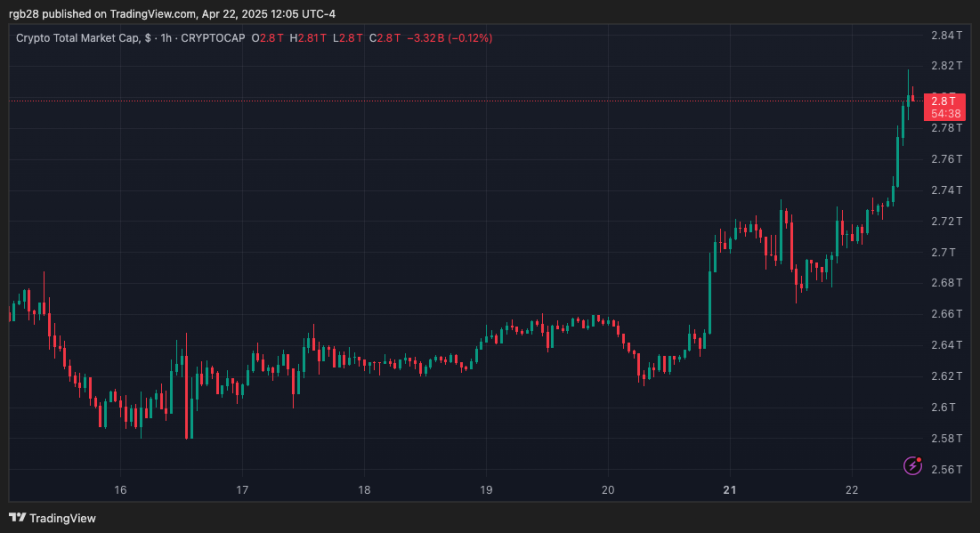
coinbase, TOTAL

Total crypto market capitalization is at $2.8 trillion in the one-week chart. Source: TOTAL on TradingView
Featured Image from Unsplash.com, Chart from TradingView.com
Editorial Process for bitcoinist is centered on delivering thoroughly researched, accurate, and unbiased content. We uphold strict sourcing standards, and each page undergoes diligent review by our team of top technology experts and seasoned editors. This process ensures the integrity, relevance, and value of our content for our readers.

Rubmar is a crypto enthusiast who likes learning and improving constantly. She enjoys reporting on the latest news and developments in the crypto industry. Rubmar also enjoys scrapbooking, crafting, simulation games, and watching football.

İlgili Okumalar

Former Huawei 'Genius Teen' Who Questioned DeepSeek Interview Lands in 'Crossfire' from Web3 Investor

Former Huawei "Genius Youth" Li Bojie recently drew public attention by criticizing his interview experience with DeepSeek. The controversy escalated when Du Jun, co-founder of Web3 investment firm ABCDE Capital, publicly accused Li of being "the founder with the least sense of contractual spirit" he had ever cooperated with, sparking a dispute over Li's startup project, Metagent. Li detailed a frustrating DeepSeek interview where he was accused of potential plagiarism, leading him to end the session. The spotlight then shifted to his venture, Metagent, a Web3+AI project aiming to tokenize AI agents. ABCDE invested $1.5 million, with an initial $500k disbursed. Du Jun claimed the project's progress was severely lacking, with a poor-quality demo and minimal social media activity. He alleged Li stopped communicating, deleted his Telegram, and failed to provide proper financial reporting. In response, Li argued the remaining $1 million was never received, crippling operations and forcing salary cuts. He stated he left Metagent in October 2024 due to family reasons and Web3 compliance concerns, with board approval. He claimed to have fulfilled disclosure duties and that his subsequent projects avoided conflicting fields. Other investors, including ArkStream Capital, shared negative due diligence experiences, citing unprofessional contracts and evasive answers on tokenomics. Metagent's social media went silent in June 2024, effectively stalling. Li has since moved to a new consumer AI agent platform, Pine AI (formerly Logenic AI), which has raised $25 million in Series A funding. He served as its Chief Scientist but recently left, clarifying he was not the founder and departed due to a shift in research interests.

Foresight News16 dk önce

Former Huawei 'Genius Teen' Who Questioned DeepSeek Interview Lands in 'Crossfire' from Web3 Investor

Foresight News16 dk önce

SemiAnalysis: Anthropic's Q3 Profit to Exceed $1 Billion

Research firm SemiAnalysis reveals that Anthropic is reshaping the AI commercialization landscape with profitability and growth rates far exceeding competitors. Leveraging a high-margin, API-centric business model, Anthropic has become a leader in the B2B AI market. The report projects that Anthropic will achieve a GAAP EBIT of $1 billion in Q3 2026, with a 6% margin. Its Annual Recurring Revenue (ARR) has surged from $9 billion at the end of 2025 to over $60 billion currently. If it maintains a Net New ARR (NNARR) of approximately $15 billion per month, its ARR could reach $300 billion by the end of 2027, implying a $6 trillion enterprise value and making it the world's most valuable company. Anthropic secretly filed for an IPO on June 1st. SemiAnalysis argues the timing is strategically urgent due to narrowing capital market windows as rivals like Alphabet and Meta secure major funding. The superior financials and business model suggest Anthropic should go public before OpenAI to seize the competitive initiative. The performance inflection stems from the explosive adoption of Claude Code, which now accounts for over 7% of all GitHub commits, driving monthly NNARR from $3 billion in January to $11 billion in March. Anthropic's revenue structure differs significantly from OpenAI's. Approximately 75-85% of Anthropic's ARR comes from usage-based API fees, with consumer subscriptions constituting only about 5%. In contrast, over 65% of OpenAI's Q1 2026 revenue was from subscriptions, with ~40% from consumers. The API model's key advantage is no per-user revenue cap, enabling growth within existing accounts. Anthropic's Net Revenue Retention (NRR) is an extraordinary 500%. This drives superior gross margins, now in the mid-60% range versus -94% in 2024, with API margins exceeding 80%. Core drivers are improved inference efficiency and a largely enterprise-focused model without the cost of serving hundreds of millions of free users. The report introduces "EBTIT" (Earnings Before Training & Interest & Taxes) to measure re-investment capacity, projecting Anthropic's cumulative EBTIT through 2028 will be $250 billion higher than OpenAI's. Over 65% of lab ARR currently comes from programming use cases. Cybersecurity is seen as the next major vertical, with upcoming model releases like Fable expected to further increase token pricing and expand NNARR. Indirect sales via hyperscaler platforms (AWS Bedrock, Azure Foundry) now account for 15-20% of ARR. A core constraint is compute supply. By 2030, combined unconstrained compute demand from Anthropic and OpenAI could exceed 100 GW, far outstripping projected new capacity. IPO proceeds are seen as crucial to lock in future compute resources. Key risks include potential price cuts by OpenAI, competitive pressure from Google DeepMind and Meta in coding models, potential government restrictions on frontier model releases, and margin dilution from growing indirect "Token-as-a-Service" sales. Regulatory actions that narrow the capability gap between open-source and proprietary models are highlighted as a fundamental threat to Anthropic's moat.

marsbit28 dk önce

SemiAnalysis: Anthropic's Q3 Profit to Exceed $1 Billion

marsbit28 dk önce

İşlemler

Spot
活动图片