CryptoQuant предупреждает: перемещение 170 000 биткоинов предвещает всплеск волатильности

cryptonews.ru2025-01-18 tarihinde yayınlandı2025-04-18 tarihinde güncellendi

Движение крупного объема криптовалюты на блокчейне указывает на приближающиеся резкие колебания курса — и эти колебания могут оказаться весьма существенными. 18 апреля аналитическая платформа CryptoQuant выразила уверенность, что период затишья на рынке биткоина вот-вот завершится.

Краткосрочные держатели выходят на сцену

Последние данные показывают, что 170 000 биткоинов, принадлежащих инвесторам, купившим криптовалюту 3-6 месяцев назад, начали активно перемещаться по сети. «Крупные перемещения в этой группе часто сигнализируют о неизбежной значительной волатильности», — отметил аналитик CryptoQuant Mignolet.

И это не просто слова — график показывает влияние подобных событий в прошлом, причем нынешний всплеск активности оказался самым масштабным по объему с конца 2021 года. Интересно, что направление цены после таких всплесков варьируется: история демонстрирует как взлеты, так и падения рынка.
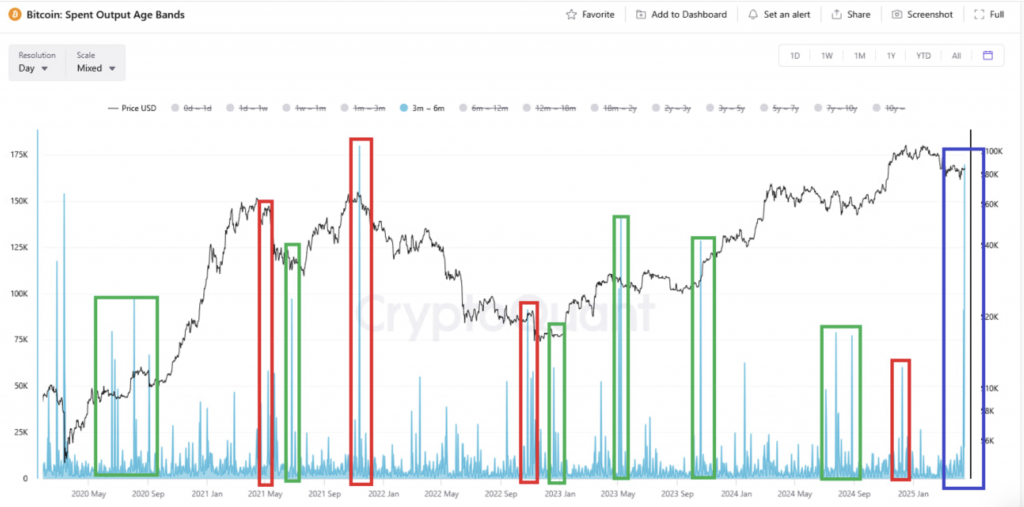
Движения биткоина в группе 3-6-месячных ходлеров. Источник: CryptoQuant

«Волатильность приближается», — подытожил Mignolet, не оставляя сомнений в своих прогнозах.

Паника среди новичков

Недавнее снижение цены биткоина уже вызвало волны панических продаж среди краткосрочных держателей — инвесторов, купивших криптовалюту менее шести месяцев назад. Эта группа традиционно более чувствительна к резким рыночным движениям и сменам настроений.

Согласно данным CryptoQuant, именно краткосрочные держатели стали основным источником нынешнего давления продаж:

  • Краткосрочные держатели отправляют в среднем около 930 биткоинов в день на биржи
  • Для сравнения, долгосрочные инвесторы перемещают только около 529 биткоинов ежедневно

Другой аналитик CryptoQuant, Crazzyblockk, назвал происходящее «классическим вытряхиванием» краткосрочников с рынка, отметив при этом, что опасения о массовом бегстве инвесторов беспочвенны.

«При боковом движении биткоина и снижении волатильности этот анализ по группам помогает понять, что текущая коррекция — не массовый исход умных денег, а скорее реакция нервных краткосрочных и среднесрочных держателей», — пояснил эксперт.


İlgili Okumalar

Q2 Crypto Market Review: Did Bitcoin Rise for 'Nothing'? Did Money Flow to AI and On-Chain?

Q2 2026 Crypto Market Recap: Bitcoin's Gains Erased Amid Shift to AI and On-Chain Activity The second quarter of 2026 saw a significant reversal for the cryptocurrency market. Bitcoin gave back all its April gains, ending Q2 down approximately 11%, while major stock indices posted strong gains. This divergence was driven by a hawkish shift in Fed rate expectations, capital rotation into AI stocks, and weakening liquidity channels into crypto. Key demand pillars deteriorated simultaneously. Spot Bitcoin ETFs recorded net outflows of $4.08 billion for the quarter, with outflows dominating June. Crypto treasury entity Strategy's bitcoin accumulation slowed markedly, and the total stablecoin market cap contracted by ~$4.2 billion. This created a tighter liquidity environment. Exchange data reflected the downturn. Spot trading volumes fell 28% quarter-over-quarter. The market underwent significant deleveraging, with $8.35 billion in long liquidations for BTC and ETH, primarily in late May/early June. Open interest and order book liquidity also declined. Despite the bearish price action, structural developments point to an expanding on-chain ecosystem. These include the rise of tokenized stocks with full legal rights, the growth of RWA (real-world asset) perpetual contracts for trading stocks and commodities 24/7, and the use of crypto markets for price discovery ahead of major events like the SpaceX IPO. On-chain vaults are also emerging as a core layer for institutional capital allocation.

Foresight News18 dk önce

Q2 Crypto Market Review: Did Bitcoin Rise for 'Nothing'? Did Money Flow to AI and On-Chain?

Foresight News18 dk önce

Xing Bo Strikes Again: Last Time 'Critiquing' World Models, This Time It's Agents' Turn

Xing Bo, President of MBZUAI and professor at Carnegie Mellon University, along with co-authors Mingkai Deng and Jinyu Hou, has released a new paper, "Critique of Agent Model," critiquing the current state of artificial intelligence agents. The paper draws a crucial distinction between "agentic" systems, which rely on external toolchains, prompts, and workflows, and truly "agentive" systems capable of genuine autonomy driven by internal decision-making structures. To illustrate this, it references a real-world incident where an AI programming assistant, following an external prompt but lacking internalized judgment, caused a catastrophic data deletion. The authors propose a detailed analysis and a new framework, "Goal-Identity-Configurator" (GIC), for building truly autonomous agents. This framework systematically addresses five key dimensions where current "Agent" designs fall short: 1. **Goal:** Moving from step-by-step human instruction to a system capable of autonomously decomposing a single long-term goal and adapting sub-goals based on new information. 2. **Identity:** Evolving self-assessment updated by experience, rather than a static description in a system prompt. 3. **Decision Making:** Replacing textual Chain-of-Thought reasoning with "simulative reasoning" that uses a dedicated world model to predict real-world consequences before selecting actions. 4. **Cognitive Control:** Introducing a separate "System III" metacognitive module that dynamically decides when to deliberate, stick to a plan, or act quickly. 5. **Learning:** Enabling "continual autonomous learning," where the agent itself decides when to act, practice in simulation, or update its world model and self-perception. The GIC architecture integrates six components—a belief encoder, goal decomposer, identity evolver, configurator (System III), simulation-based planner (System II), and executor (System I)—to embody these principles. The paper argues that a growth path akin to pilot training (ground theory, simulator practice, real deployment) should be underpinned by a unified cognitive architecture, not separate workflows. On safety, the authors contend that the GIC framework's modular, explicit design enhances inspectability, allowing problematic behavior to be traced to specific components (e.g., flawed goal or poorly trained module) rather than emerging opaquely. However, they acknowledge that ultimate safety depends on correctly training these modules in the first place. In conclusion, the paper challenges the loose application of the term "Agent," asserting that task completion alone does not equal true autonomy. True autonomy requires goals, identity, and judgment to be genuinely internalized within the agent's architecture, not merely enforced by external scripts.

marsbit59 dk önce

Xing Bo Strikes Again: Last Time 'Critiquing' World Models, This Time It's Agents' Turn

marsbit59 dk önce

How Collector Crypt Uses 'Recirculating Buybacks' to Create an Illusion of Growth

Title: How Collector Crypt Creates a Growth Illusion with "Buyback Loops" Key Findings: Collector Crypt's (CC) net take rate has halved from 11.2% in Q3 2025 to 5.6% in Q2 2026, while GMV grew 4.7x. This growth is driven by higher-tier card packs ($250, $1,000, $2,500) which have lower platform dollar retention rates. The newly launched $2,500 Mythic tier captured 36.7% of June GMV within 13 days. Growth is fueled by a small cohort of high-spending, high-frequency wallets rather than broad user base expansion. The economic model faces pressure from three key areas: 1) **Shifting GMV Mix**: Pushing users towards larger, lower-retention card packs increases GMV but reduces overall profitability. 2) **Physical Redemptions**: Card redemptions for physical items remove reusable inventory from the system, creating costly replenishment needs. In May, redemptions consumed 41.6% of pre-redemption net income. Only 75 wallets drove redemptions in June. 3) **B2B/API Strategy**: Partner revenue remains negligible (cumulatively $1.83M) and dependent on CC for inventory, vaulting, and buyback services, failing to create a scalable, asset-light recurring revenue stream. The core product is a repetitive pack-buyback loop with limited secondary market activity and token value accrual. Sensitive modeling shows CC's economics turn negative when any two of the following pressures coincide: replenishment costs near market price, redemption rates exceeding 9%, or high-tier buyback rates around 93%. While CC operates in a large and growing collectibles market, its current growth levers—bigger packs, high buyback rates, and capital recycling by a few wallets—create a volume illusion without demonstrating sustainable collector engagement, deep secondary markets, or a viable path to improved margins. Future proof points include broadening collector participation, deepening secondary trading, and developing true asset-light B2B revenue channels.

Foresight News1 saat önce

How Collector Crypt Uses 'Recirculating Buybacks' to Create an Illusion of Growth

Foresight News1 saat önce

İşlemler

Spot
活动图片