Криптопроект Трампа в убытке на $145 млн от покупки токенов. Почему так

RBK-crypto2025-04-14 tarihinde yayınlandı2025-04-14 tarihinde güncellendi

Несмотря на бумажные убытки, World Liberty Financial докупил новую партию токенов SEI

«РБК-Крипто» не дает инвестиционных советов, материал опубликован исключительно в ознакомительных целях. Криптовалюта — это волатильный актив, который может привести к финансовым убыткам.

Убытки криптопроекта семьи Трампов World Liberty Financial (WLFI) от вложений в криптовалюты достигли $145 млн. В общей сложности стартап потратил около $350 млн на токены, которые сейчас оцениваются примерно в $200 млн, согласно информации собранной криптоаналитиком Lookonchain.
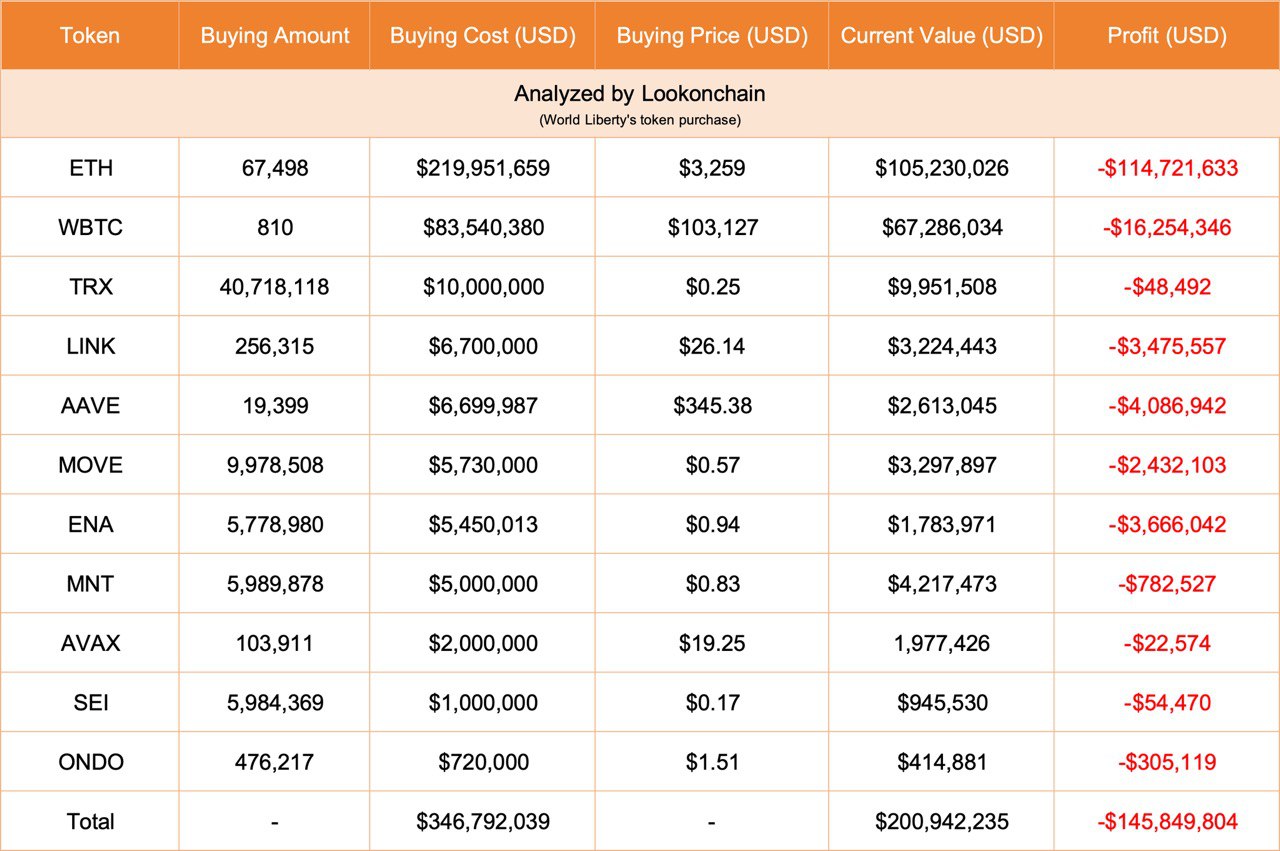
Инвестиции WLFI. Данные на 12 апреля 2025 года. Источник: Lookonchain

В документах на сайте World Liberty Financial президент США Дональд Трамп указан как «главный правозащитник» проекта. Его сыновья Эрик и Дональд Трамп-младший являются «амбассадорами web3», а Бэррон носит титул «DeFi-визионера».

Проект инвестировал в Ethereum (ETH), Tron (TRX), Chainlink (LINK), Aave (AAVE), Ethena (ENA), Movement (MOVE), Sei (SEI), Ondo (ONDO), Mantle (MNT), Avalanche (AVAX) и «обернутый» биткоин WBTC. Последним приобретением стала новая партия криптовалюты Sei (SEI). В прошедшие выходные WLFI потратил около $775 тыс. на покупку 4,89 млн SEI, по данным Arkham Intelligence.

Телеграм-канал «РБК-Крипто» — подпишитесь и будьте в курсе самых главных и актуальных новостей о криптовалюте.

Присоединяйтесь к форуму «РБК-Крипто» в Telegram для обсуждения новостей и тенденций криптомира.

Sei Network — блокчейн 1 уровня, на его платформе разработчики создают приложения для криптовалютной торговли. Команда проекта состоит из бывших сотрудников Goldman Sachs, Databricks, Robinhood, Google и Nvidia. В августе 2023 года проект запустил токен SEI, объем торгов которым в первые сутки превысил $1,6 млрд, обогнав по этому показателю такие крупные монеты как XRP от Ripple, BNB или Dogecoin.

По данным на 14 апреля, капитализация SEI составляет $883 млн, она занимает 67 место в списке криптовалют по этому показателю. Максимум монета достигла в марте 2024 года на отметке в $1,14. Сейчас SEI торгуется около $0,18 — на 84% ниже рекорда. Всего на кошельках WLFI хранится около 5,9 млн SEI.

Из-за просадки курса токенов после покупок, «бумажный» (нереализованный) убыток проекта составляет порядка $145,8 млн, по данным на 12 апреля. Самый убыточный актив — ETH. В феврале Эрик Трамп называл курс «эфира» по $2,8 тыс. — «отличной точкой входа», с тех пор за два месяца цена альткоина упала до двухлетних минимумов около $1,5 тыс.

Поддержку криптовалют Эрик объясняет тем, что ранее на семью Трампов было оказано политическое давление через закрытие счетов в традиционных банках. Тогда он понял, что криптовалюты быстрее, дешевле, прозрачнее, и «тебя не могут в них «отменить», говорит Трамп.

Все существующие и планируемые криптовалютные ETF. Полный список

Цена криптовалюты OM потеряла более 90% за два часа. Что известно

Курс биткоина попытался преодолеть $85 тыс. Что случилось на крипторынке

İlgili Okumalar

Chip Stocks Lead U.S. Market Decline: Is AI Trading Being Hit by Both Interest Rates and Returns?

Chip stocks led a broad decline in US markets, with the Nasdaq dropping 2.2% and the S&P 500 falling 1.4%. This selloff reflects a dual challenge for the once-high-flying AI hardware trade: rising interest rate expectations and growing investor impatience for clear returns from massive AI capital expenditures. The pressure was most acute on hardware leaders. Nvidia fell about 4%, dipping below a $5 trillion market cap, while Micron plunged 13.2% ahead of its earnings report. Declines across memory, storage, AI, and mobile chips indicated a sector-wide retreat. The selloff spread globally, with South Korea's KOSPI index dropping nearly 10% as key suppliers SK Hynix and Samsung recorded double-digit losses. Investors appeared to be taking profits from the most crowded trades first. Macro headwinds intensified as market expectations shifted toward a more aggressive Federal Reserve. Forecasts for multiple rate hikes in 2026 pressured high-valuation tech stocks, which rely on long-term growth projections that become less attractive as discount rates rise. Concurrently, investors are scrutinizing the profit potential of the immense AI spending by cloud giants like Alphabet, Amazon, and Meta. While these expenditures drive demand for chips and hardware, the market is now questioning whether AI services will generate sufficient returns to justify the ongoing costs. This adjustment is not necessarily a bubble burst but a recalibration. AI demand fundamentals remain, but the narrative of endless growth can no longer fully offset concerns over higher interest rates and a longer path to profitability. Near-term direction may hinge on Micron's upcoming earnings guidance and incoming inflation data, which will influence both the AI demand outlook and the Fed's policy path. The market is transitioning from blindly buying growth to demanding clearer visibility on returns.

marsbit58 dk önce

Chip Stocks Lead U.S. Market Decline: Is AI Trading Being Hit by Both Interest Rates and Returns?

marsbit58 dk önce

OpenAI's New Paper: How to Train an AI that "Doesn't Deteriorate Under Pressure"?

OpenAI's new paper "Reinforcement Learning Towards Broadly and Persistently Beneficial Models" explores training AI to maintain safe, helpful, and honest behavior even under pressure, in unseen scenarios, or after being fine-tuned for harmful purposes. Moving beyond simple rule-based "don'ts," the research focuses on cultivating "beneficial traits" like honesty, risk-awareness, corrigibility, and transparency. It investigates if reinforcement learning (RL), often prone to "reward hacking" where models exploit loopholes, can instead be used to instill robust, generalized positive behaviors. Researchers created a multi-domain synthetic dialogue dataset covering areas like healthcare and law. They trained a model by replacing 5% of standard RL data with "beneficial trait" data. This model outperformed the baseline in 83% of 53 evaluations, showing average gains of 9.1% in alignment, safety, and helpfulness. Crucially, improvements generalized: a model trained only on healthcare "good behavior" data also performed better in 17 out of 19 non-healthcare alignment tests. The paper also tests "alignment persistence." When subjected to adversarial prompts or harmful fine-tuning, the beneficial trait model showed greater resilience, with smaller performance drops and less "spillover" of bad behavior to unrelated tasks. While not a complete solution, this work suggests a shift from post-hoc correction to proactively shaping robust, principled AI behavior, a critical step for deploying models in high-stakes, complex decision-making scenarios.

marsbit1 saat önce

OpenAI's New Paper: How to Train an AI that "Doesn't Deteriorate Under Pressure"?

marsbit1 saat önce

Semiconductor Stock Rebound: Is the Technical Correction Over or a Trend Reversal?

The core of recent semiconductor stock volatility is not about daily price swings, but rather the market questioning whether AI-driven semiconductor pricing has entered a new phase. Following a sharp sell-off in Korean stocks on June 23rd, led by Samsung and SK Hynix, a subsequent rebound is seen more as a technical positioning adjustment rather than a confirmed trend reversal. The key variable is HBM (High Bandwidth Memory), essential for AI chips. Its supply-demand imbalance granted memory makers significant pricing power. The current market focus is on whether this dynamic remains strong enough to justify elevated valuations. All eyes are on Micron's upcoming earnings report. The critical factor is not whether results meet already high expectations, but whether the company's guidance confirms that AI memory pricing power, order visibility, and future margins are still expanding. Micron's outlook will serve as a crucial test for the broader AI semiconductor chain, including Samsung, SK Hynix, and other infrastructure players. The recent bounce appears to be a pre-earnings positioning repair. For it to evolve into a sustained uptrend, concrete evidence is needed that the AI infrastructure expansion cycle's fundamentals—particularly for high-end memory—remain robust and can continue to surpass elevated market expectations. The risk is that strong demand alone may not be sufficient if future guidance hints at peaking momentum or increasing supply-side pressures.

marsbit1 saat önce

Semiconductor Stock Rebound: Is the Technical Correction Over or a Trend Reversal?

marsbit1 saat önce

İşlemler

Spot
Futures
活动图片