Dogecoin’s Wyckoff Accumulation Schematic Points To Surge To This Crucial Level

bitcoinist2025-04-13 tarihinde yayınlandı2025-04-14 tarihinde güncellendi

Özet

Crypto analyst Bitcoin Sensus has revealed a technical pattern that is playing out for the Dogecoin price. Based on this...

Trusted Editorial content, reviewed by leading industry experts and seasoned editors. Ad Disclosure

Crypto analyst Bitcoin Sensus has revealed a technical pattern that is playing out for the Dogecoin price. Based on this pattern, the analyst suggested that the foremost meme coin could soon witness a surge to this crucial level. 

Wyckoff Accumulation Schematic Points To Bullish Reversal

In an X post, Bitcoin Sensus stated that a Wyckoff Accumulation Schematic is playing out for Dogecoin on a four-hour timeframe. He explained that this is a healthy bottom formation for DOGE to be able to sustain a healthy uptrend in the coming months. His accompanying chart showed that the foremost meme coin could rally to as high as $0.24 in the short term. 
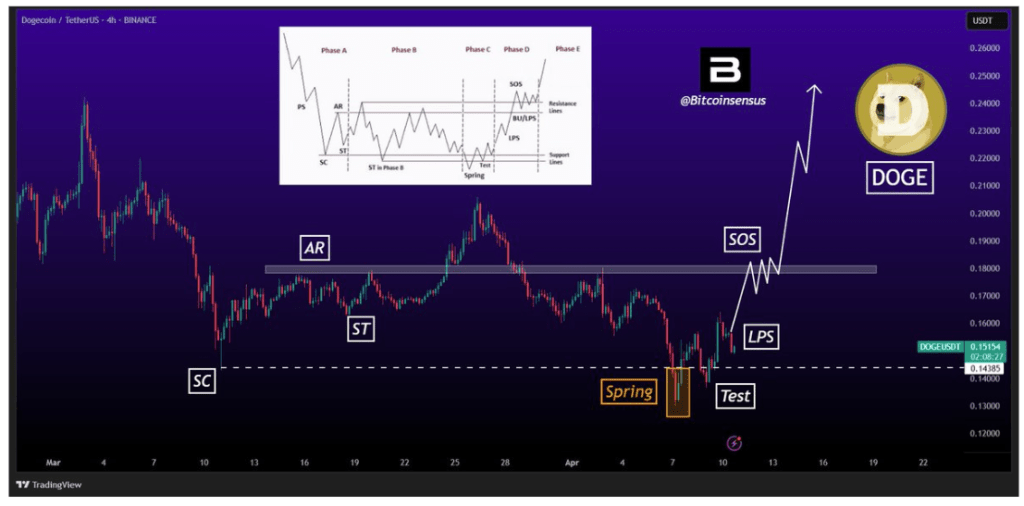
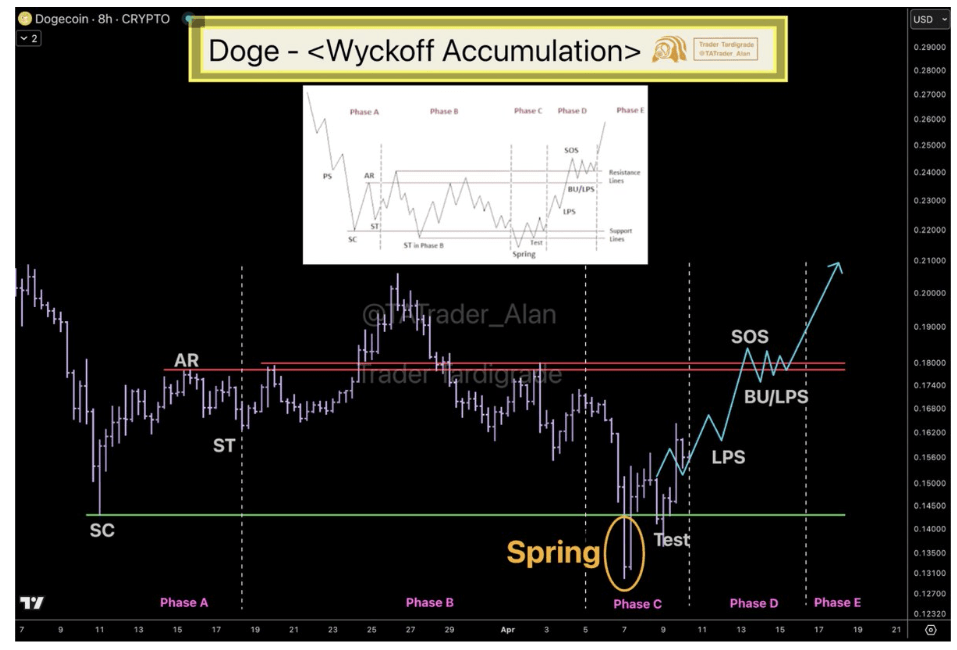
The chart also showed that the crash to $0.14 was likely the bottom for Dogecoin. Crypto analyst Trader Tardigrade also alluded to the Wyckoff Accumulation pattern, suggesting that the bottom was in for DOGE. He stated that this pattern is playing out as predicted, noting that a perfect test was completed. The analyst added that Dogecoin will find LBS soon, and the next will be SOS and BU, which will lead to phase E. His chart showed that the meme coin will break above $0.21 on phase E. 
In another X post, Trader Tardigrade again suggested that Dogecoin has found its bottom. He stated that the foremost meme coin has successfully reclaimed its previous breakdown, marking the first time since the downtrend began in January 2025. The analyst remarked that this price action suggests that DOGE is gaining strength and may have already reached its bottom. 
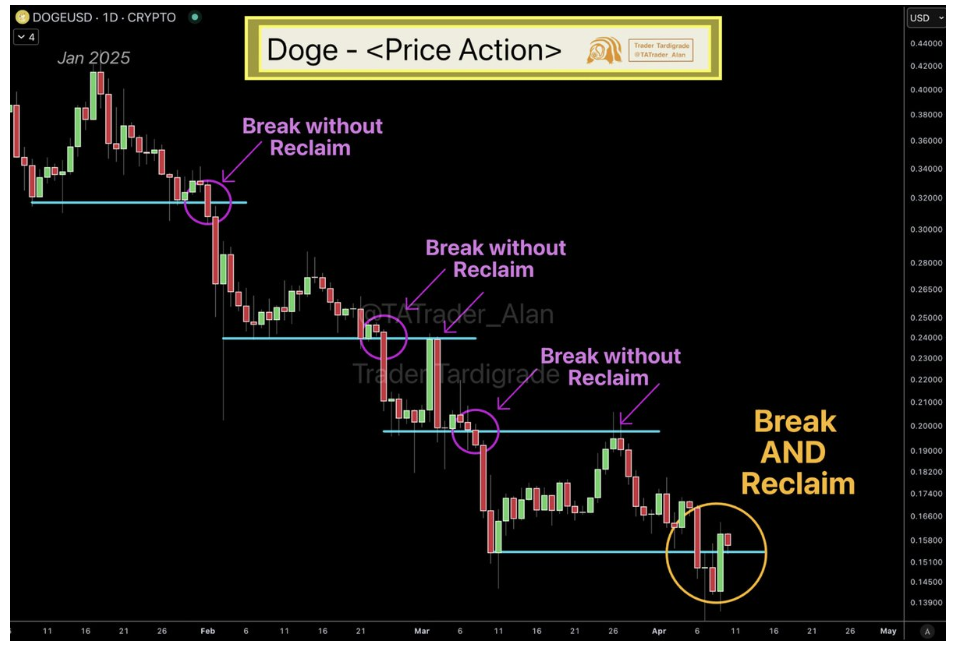
With Dogecoin finding its bottom, the meme coin could soon break above the psychological $0.2 level, paving the way for a rally to new highs. The Bitcoin price is also rebounding, which could spark this surge for DOGE if BTC maintains its bullish momentum. 

DOGE is currently trading at $0.16. Chart: TradingView

Dogecoin Chart Is ‘Beautiful’

Crypto analyst Master Kenobi asserted that Dogecoin’s chart is a “beautiful” thing. He remarked that events seem to be orchestrated long before they unfold, hinting at a bullish reversal for the foremost meme coin. His accompanying chart also showed that DOGE was looking to rebound and could rally to the much-anticipated $1 price level if it touches the upper boundary of an ascending channel. 


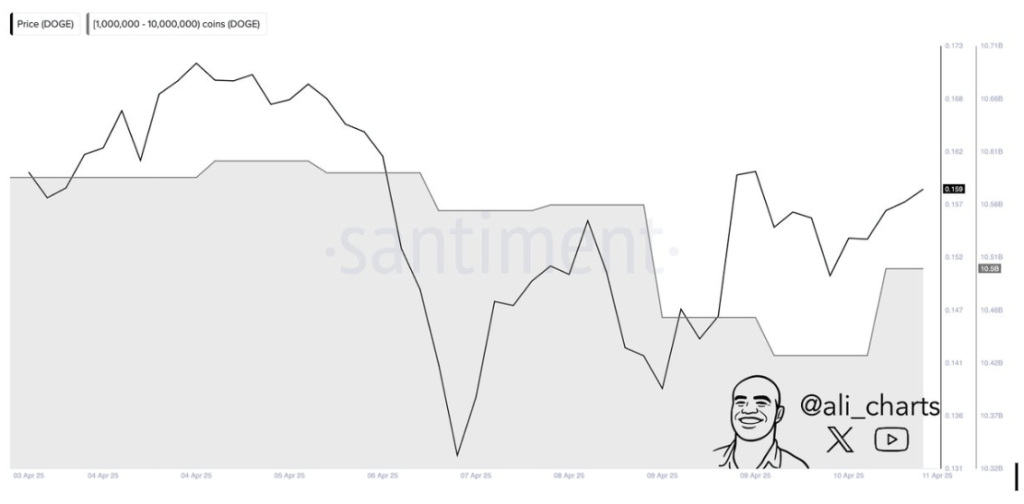
Ahead of this Dogecoin price rebound, DOGE whales are actively accumulating, which is a positive for the foremost meme coin. Crypto analyst Ali Martinez revealed that these whales have bought over 80 million DOGE in the last 24 hours. Whale accumulations like these are known to usually precede a price reversal, suggesting that the meme coin could soon rally. 
At the time of writing, the Dogecoin price is trading at around $0.16, up over 3% in the last 24 hours, according to data from CoinMarketCap.

Featured image from Business Insider, chart from TradingView

Editorial Process for bitcoinist is centered on delivering thoroughly researched, accurate, and unbiased content. We uphold strict sourcing standards, and each page undergoes diligent review by our team of top technology experts and seasoned editors. This process ensures the integrity, relevance, and value of our content for our readers.

Scott Matherson is a leading crypto writer at Bitcoinist, who possesses a sharp analytical mind and a deep understanding of the digital currency landscape. Scott has earned a reputation for delivering thought-provoking and well-researched articles that resonate with both newcomers and seasoned crypto enthusiasts. Outside of his writing, Scott is passionate about promoting crypto literacy and often works to educate the public on the potential of blockchain.

İlgili Okumalar

Examining the Open USD Partner Lineup: Follow Who's Joining to See Where the Money Flows

**Title: Deciphering the Open USD Partner Roster: Following the Money** The launch of Open USD is notable less for the stablecoin itself and more for its expansive list of over 140 founding partners, which reads like a "who's who" of global finance and tech. This coalition, including asset managers like BlackRock, card networks Visa and Mastercard, banks (BNY Mellon, Standard Chartered, etc.), tech giants (Google, IBM), merchants (Shopify), and crypto firms (Coinbase, Ripple, Aave, MetaMask), signals a strategic shift. The diverse membership reveals that stablecoins are increasingly viewed not as products to compete over, but as shared infrastructure too critical to be left to any single entity. Each partner category has distinct motives. Asset managers like BlackRock seek to manage the large, sticky cash reserves, a lucrative fee-generating opportunity. Merchants like Shopify aim for lower-cost settlement and potential yield on balances. Banks join defensively to retain custody and settlement roles, fearing deposit outflows to stablecoins. Tech companies bet on programmable money for future machine-to-machine commerce. Crypto firms gain mainstream legitimacy and distribution channels. Remarkably, the consortium includes direct competitors (Visa vs. Mastercard, Coinbase vs. Ripple), indicating that the fear of exclusion from this emerging financial layer outweighs competitive rivalries. However, this shared governance could also lead to slow decision-making. The roster's composition is the real message: it represents a collective bet that a widely accepted, consortium-owned stablecoin is preferable to proprietary versions or having none at all. For incumbents like Circle and Tether, this alliance poses a significant threat, as potential clients have collectively chosen to build their own alternative. The absence of major U.S. retail banks (busy with their own tokenized deposit networks) is equally telling. In essence, the partner list maps where the industry believes value and risk will flow in a tokenized dollar future, marking stablecoin's evolution from a product to a utility.

Foresight News12 dk önce

Examining the Open USD Partner Lineup: Follow Who's Joining to See Where the Money Flows

Foresight News12 dk önce

IOSG: Q-Day Countdown, Will Quantum Computing End Cryptocurrency?

IOSG: The Q-Day Countdown – Will Quantum Computing End Cryptocurrency? This analysis explores the looming threat quantum computing poses to blockchain technology. Quantum computers, leveraging Shor's algorithm, could theoretically break the elliptic curve cryptography (ECC) underpinning cryptocurrencies like Bitcoin and Ethereum. The article outlines a hypothetical "Q-Day" scenario where exposed public keys from dormant assets are compromised, leading to fund theft and a deep governance crisis. The core risk is not the complete erasure of blockchains but a systemic reset of public-key cryptography. Bitcoin faces significant challenges due to its "code-is-law" ethos and the immense social consensus required for migration. Its primary vulnerability lies in legacy UTXOs with publicly exposed keys. Ethereum's path involves a more complex, full-stack cryptographic agility upgrade across execution, consensus, and data layers. The industry has a limited "engineering comfort window" of 5-8 years to coordinate a migration to post-quantum cryptography (PQC), such as lattice-based or hash-based signatures. While the existential threat is often overstated, the real bottleneck is the immense coordination required across protocol developers, node operators, wallet providers, exchanges, and custodians. Market repricing of crypto assets may occur well before an actual Q-Day if quantum hardware roadmaps accelerate or regulatory pressure mounts. The article concludes that quantum computing is not a doomsday weapon but a severe stress test for blockchain's foundational security model and governance structures.

marsbit41 dk önce

IOSG: Q-Day Countdown, Will Quantum Computing End Cryptocurrency?

marsbit41 dk önce

Why 2026 could redefine Ethereum, Solana, Base and Avalanche

Blockchain infrastructure is undergoing a major coordinated transformation, driven by institutional demand for reliability, compliance, and predictable settlement. Over $30 billion in Real-World Assets (RWA) on-chain has exposed network weaknesses. Major blockchains are responding with foundational upgrades, moving beyond incremental speed improvements. Ethereum's "Glamsterdam" upgrade, planned for H1 2026, will significantly increase gas limits and introduce features like PBS (pre-blocked state) for enhanced settlement and parallel execution. Solana's "Alpenglow," targeting a mainnet launch in H2 2026, focuses on reducing finality time dramatically and freeing network resources to improve reliability. Beyond speed, compliance is critical. Base's "Beryl" upgrade in Q3 2026 will introduce a standardized, regulatory-compliant token framework (B20). Avalanche's "Octane" upgrade aims to boost transaction processing and reduce costs for enterprise applications. Even Bitcoin is evolving with the potential activation of OP_CAT by late 2026/early 2027. The competition is shifting. While technical upgrades are widespread, institutions will ultimately allocate capital based on proven execution, operational resilience, and regulatory compatibility during market stress. Ethereum currently leads in tokenized assets, while networks like Base and Solana are strengthening their institutional offerings. The blockchain that best delivers reliable, compliant, and uninterrupted service is poised to attract the greatest share of future institutional capital.

ambcrypto1 saat önce

Why 2026 could redefine Ethereum, Solana, Base and Avalanche

ambcrypto1 saat önce

İşlemler

Spot
活动图片