65% Of All Shiba Inu Holders Now Underwater As Profitability Drops To 2024 Levels

bitcoinist2025-04-09 tarihinde yayınlandı2025-04-09 tarihinde güncellendi

Özet

Shiba Inu investors continue to endure major losses as the SHIB price remains 87% below its all-time high price reached...

Trusted Editorial content, reviewed by leading industry experts and seasoned editors. Ad Disclosure

Shiba Inu investors continue to endure major losses as the SHIB price remains 87% below its all-time high price reached back in 2021. Multiple price crashes over the last few have left the majority of investors in the red with profitability dropping to early 2024 levels once again.

65% Of Shiba Inu Investors Suffer Losses

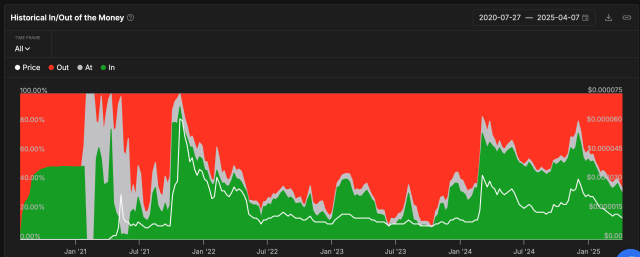
In the last year alone, the Shiba Inu price has declined by more than 60% to eliminate most of the recovery from 2023-2024. As a result, investors have been nursing losses, with over 65% of investors seeing losses already. In contrast, 32% are seeing some profit, while 3% are struggling at breakeven prices.

IntoTheBlock’s data shows that at the current price, only 98.2 trillion SHIB, worth $1.12 billion bought by investors is seeing any profit. This is in comparison to the 878.5 trillion SHIB, worth $9.99 billion, that are current nursing losses. Lastly, the amount of SHIB sitting at breakeven is only 8.14 trillion SHIB, worth $92.59 million.

Historically, the profitability has fluctuated wildly as bull and bear markets have come and gone. After the 2021 bear market which saw the highest levels of profitability in October, SHIB holders have had a hard time keeping up profitability. Throughout 2022 and 2023, profitability remained low, well into 2024 before a turn in the market.
Shiba Inu profitability
Source: IntoTheBlock

By December 2024, profitability reached over 72% again as the Shiba Inu price looked like it was surging toward new all-time highs. However, 2025 has come with a different narrative with profitability tanking once again. Currently, in April 2025, profitability is now sitting at levels not seen since February 2024.

When it comes to the bullish versus bearish narrative, the bulls continue to dominate despite the sell-offs. Expectations remain that the Shiba Inu price would bottom soon and that a rally would follow shortly after.

Why A SHIB Price Recovery Could Happen

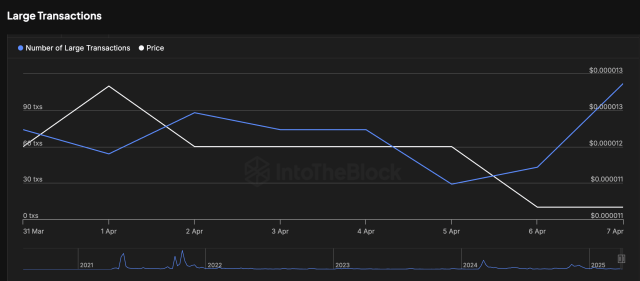
Large Shiba Inu transactions have seen a spike in the last few days amid the market downturn. According to IntoTheBlock, large transaction volumes rose over 100% between Sunday and Monday, and have continued to rise.
Shiba Inu whales
Source: IntoTheBlock

On the one hand, this could suggest that whales were part of the selling spree that contributed to the SHIB price crash. However, it could also mean that interest is returning for the meme coin, and if this participation turns into buying pressure, then it could lead to a recovery for SHIB.

Shiba Inu price chart from TradingView.com
Bears maintain control of price | Source: SHIBUSDT on TradingView.com

Featured image from Dall-E, Chart from TradingView.com

Editorial Process for bitcoinist is centered on delivering thoroughly researched, accurate, and unbiased content. We uphold strict sourcing standards, and each page undergoes diligent review by our team of top technology experts and seasoned editors. This process ensures the integrity, relevance, and value of our content for our readers.

Scott Matherson is a leading crypto writer at Bitcoinist, who possesses a sharp analytical mind and a deep understanding of the digital currency landscape. Scott has earned a reputation for delivering thought-provoking and well-researched articles that resonate with both newcomers and seasoned crypto enthusiasts. Outside of his writing, Scott is passionate about promoting crypto literacy and often works to educate the public on the potential of blockchain.

İlgili Okumalar

Morning News | Coinbase Partners with Standard Chartered to Expand Multi-Currency Fiat Channels; Sharplink and Forward to be Included in Russell Indices; JPMorgan May Issue Stablecoin in the Future

Daily Crypto Recap: Key Developments Institutional adoption continues: Coinbase partners with Standard Chartered to expand multi-currency fiat rails for institutions via Coinbase Prime, supporting AUD, SGD, CAD, CHF, EUR, and GBP. Meanwhile, Sharplink and Forward Industries, companies holding significant ETH and SOL reserves respectively, are set to be included in the Russell indexes, providing indirect crypto exposure to traditional index investors. Regulatory and compliance moves are in focus. Hong Kong's monetary authority announced new measures for investment accounts of mainland Chinese investors, including retroactive document checks to January 2023. Prediction market Polymarket is considering implementing KYC requirements to address sanctions and legal risks. Major financial players signal deeper involvement. JPMorgan Chase CEO Jamie Dimon suggested the bank might issue a stablecoin in the future. Concurrently, Falcon Finance and Anchorage Digital launched fUSD, a compliant, institution-focused stablecoin. Market sentiment presents a mixed picture. Bitmine's Tom Lee predicts an incoming crypto "supercycle," driven by Wall Street tokenization and AI agents, with Ethereum as a key beneficiary. However, a prominent trader cautions that the current period of investor losses may not be long enough to confirm a bear market bottom, and TD Cowen analysts note diminished chances for U.S. crypto market structure legislation this year due to a worsening political climate. Other notable news includes a16z crypto's observation that most tokenized assets are merely "digitized" and not actively used in DeFi, South Korea's crypto trading volume falling to about 8% of KOSPI's, and the Chinese Supreme Court stating it will research judicial rules for virtual currency cases.

链捕手59 dk önce

Morning News | Coinbase Partners with Standard Chartered to Expand Multi-Currency Fiat Channels; Sharplink and Forward to be Included in Russell Indices; JPMorgan May Issue Stablecoin in the Future

链捕手59 dk önce

Sitting on a Trillion-Dollar Market, Why Hasn't Real Estate Tokenization Taken Off?

For years, real estate tokenization has been hailed as a breakthrough technology poised to democratize property investment. In theory, it promises fractional ownership of premium assets, rapid transactions, and enhanced liquidity. Yet, in practice, it has failed to gain traction, accounting for less than 0.1% of the global real estate market. The core issue is not a lack of tokens, but the absence of a robust legal, operational, and compliant framework that grants them credibility as financial instruments. The industry initially erred by prioritizing technology over investor needs, creating products with unclear ownership and unreliable liquidity. Key infrastructure remains missing: legally sound ownership structures, compliant transfer mechanisms, professional servicing, and interoperability with traditional finance. This regulatory ambiguity and operational complexity deter institutional investors, who already have access to established, well-governed investment channels. A mature model would feature low minimum investments in institutional-grade assets, transparent rental income distribution, and genuine liquidity through regulated secondary markets. While regulatory progress in regions like the UAE and growth in other tokenized asset sectors (like treasuries) are positive signs, the focus must shift from issuing tokens to building foundational systems. The investment proposition of tokenized real estate is not to create new returns, but to improve access, efficiency, and liquidity for existing income-generating properties. For mainstream adoption, the sector must demonstrate tangible economic advantages over traditional models, not just technical novelty. The next phase depends on proving scalable, compliant operations with auditable track records. The barrier is no longer technology, but infrastructure and regulation. The vision remains unfulfilled until this gap is bridged.

marsbit1 saat önce

Sitting on a Trillion-Dollar Market, Why Hasn't Real Estate Tokenization Taken Off?

marsbit1 saat önce

Large Language Models Ace All Exams, Yet Move Farther from AGI: What Does This Paper Reveal?

The article discusses the ongoing challenge of defining and achieving Artificial General Intelligence (AGI). It notes that industry leaders have set vague, often profit- or time-based benchmarks for AGI, while the concept itself lacks a consensus definition—a situation the article compares to a "Rorschach test." It highlights a recent 2025 paper by researcher Michael Timothy Bennett, who proposes a new, measurable definition. Bennett frames AGI not as mimicking human performance on tests, which current large language models (LLMs) have already mastered, but as an "artificial scientist." A true AGI, according to this view, should be able to widely and efficiently adapt to new environments and tasks within real-world constraints (like computational and energy limits), focusing on the *discovery of new knowledge* rather than the replication of existing data. The author contrasts this with the current dominant approach of "scale-maxing"—massively scaling up data, parameters, and compute. While powerful, this method leads to models that fail on out-of-distribution problems and lack core intelligent abilities: they are passive learners, cannot reason causally, and cannot actively experiment or balance exploration with exploitation. The article argues that Bennett's framework offers a crucial shift. It makes AGI a quantifiable engineering problem and proposes new evaluation "adaptation benchmarks" that test an AI's ability to actively learn in novel scenarios. The conclusion is that achieving AGI will require a fundamental reset—a fusion of multiple methodologies beyond simple scaling, moving AI from mimicking patterns to embodying the scientific spirit of inquiry and discovery.

marsbit2 saat önce

Large Language Models Ace All Exams, Yet Move Farther from AGI: What Does This Paper Reveal?

marsbit2 saat önce

İşlemler

Spot
Futures
活动图片