US DOJ Disbands Crypto Enforcement Unit Amid Trump Administration’s Regulatory Shift – Report

bitcoinist2025-04-09 tarihinde yayınlandı2025-04-09 tarihinde güncellendi

Özet

The US Department of Justice (DOJ) is reportedly disbanding the National Cryptocurrency Enforcement Unit (NCET) to comply with President Donald...

Trusted Editorial content, reviewed by leading industry experts and seasoned editors. Ad Disclosure

The US Department of Justice (DOJ) is reportedly disbanding the National Cryptocurrency Enforcement Unit (NCET) to comply with President Donald Trump’s regulatory shift towards digital assets.

DOJ Disbands Crypto Enforcement Unit

On Monday evening, the DOJ notified its staff that the NCET, the unit dedicated to crypto investigations, would be disbanded “effective immediately,” a Fortune report claims. The news media outlet reviewed a four-page memo announcing the decision and criticizing the previous administration’s crackdown on the industry.

US Deputy Attorney General Todd Blanche wrote, “The Department of Justice is not a digital assets regulator. However, the prior Administration used the Justice Department to pursue a reckless strategy of regulation by prosecution.”

Blanche, the second-ranking official in the DOJ, explained that the crypto enforcement unit’s disbandment was part of the agency’s actions to “comply with Trump’s January executive order on digital assets,” aiming to establish regulatory clarity for the crypto sector.

Moreover, the Deputy Attorney General told the DOJ employees in the memo to focus on “prosecuting individuals who victimize digital asset investors” instead of crypto exchanges, mixers, and “offline wallets,” the report states.

The NCET was a joint task force established in October 2021 under the Biden administration and has been active since February 2022. It was formed with prosecutors from the agency’s money laundering and cybercrime units and attorneys from other district offices.

The enforcement unit worked on some of the most prominent crypto-related cases, including the Avraham Eisenberg lawsuit and Tornado Cash, which was recently delisted from the US Department of the Treasury’s Office of Foreign Assets Control (OFAC)’s Specially Designated Nationals (SDN) list.

The US New Regulatory Era

The DOJ move follows the Trump administration’s efforts to develop clear regulatory guidelines to protect investors and develop the industry. The US Securities and Exchange Commission (SEC) has reportedly taken similar actions to end the previous “regulation by enforcement” approach.

As reported by Bitcoinist, the SEC downsized its special unit for crypto enforcement actions in February. Five sources told The New York Times that the Commission’s special unit members were reassigned to other SEC departments.

The division was created in 2017 during the first Trump administration and comprised lawyers and staff dedicated to bringing industry-related enforcement actions. However, it significantly grew under Gary Gensler’s supervision.

The SEC’s enforcement unit nearly doubled its size to 50 dedicated positions in May 2022, bringing over 100 crypto-related actions during the Biden administration, allegedly “related to fraudulent and unregistered crypto asset offerings and platforms.”

It’s worth noting that the Commission, under acting chair Mark Uyeda, created a Crypto Task Force to review the agency’s approach toward digital assets. The task force, led by Commissioner Hester Peirce, is taking a “more enjoyable and less risky” approach than the SEC’s strategy in the last decade.

As part of these efforts, the regulatory agency is hosting four digital assets-dedicated roundtables in the coming months. Recent reports revealed that representatives from major industry players, like Coinbase and Uniswap Labs, will attend the first roundtable, scheduled for April 11.
crypto, bitcoin, btc, btcusdt

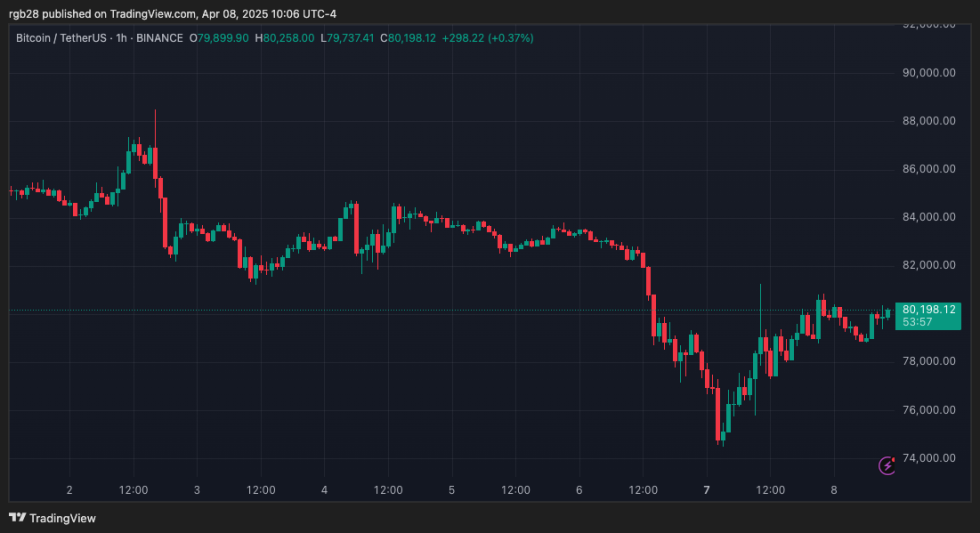
Bitcoin (BTC) trades at $80,198 in the one-week chart. Source: BTCUSDT on TradingView
Featured Image from Unsplash.com, Chart from TradingView.com
Editorial Process for bitcoinist is centered on delivering thoroughly researched, accurate, and unbiased content. We uphold strict sourcing standards, and each page undergoes diligent review by our team of top technology experts and seasoned editors. This process ensures the integrity, relevance, and value of our content for our readers.

Rubmar is a crypto enthusiast who likes learning and improving constantly. She enjoys reporting on the latest news and developments in the crypto industry. Rubmar also enjoys scrapbooking, crafting, simulation games, and watching football.

İlgili Okumalar

Behind Changxin Technology, Stands a Group of A-Share Companies

Changxin Technology, a leading Chinese DRAM (Dynamic Random Access Memory) manufacturer, has passed the review by the STAR Market listing committee, moving closer to an IPO. The company, seeking to raise 29.5 billion yuan, is the first to utilize the new "pre-review mechanism" on the STAR Market, expediting its approval process within five months. As China's largest and most technologically advanced integrated DRAM company, Changxin has achieved mass production of mainstream DDR5 and LPDDR5X products. It holds the fourth-largest global market share and ranks first in China, though it still trails behind industry leaders Samsung, SK Hynix, and Micron in areas like HBM technology. The company reported its first annual profit in 2025, with net profit surging to 24.762 billion yuan in Q1 2026, driven by booming AI-related demand. The IPO has drawn significant market attention due to Changxin's extensive and prestigious shareholder base. This includes state-backed funds like the National Integrated Circuit Industry Investment Fund II, industrial partner GigaDevice, internet giants (Xiaomi, Alibaba, Tencent), and several securities firms and A-share listed companies such as InfoMotion, Shangfeng Cement, and Hefei Urban Construction, which stand to benefit from the listing. The company's founder, Zhu Yiming, a pivotal figure in China's semiconductor industry who also founded GigaDevice, has committed to an unprecedented long-term lock-up of his shares and a massive personal equity incentive plan worth an estimated over 20 billion yuan for employees, excluding himself, upon listing.

marsbit4 dk önce

Behind Changxin Technology, Stands a Group of A-Share Companies

marsbit4 dk önce

When Vitalik Stops Blogging to Write Sci-Fi

Vitalik Buterin, founder of Ethereum, has announced a pause in his long-form technical blogging to instead write a science fiction novel exploring decentralized governance. The story, set in a fictional nation called Veridia, follows a member of a governance body that uses complex systems like quadratic voting, privacy-preserving audits, and AI-assisted decision-making to guide society through incentive structures rather than outright bans. This creative shift comes at a pivotal moment for the Ethereum ecosystem. The Ethereum Foundation has seen significant internal upheaval in 2026, with at least nine core contributors, including key protocol leaders, departing. Just days before his announcement, Vitalik published a statement addressing this turbulence, framing the Foundation as a "smaller ship" that will now focus on core principles like censorship resistance and security, while moving from a growth-oriented to a sustainability-focused organization. The novel's themes directly mirror Vitalik's long-standing technical interests in governance mechanisms. Community reactions are mixed: some see it as a thoughtful exploration of ideas through narrative, while others view the timing—amidst core team departures and a significant drop in ETH's price—as pointedly symbolic. The move is also interpreted as a personal transition, signaling Vitalik's evolving role from a central executive figure to one of many decentralized thought leaders within the Ethereum ecosystem.

marsbit39 dk önce

When Vitalik Stops Blogging to Write Sci-Fi

marsbit39 dk önce

İşlemler

Spot
Futures
活动图片