EOS crypto rallies 20% – What’s behind the surge and can it last?

Ambcrypto2025-04-03 tarihinde yayınlandı2025-04-03 tarihinde güncellendi

Özet

With a fresh rebrand, EOS is the talk of the town.

EOS rallied over 20%, driven by rebranding to Vaulta, high staking yields, and bullish derivatives

Social Dominance spiked but then cooled off; EOS price still holds steady with strong buying pressure

EOS [EOS] is making waves in the market, rallying over 20% and leaving traders buzzing about its transformation into Vaulta.

With staking yields poised to outshine Ethereum[ETH] and Solana[SOL] and derivatives traders betting big on more upside, EOS is shedding its stagnant past and stepping into the spotlight. But is the hype sustainable, or will profit-taking put a lid on the gains?

Catalysts behind EOS’s surge

The recent EOS crypto rally can be traced to three key factors. First, the buzz around EOS’s impending rebranding to Vaulta is drawing investor attention.

Set to launch by the end of May 2025, Vaulta aims to transform EOS into a blockchain-powered banking hub, complete with a new ticker and continued integration with exSat, the Bitcoin banking solutions.

Secondly, the introduction of a staking yield of around 17% for the new Vaulta token is significantly higher than Ethereum’s 2.03% and Solana’s 5.14%, supported by a reward pool of roughly 250 million tokens.
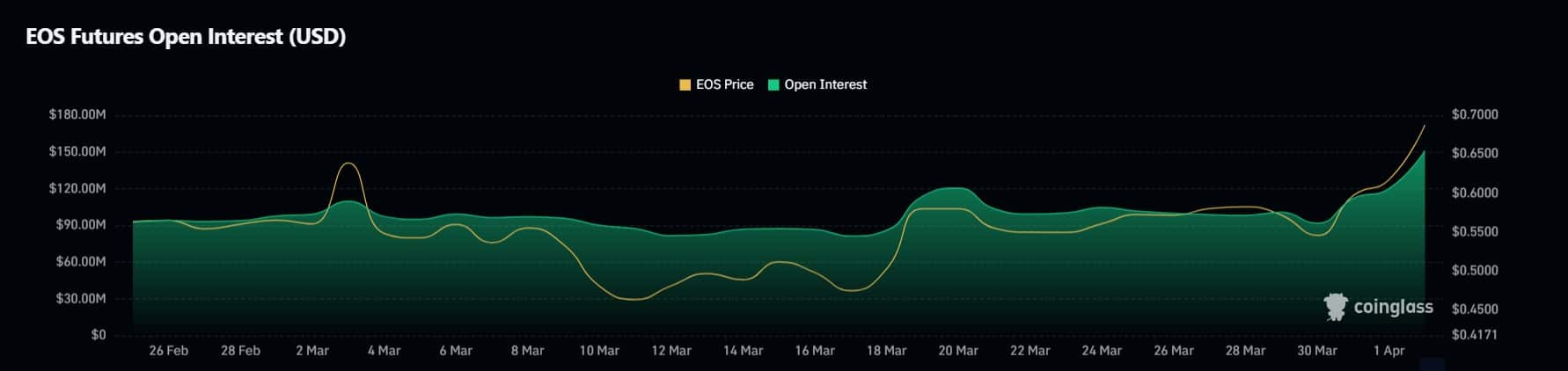
Lastly, derivatives traders are showing growing confidence in EOS. According to data from CoinGlass, Open Interest (OI) in EOS futures has seen a sharp rise, reaching a recent high of approximately $170 million.

This represents a significant jump from the $90 million level recorded just a few weeks ago, signaling strong bullish sentiment.

Additionally, the data highlights EOS’s price rallying alongside the increase in OI, suggesting that traders are positioning themselves for further gains, driven by the ongoing rebranding excitement and attractive staking incentives.

The crowd is taking notice

EOS’s Social Dominance has also seen a notable rise following the surge in derivatives activity. Santiment data reveals that the metric jumped to nearly 2.8% as EOS’s price climbed above $0.80, reaching its highest level in months.

This increase in social activity highlights the growing alignment between retail and institutional interest, driven by anticipation of the upcoming Vaulta rebranding.
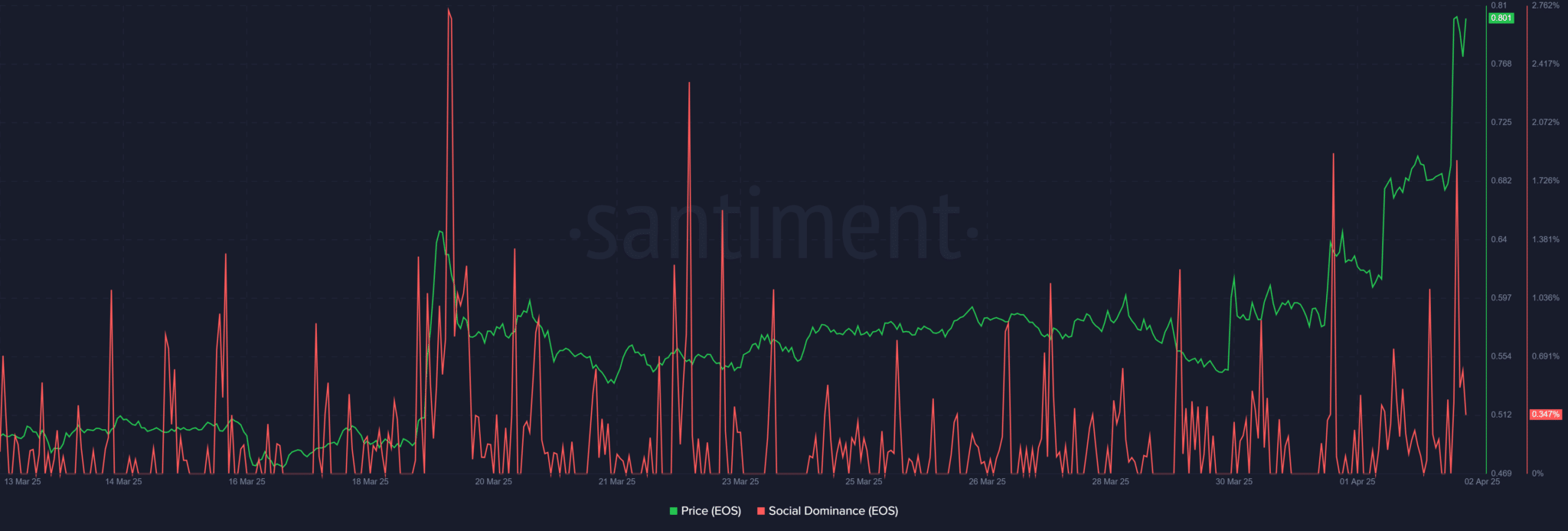
However, Social Dominance has since cooled off to around 0.35%, suggesting that while the initial buzz was intense, it may be tapering off.

Still, the price remains resilient, hinting that the rally’s momentum could persist if social sentiment picks up again.

EOS price outlook
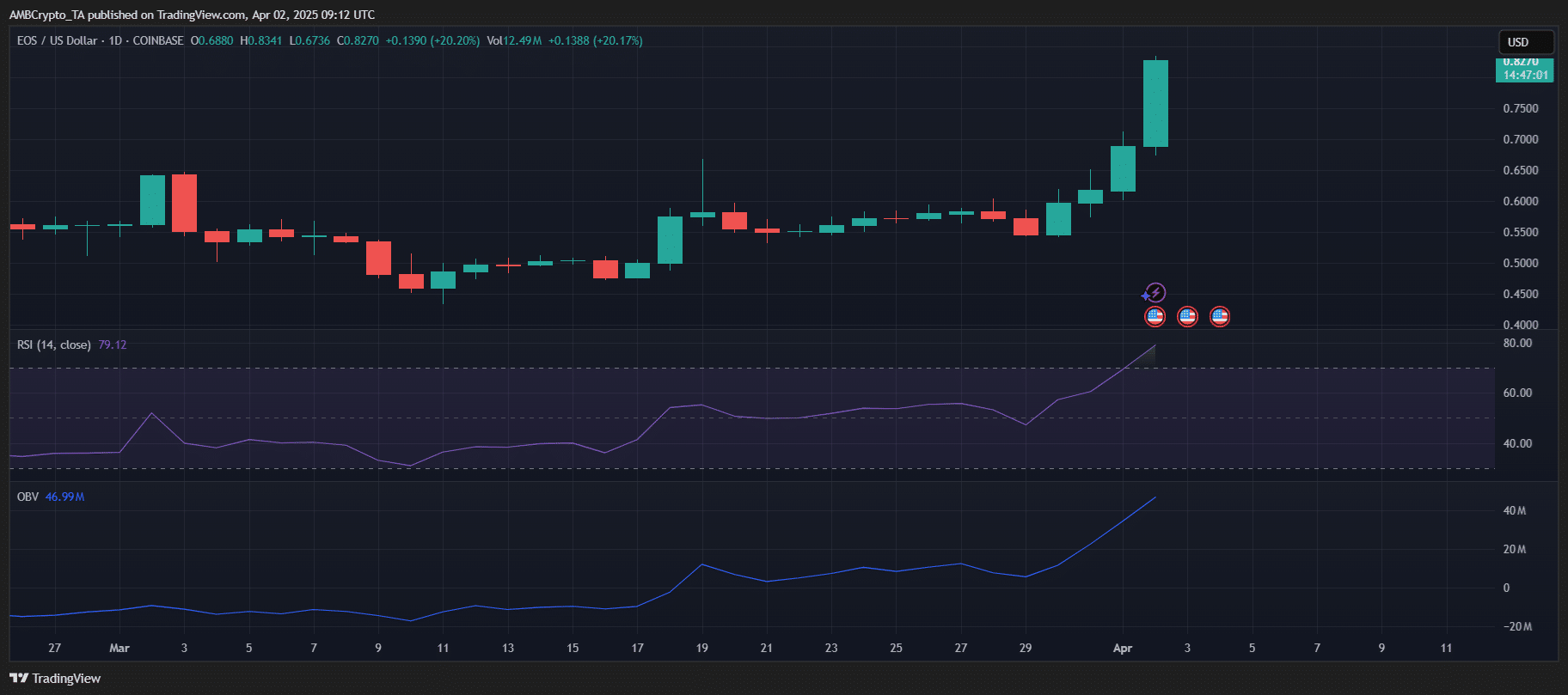
EOS experienced a strong bullish breakout, with prices soaring over 20% to reach $0.82 at the time of writing.

The daily RSI stood at 79.12, signaling overbought conditions and suggesting the possibility of consolidation or a minor pullback. However, the OBV at 46.99M reflected substantial buying pressure, indicating that the rally may still have momentum.

A short-term dip to $0.75 could occur as traders take profits, but sustained volume accumulation might push EOS higher, potentially targeting the $0.90 level.

Should the rally lose steam, the $0.68 support level could act as a cushion before the next upward move.


İlgili Okumalar

Retail Investors' 'Lead Brother' Serenity vs. Newly Minted Stock God Leopold: How Are the Two Top Hunters Mining AI's 'Physical Limits'?

The article profiles two prominent figures, Serenity and Leopold Aschenbrenner, who are gaining attention for their unconventional investment strategies focused on the physical constraints of the AI boom, moving beyond mainstream software narratives. Serenity, an anonymous online trader, advocates a "shiso leaf" theory. He targets small-cap companies with monopolies on critical, overlooked components in the AI hardware supply chain, such as specific semiconductor materials. His deep, technical analysis of bottlenecks in areas like co-packaged optics (CPO) has reportedly yielded massive returns, though his anonymity and focus on illiquid micro-cap stocks pose significant risks for followers. Leopold Aschenbrenner, a former OpenAI researcher, founded a multi-billion dollar hedge fund. His macro thesis argues that physical infrastructure—power grids, land, data centers—is the true bottleneck for AI growth, lagging far behind chip production. Consequently, his fund employs an infrastructure arbitrage strategy: heavily investing in storage and compute infrastructure companies while placing massive bearish bets (put options) against major semiconductor stocks, betting their valuations will correct as physical constraints become apparent. While their methods differ—Serenity drills into microscopic supply chain details, while Leopold takes a macroscopic, infrastructure-focused view—both share a core belief: the real power and investment alpha in the AI era lie in controlling scarce physical resources, not just software. The article concludes by noting the inherent risks in both approaches, such as liquidity issues for micro-caps and timing risks for macro bets, but suggests they signal a broader market re-evaluation of AI's foundational assets.

marsbit4 saat önce

Retail Investors' 'Lead Brother' Serenity vs. Newly Minted Stock God Leopold: How Are the Two Top Hunters Mining AI's 'Physical Limits'?

marsbit4 saat önce

Who Will Make Money in the Age of Agents?

In the Agents era of blockchain, traditional value capture theories face challenges. The "Fat Protocol" theory, dominant since 2016, suggested protocols capture most value as their tokens are essential for network use. However, the proliferation of interchangeable L1s, L2s, and modular layers has eroded protocol scarcity and pricing power. Conversely, the "Fat App" theory posits that applications capturing user relationships (like wallets and exchanges) become the primary value layer by controlling distribution and transaction flows. This aligns with the current "Great Repricing" cycle. Agents disrupt this logic. As software users, they lack brand loyalty, prioritize cost and efficiency, and switch between platforms seamlessly. This undermines the front-end UX moats that "Fat Apps" rely on. The article explores several potential futures: 1. **Headless Applications:** Current leading apps could strip their front-ends and become backend API infrastructure for Agents, preserving their role. 2. **Protocol Resurgence:** If integration becomes trivial, Agents might bypass aggregators and interact directly with protocols, reviving "Fat Protocol" dynamics. 3. **Pricing Power Collapse:** Agents' rational, frictionless routing could commoditize the entire stack, compressing margins toward cost and leaving little profit for intermediaries. 4. **Unprecedented Activity:** Agents may enable new, high-frequency, machine-to-machine economic activities, expanding the total value pie even if margins are thin. 5. **A New, Unnamed Model:** Historically, major tech shifts (like the internet's attention economy) create unforeseen business models. The Agents era may spawn entirely new ways to capture value. The most likely outcome is a coexistence where "Fat Apps" continue to serve human users valuing UX, while a separate, Agent-driven economy emerges governed by different rules—where loyalty is based on factors like liquidity, latency, and settlement guarantees rather than brand.

marsbit5 saat önce

Who Will Make Money in the Age of Agents?

marsbit5 saat önce

İşlemler

Spot
Futures
活动图片



