FOMC Meeting Ends: Will the Next Fed Chair Under Trump Fuel a Rally for These Best Presales?

bitcoinist2025-03-20 tarihinde yayınlandı2025-03-20 tarihinde güncellendi

Özet

In its latest meeting, the Federal Open Market Committee (FOMC) opted to keep the federal funds rate steady at the...

Trusted Editorial content, reviewed by leading industry experts and seasoned editors. Ad Disclosure

In its latest meeting, the Federal Open Market Committee (FOMC) opted to keep the federal funds rate steady at the target range of 4.25% to 4.50%.

That continues the status quo, and sets up the crypto market for continued volatility – but also, opportunities for the best presales to shine.

The recent decision indicates the Federal Reserve’s caution in light of prevailing economic uncertainties; with slightly lower GDP growth and slightly higher inflation, the Fed wants to play things safe.

But will US President Trump let it?

Given how Trump has approached policy-making so far, with broad attempts to reset the US approach on everything from crypto to foreign policy, there’s a very real chance that the next Fed chairman might be appointed primarily to do what Trump wants them to do, rather than what’s best for fiscal policy.

That’s especially true given all the economic mixed signals:

❌ GDP growth slowing to 1.7% in 2025

❌ Inflation projected to rise to 2.7%

✅ Unemployment rate stays low, estimated 4.4% by EOY

That leaves the Federal Reserve on a tightrope requiring very careful and delicate moves.

And ‘careful and delicate’ are hardly words to describe Trump’s approach.​

Trade Policies Contribute to Unsteady Markets; Crypto and Stocks Respond Positively

Reporters asked Federal Reserve Chair Jerome Powell about the impact of recent trade policies, including tariffs, on inflation projections. Powell’s answer, while cautious, noted that ‘a good part of it is coming from tariffs.’

But despite the somewhat muted tone coming out of the meeting, financial markets reacted positively to the FOMC’s announcements.

Major U.S. stock indices experienced gains:

  • Dow Jones Industrial Average rose by 383.32 points (0.92%)
  • S&P 500 gained 60.63 points (1.08%)
  • Nasdaq Composite increasing by 246.67 points (1.41%)

On the crypto front, the global market cap rose 3.19% to $2.81T.

$BTC climbed nearly 3% to $85.7K, $ETH rose 3.5% to break the $2K mark, and $XRP spike over 7% to $2.47.

A surprisingly strong response, given the broader uncertainty, but the markets still like the underlying fundamentals: potentially lower interest rates down the line and strong interest even in riskier assets like crypto.

Here are three of the best presales to watch as the markets continue to gain momentum.

1. BTC Bull ($BTCBULL) – First-Ever Bitcoin Meme Coin with Three Ways to Earn

BTC Bull Token wants to ride Bitcoin all the way to $250K and beyond.

It’s a memecoin for all the Bitcoin maximalists out there, investors convinced by $BTC’s astounding 230% AAR and looking for ways to capitalize on Bitcoin’s success.

BTC Bull official bitcoin meme coin

With $BTCBULL, token holders receive 111% staking returns during the crypto presale. Those returns are paid out over the next two years post-launch, providing both short-term and long-term gains.

BTC Bull rewards holders whenever Bitcoin reaches key price points.

At $150K and $200K, holders receive $BTC airdropped directly into their Best Wallet app crypto wallets. The only eligibility requirement is to purchase and hold $BTCBULL in Best Wallet.

At $125K, $175K, and $225K, the project will burn $BTCBULL tokens, reducing supply and potentially driving the token price higher.

And at $BTC $250K, there’s a massive $BTCBULL airdrop.

Each milestone is designed to link $BTCBULL’s rewards and price directly to $BTC’s continued success. And with a Bitcoin Strategic Reserve on the way, that success seems highly likely.

Certainly, the US president is betting on it, making BTC Bull a meme coin worth watching.

You can learn how to buy $BTCBULL by checking out our guide.

In the meantime, 1 $BTCBULL is worth $0.00242, and the project has raised $3.8M to date. Check out the token presale, and don’t sleep on the first Bitcoin memecoin.

2. BlockDAG ($BDAG) – Hybrid Blockchain with $USDT Rewards Program

Directed Acrylic Graphs (DAGs) take traditional linear blockchains and restructure them, allowing multiple transactions to be added to the ledger simultaneously.

It’s an innovative approach to traditional blockchain congestion and scalability issues. BlockDAG is fully EVM-compatible, allowing it to integrate existing Ethereum smart contracts. At the same time, BlockDAG is a proof-of-work algorithm; $BDAG is mined in the same way as Bitcoin.
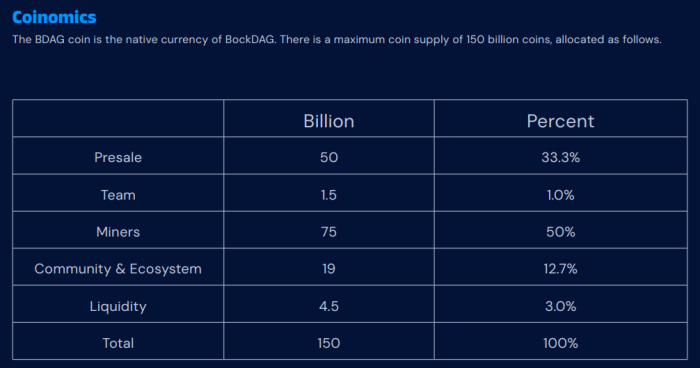
BlockDAG Coinomics

The project envisions deploying a powerful DAG blockchain that combines a number of advantages in one protocol:

  • Ethereum’s smart contracts
  • Bitcoin’s proof-of-work consensus mechanism
  • Multichain architecture with UTXO/EVM

Added all together, and it’s not a surprise that the project has raised over $203M.

3. Best Wallet ($BEST) – Best Presale Crypto Wallet with $BEST Airdrop

Best Wallet Token takes one of the leading Web3 wallets and adds loads of utility.

$BEST token holders get:

  • Access to exclusive crypto presales
  • Reduced transactions fees
  • Higher staking rewards
  • Community governance

That’s on top of a web3 wallet poised to capture 40% of the $11B non-custodial wallet market by 2026.

For investors who purchase $BEST during the ongoing presale, there’s also the opportunity to stake their tokens for an estimated 140% APY, disbursed over 3 years.

best wallet token airdrop

There’s also a way to earn part of a free crypto airdrop with the Best Wallet Token airdrop. Eligibility is determined by completing daily and one-time quests found in the wallet or on social media. Learn more in our guide on how to buy Best Wallet Token.

The broader Best Wallet ecosystem facilitates cross-chain swaps and includes a fiat offramp, key features in a multi-functional crypto wallet. It’s a true non-custodial wallet; investors always control their own keys.

That utility makes $BEST one of more intriguing new crypto projects in 2025.

The Best Wallet Token presale continues at the presale page, and has raised over $11.2M so far with a current token price of $0.0244. You can learn more about how far $BEST might go in our price prediction (spoiler, a potential 2,440% increase by the end of 2026).

Will Powell vs Trump Hurt the Market – Or Spur It On?

With Powell openly hinting that Trump’s tariffs are at least partly to blame for inflation, is another departmental war about to break out?

And if Trump moves to replace Jerome Powell as chairman of the Federal Reserve, what does that mean for interest rates?

Trump could pressure the new chair to lower rates even further; that would reduce borrowing pressure, but likely push inflation higher.

It could also drive crypto up, both as an inflationary hedge and directly due to cheaper borrowing costs. And if that happens, the crypto presales on this list could be poised for big moves.

Do your own research. This isn’t financial advice, and it’s on you to make sure you know what you’re investing in. Losses are always possible.

But with the Federal Reserve playing it safe, it could be a good time to look at the potential of crypto presales.

Editorial Process for bitcoinist is centered on delivering thoroughly researched, accurate, and unbiased content. We uphold strict sourcing standards, and each page undergoes diligent review by our team of top technology experts and seasoned editors. This process ensures the integrity, relevance, and value of our content for our readers.

Bitcoinist is the ultimate news and review site for the crypto currency community!

İlgili Okumalar

Bankless Co-founder: Why I Sold All My ETH

Author David Hoffman, founder of Bankless, explains his decision to sell all his ETH, despite being a prominent figure in the Ethereum ecosystem. He clarifies that his move is not a bearish take on Ethereum itself, which he remains highly optimistic about as a network. His core argument is that the "ETH is money" thesis, which he helped popularize, has largely played out. Hoffman argues that ETH has achieved the market valuation it deserves based on Ethereum's current success and competitive position. He details several reasons for this view. First, the path for ETH to become global money required nearly flawless execution and sustained dominance across Ethereum's entire technical and social stack—a coordination challenge he now believes had a narrower window for success than anticipated. Second, market data shows a strong correlation between L1 chain activity/fees and the price of its native asset; Ethereum's fee dominance has been challenged by competitors like Solana. Third, the "strong version" of crypto (decentralized, native crypto economies) that ETH's monetary thesis relied upon has struggled to maintain a positive mainstream narrative and stable adoption beyond a brief period. Finally, Ethereum's architecture as a "giver"—providing secure block space and tokenization capabilities at cost to L2s and applications—means it doesn't capture premium value directly. Its rollup-centric roadmap further directs most profits to L2s and applications ("fat app theory"). In conclusion, Hoffman believes the opportunity for ETH to be revalued significantly upward as money has diminished. He sold not because ETH will fail, but because its monetary thesis has matured, and he seeks to allocate capital to other opportunities he finds more compelling.

链捕手33 dk önce

Bankless Co-founder: Why I Sold All My ETH

链捕手33 dk önce

From Issuer to Infrastructure Owner: Circle's Arc Strategy and the Fatal Gap in the GENIUS Act

Circle raised $222 million for its proprietary Layer-1 blockchain, Arc, positioning itself not just as a stablecoin issuer but as the owner of the settlement infrastructure USDC relies on. This move, backed by investors like BlackRock and Apollo, highlights a significant structural conflict unaddressed by the GENIUS Act of 2025. While the act focuses on stablecoin reserves and issuer oversight, it remains silent on the market structure implications of an issuer controlling the underlying network—a scenario akin to a currency issuer also owning the payment rails. Traditionally, financial regulations separate issuers from settlement infrastructure to ensure neutrality. With Arc, Circle gains control over transaction ordering, fees, and network rules, potentially favoring USDC over competitors. The article argues that this creates a permanent structural temptation, even if no abuse occurs. The solution lies in applying established market infrastructure principles: mandating neutral transaction ordering, transparent fee schedules, and governance separated from Circle’s commercial interests. The current pre-mainnet phase offers a critical window for regulators to establish these rules before Arc becomes entrenched. Once operational, enforcing changes would be costly and disruptive. The core question remains: should a regulated stablecoin issuer be allowed to own the settlement network its competitors must use? The GENIUS Act doesn’t answer this, but Circle’s Arc strategy makes it urgent.

marsbit39 dk önce

From Issuer to Infrastructure Owner: Circle's Arc Strategy and the Fatal Gap in the GENIUS Act

marsbit39 dk önce

What Are the Key Variables Determining the AI Bull Market?

Title: What Determines the AI Bull Market? Key Variables Revealed Despite rising oil prices above $100/barrel, persistent inflation, and fragile Fed rate cut expectations—a traditionally hostile environment for high-valuation tech stocks—the AI sector continues to drive the market to new highs. According to analysts, the current AI boom is in a phase of "rational fervor": while bubbles exist, they are not yet out of control. The crucial shift is the emergence of Agentic AI, which is evolving from an assisting tool (Copilot) to an autonomous execution tool (Autopilot), creating a clearer commercial path from investment to revenue. This shift accelerates Token consumption and inference computing demand while boosting revenue forecasts for leading firms. The market is now rewarding capital expenditure as it transforms from a burden into a competitive moat, supporting hardware chains like GPUs, optical modules, and storage. However, valuations have already priced in growth expectations for 2027-2028. The forward P/E ratio for the "Magnificent Seven" tech giants is about 35x, compared to 25x for the rest of the S&P 500. This premium implies AI adoption must occur 5 to 8 times faster than past technological revolutions—a scenario with little room for error. The sustainability of the AI bull market hinges on three key variables: 1. **Short-term liquidity shocks**: Risks include sustained high oil prices, resurgent inflation, rising interest rates, and potential unwinding of the yen carry trade. The critical question is whether the upward revision speed of Annual Recurring Revenue (ARR) can outpace the rise in interest rates. 2. **Mid-term industry realization**: Can the actual pace of AI adoption and commercialization match the current lofty valuations? Historically, general-purpose technology revolutions follow a non-linear path with periods of acceleration and deceleration. 3. **Long-term structural constraints**: These include energy and power grid limitations, employment displacement and consumer purchasing power, social acceptance and potential backlash, and potential hardware technology breakthroughs that could disrupt current supply chains. While the long-term prospects for AI remain optimistic with potential for significant productivity gains, the stock market's pricing depends not just on the vision but on the actual speed of realization amid these growing constraints. The direction is clear, but the pace of execution will determine whether the bubble remains controlled or spirals out of control.

marsbit39 dk önce

What Are the Key Variables Determining the AI Bull Market?

marsbit39 dk önce

İşlemler

Spot
Futures
活动图片