В Yuga Labs прогнозируют падение дальнейшее эфириума на 80-90%

cryptonews.ru2024-05-11 tarihinde yayınlandı2025-03-11 tarihinde güncellendi

Вице-президент по блокчейну компании Yuga Labs, известный под ником Quit, сомневается в оптимистичных прогнозах в отношении эфириума. Пока большинство криптоаналитиков предупреждают, что вероятный минимум для альткоина находится на уровне $1500, он предсказывает просадку на 80-90% до $200-$400.

По мнению аналитика, падение ETH на 30% за неделю и на 50% за последние три месяца может быть только началом коррекции, если рынок войдёт в новый медвежий цикл. Quit посоветовал инвесторам пересмотреть свои вложения в эфириум, если они не готовы к дальнейшему снижению его курса.
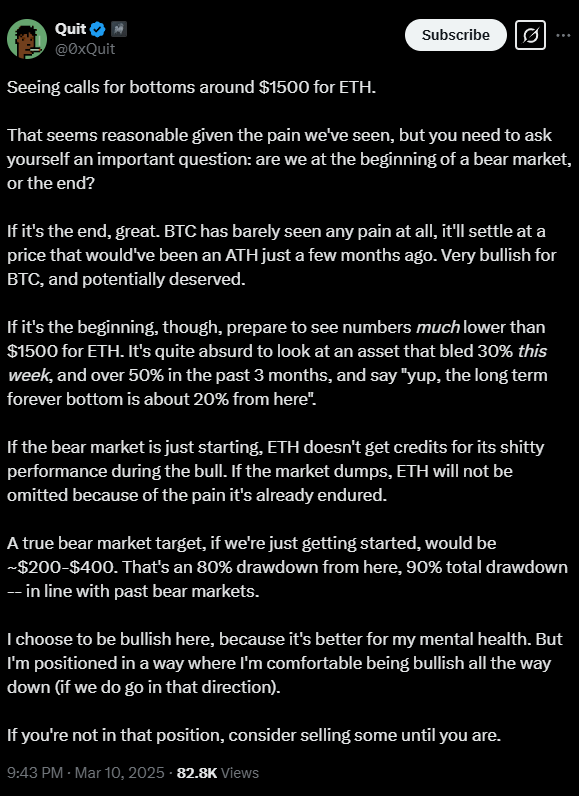
рис 1

Тем временем крупные держатели эфириума уже готовятся к дальнейшему потенциальному снижению цены актива. 11 марта Lookonchain зафиксировал крупную транзакцию — с кошелька, связанного с Ethereum Foundation, перевели 30 098 ETH (примерно $56,08 млн) в MakerDAO. Сейчас на этом адресе хранится 100 394 ETH почти на $182 млн.

Падение ведущего альткоина было спровоцировано сразу несколькими причинами, к примеру, снижением активности сети Ethereum, падением спроса со стороны институциональных инвесторов и растущей конкуренции со стороны более быстрых и дешёвых блокчейнов.

İlgili Okumalar

Li Fei-Fei's Latest Long-Form Article: When Video Generation, Robotics, and NVIDIA All Call Themselves World Models, We Need a Taxonomy

In a new article, Dr. Fei-Fei Li addresses the widespread and often inconsistent use of the term "world model" in AI. She proposes a clear, functional taxonomy rooted in the classic Partially Observable Markov Decision Process (POMDP) loop (agent → action → state → observation → agent). According to this framework, current systems called "world models" are different projections of this loop, categorized by their primary output: 1. **Renderers**: Output observations (pixels). Their goal is visual fidelity for human consumption (e.g., video generation models like Sora). They are the most commercially mature but are limited by a focus on appearance over physical accuracy. 2. **Simulators**: Output states (geometric, physical, dynamic representations). They provide a structurally accurate world for both human professionals (e.g., architects) and computational agents (e.g., robots for training). Li argues simulators are the crucial, underappreciated bridge, as they can underpin both rendering and planning. 3. **Planners**: Output actions. Given an observation and a goal, they decide what an agent should do next (e.g., robotic action models). This area is highly promising but remains the least mature for real-world deployment. Li highlights a key trend: the boundaries between these three categories are beginning to blur, as they all rely on a shared underlying understanding of geometry, physics, and dynamics. The logical endpoint is a unified world foundation model capable of switching between rendering, simulation, and planning based on downstream needs. This convergence, she concludes, is central to advancing spatial intelligence—enabling machines not just to talk about the world, but to truly understand, imagine, and interact with it.

marsbit4 saat önce

Li Fei-Fei's Latest Long-Form Article: When Video Generation, Robotics, and NVIDIA All Call Themselves World Models, We Need a Taxonomy

marsbit4 saat önce

İşlemler

Spot
活动图片