Криптомошенничество может стоить Милею президентского кресла

cryptonews.ru2021-08-16 tarihinde yayınlandı2025-02-16 tarihinde güncellendi

Президенту Аргентины Хавьеру Милею грозит импичмент за мошенничество с криптовалютой, в котором его обвиняют оппозиционеры.

14 февраля Милей опубликовал в соцсети сообщение о выпуске нового токена Libra (LIBRA). За несколько часов этот цифровой актив подорожал в несколько раз, однако после того, как Хавьер удалил пост о криптовалюте, её стоимость рухнула более чем на 94% за считанные часы.
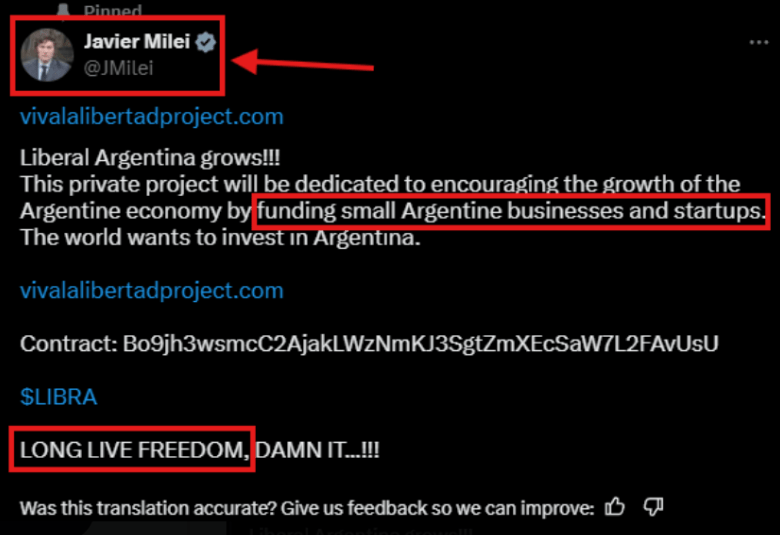
рис 4

Публикация Милея о криптовалюте LIBRA

Блокчейн-сыщики выяснили, что инсайдеры заработали на торговле LIBRA как минимум $20,2 млн. Однако трейдеры, которые купили монеты и не успели их продать на пике, понесли гигантские убытки, потому что уровень капитализации LIBRA достигал $4,56 млрд.
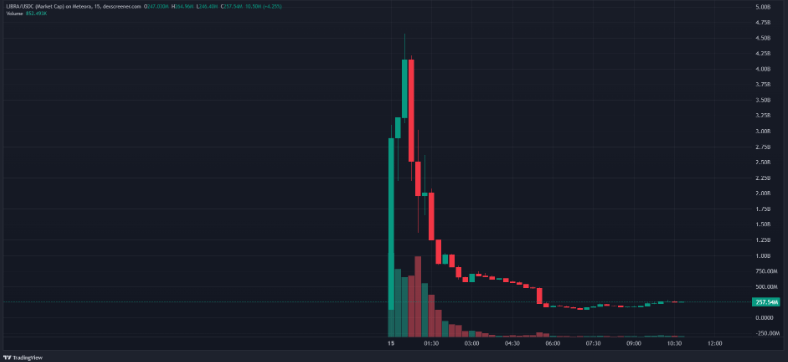
рис 3

Взлёт и крах курса LIBRA

Сотрудники аргентинской Финансово-технологической палаты заподозрили создателей LIBRA в реализации мошеннической схемы под названием Rug Pull. По мнению экспертов, команда проекта избавилась от цифровых активов, когда их цена сильно выросла, и спровоцировала таким образом дамп.

В свою защиту Хавьер заявил, что он не знал подробностей о криптовалютном стартапе, когда писал о нём в соцсети. Милей считает, что курс токена рухнул из-за его политических оппонентов.

Этот скандал дискредитирует нас на международном уровне, поэтому мы должны запустить процедуру импичмента президента [Хавьера Милея], — заявил член коалиции оппозиционных партий Леандро Санторо.


İlgili Okumalar

The "Impossible Triad" Is Fundamentally a Pseudo-Problem

The article argues that blockchain's fundamental limitation is not the scalability trilemma (decentralization, scalability, security), which has been largely solved, but the lack of **privacy** and, until recently, clear **legitimacy**. Blockchain is described as a slow, expensive, globally shared computer whose core value is censorship resistance and verifiability. While ideal for native digital assets like money (e.g., stablecoins), its default transparency acts as a **tax**, exposing all transactions and enabling MEV extraction, which deters serious institutional capital. Simultaneously, its permissionless nature created regulatory ambiguity. The piece contends that **privacy** is the missing critical feature. It rejects the false choice between total transparency and complete anonymity. Modern cryptography (like zero-knowledge proofs) enables **compliant privacy**: users can prove facts (solvency, KYC status, compliance) without revealing the underlying sensitive data (specific holdings, identities). This preserves auditability for regulators and eliminates the leak of financial information. With recent regulatory progress (e.g., the GENIUS Act) addressing legitimacy, adding default, provably compliant privacy becomes a pure upgrade. It transforms blockchain from a costly, public ledger into a confidential settlement layer, finally bridging the gap to mainstream institutional and individual adoption of on-chain finance.

链捕手11 saat önce

The "Impossible Triad" Is Fundamentally a Pseudo-Problem

链捕手11 saat önce

Optical Chips: Collective Capacity Expansion

The global optical chip industry is experiencing a massive wave of expansion driven by surging AI data center demand. Major players across the US, Japan, Europe, and China are aggressively investing to ramp up production capacity. In the US, Coherent is expanding its 6-inch Indium Phosphide (InP) semiconductor fab in Texas, supported by CHIPS Act funding and a $2 billion strategic investment from NVIDIA. Lumentum is building a new factory for InP optical devices, and Nokia is scaling its advanced photonic chip packaging and testing capabilities. NVIDIA's investments aim to secure future supply of critical lasers and optical interconnect products for AI infrastructure. Japan's JX Advanced Metals, a leading InP substrate supplier, plans a multi-billion yen investment to increase its capacity 7-10 times, strengthening its grip on the crucial upstream materials market. In Europe, IQE and Tower Semiconductor settled a patent dispute and signed a multi-year InP epitaxial wafer supply agreement, highlighting that next-generation silicon photonics platforms will integrate high-performance InP components. STMicroelectronics and Sivers Semiconductors are also expanding silicon photonics production and partnerships. China is rapidly building out its domestic supply chain. Dongshan Precision's subsidiary, Source Photonics, announced a $12 billion project to expand optical chip and module production. Companies like Sanan Optoelectronics and Yunnan Germanium are scaling up InP chip manufacturing and substrate production, moving towards vertical integration from materials to modules. While debate continues around the exact future architecture—whether CPO (Co-Packaged Optics), NPO, or pluggables will dominate—analysts like Morgan Stanley argue the underlying driver is unchangeable: the explosive growth in bandwidth demand. This will inevitably increase the volume of optical engines, lasers, and related content per GPU, regardless of the final technical path. The competition for "more light" in the AI era has intensified into a global, full-chain capacity race.

marsbit14 saat önce

Optical Chips: Collective Capacity Expansion

marsbit14 saat önce

İşlemler

Spot
Futures
活动图片