Что, если бы вы в 2017 году потратили 25 долларов в неделю в биткоинах?

cryptonews.ru2022-02-09 tarihinde yayınlandı2025-01-09 tarihinde güncellendi

  • За восемь лет биткоин принес доходность, в семь раз превышающую доходность золота и в восемь раз превышающую доходность акций.
  • DCA (усреднение стоимости в долларах) — хороший вариант как для новичков, так и для экспертов, но он не лишен недостатков.
  • Это предпочтительная инвестиционная стратегия для большинства криптоинвесторов: 59% используют ее в качестве основного подхода.

С ценой биткоина, колеблющейся около 93 тыс., нет недостатка в разговорах о его постоянно растущей стоимости. Так что, если вы прыгнули на борт в 2017 году и DCA-ed (постоянно инвестируя заранее определенную сумму денег в определенный актив, независимо от его текущей рыночной цены) по 25 долларов каждую неделю?

Спойлер: сейчас у вас будет куча денег. Более того, за эти 8 лет биткоин превзойдет золото и акции по рентабельности инвестиций.

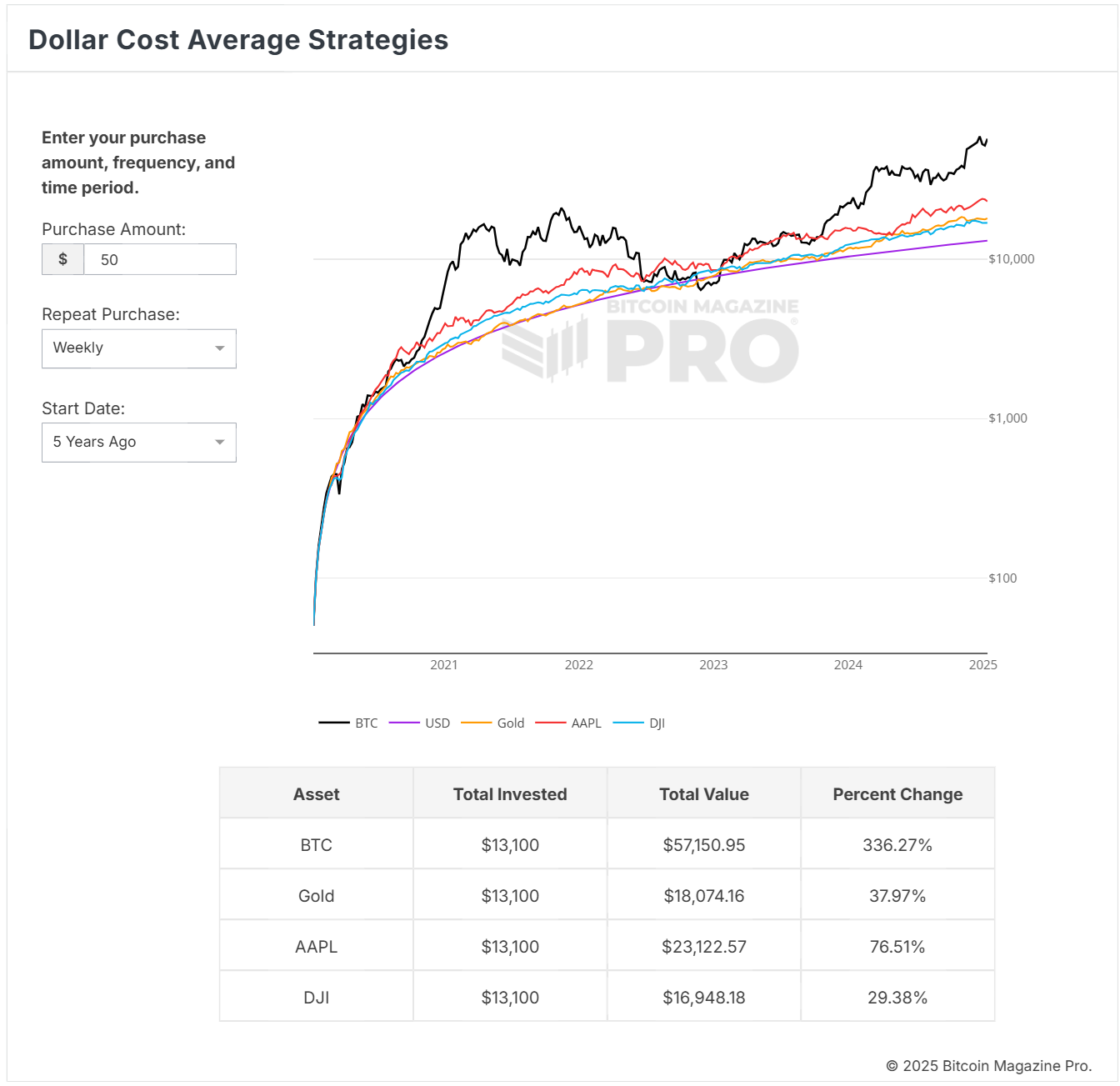
Давайте разберемся. Начиная с 2017 года, если вы DCA-ed $25 в неделю, то сейчас у вас будет примерно $10,450 инвестиций. Таким образом, ваши инвестиции вернут примерно $16,946.00 в золоте или около $15,358.23 в акциях.

Однако для Bitcoin это будет колоссальная сумма в $133,689.39! Это в 8 раз больше, чем доходность акций и в 7 раз больше, чем доходность золота. Хотя это ситуация «что если», она показывает огромный рост Bitcoin за эти годы и потенциал усреднения стоимости доллара.

Если вы хотите убедиться в этом сами и поэкспериментировать с различными временными интервалами и уровнями инвестиций, ознакомьтесь с этой таблицей.
Для чего нужен DCA?

Основное применение DCA — снижение волатильности рынка, поскольку инвестирование фиксированной суммы через регулярные промежутки времени помогает сгладить влияние рыночных колебаний.

Он также удобен для новичков, потому что упрощает инвестирование, делая его доступным даже для тех, кто не обладает обширными знаниями рынка или опытом. Кроме того, DCA устраняет необходимость в постоянном мониторинге рынка и одержимости тем, если рынок чувствует себя хорошо.

Таким образом, эта стратегия стала популярной: прошлогодний опрос показал, что 59% криптоинвесторов отдают приоритет усреднению долларовой стоимости в качестве своей основной инвестиционной стратегии.

Обратите внимание, что DCA не дает никаких гарантий, и вполне возможно, что вы можете упустить более высокую прибыль, если рынок будет постоянно расти в течение вашего инвестиционного периода. Следовательно, это не для всех.

При этом, если вы решили поэкспериментировать с DCA в криптовалюте, начните с выбора криптовалюты, в которую вы хотите инвестировать. Затем установите свой инвестиционный бюджет и частоту ваших взносов. Кроме того, обязательно проведите тщательную оценку своего финансового положения, а также любые необходимые исследования.


İlgili Okumalar

Insurance Industry Faces Its Biggest Competitor: Are Prediction Markets the 'Barbarians at the Gate'?

"Insurance Industry Faces New Rival: Are Prediction Markets the 'Barbarians at the Gate'?" Prediction markets, exemplified by platforms like Kalshi and Polymarket, are emerging as potential disruptors to the traditional insurance industry by offering alternative risk-hedging mechanisms. These markets allow users to bet on specific event outcomes, effectively creating a form of customizable, on-demand insurance. Key examples highlight this shift. In sports, Kalshi partnered with insurance broker Game Point Capital to provide NBA teams with more affordable options to hedge performance bonuses compared to traditional insurers. In real estate, Polymarket's collaboration with Parcl lets users speculate on city-specific housing price indices, allowing homeowners to hedge against price drops or buyers against price increases. Furthermore, businesses like a New York bar have used Kalshi to hedge marketing promotions (e.g., offering free drinks if a team wins), framing the transaction explicitly as placing a "hedge." The article argues prediction markets offer advantages over traditional insurance and even sports betting in transparency, liquidity, and flexibility. They provide a wider range of event coverage, act as neutral platforms rather than counterparties, and offer clearer pricing. The piece cites historical precedents like large "refund promotion" hedges by businesses using sportsbooks but notes prediction markets modernize the concept. However, challenges remain for widespread adoption as an insurance alternative, including limited liquidity in some markets, unclear regulatory status, and potential vulnerabilities in event resolution mechanisms. Despite these hurdles, prediction markets are positioning themselves as new tools for risk management, directly challenging certain segments of the conventional insurance landscape.

Odaily星球日报9 dk önce

Insurance Industry Faces Its Biggest Competitor: Are Prediction Markets the 'Barbarians at the Gate'?

Odaily星球日报9 dk önce

Which Crypto Sectors Have Been 'Eaten' by AI Agents?

The article examines the transformative impact of AI Agents on the cryptocurrency landscape, highlighting how specific sectors are becoming increasingly dominated by automated systems. Key "agent-eaten" sectors include derivatives trading (perpetuals), where AI agents demonstrate significantly higher survival and performance rates than human traders; MEV and arbitrage trading, which are almost entirely automated; yield optimization, with over two-thirds of new DeFi protocols incorporating AI agents; and spot trading/portfolio management, where agents drive a growing share of DEX volume. "Battleground" sectors like prediction markets and DeFi lending show a mix, with agents excelling in short-term/arbitrage activities but humans retaining an edge in longer-term, nuanced decisions. Sectors still primarily "human-led" include stablecoin payments/remittances (driven by real-world economic activity) and wallets, where human oversight for approvals and security remains critical. As AI agent activity grows, the article emphasizes the rising importance of human-agent verification layers (e.g., World/AgentKit, t54, Self Protocol) to ensure trust, accountability, and control in an increasingly agentic economy. The conclusion is that while AI agents dominate in speed and optimization-focused areas, human judgment, trust, and real-world context remain essential in value-creating layers like payments and identity.

marsbit10 dk önce

Which Crypto Sectors Have Been 'Eaten' by AI Agents?

marsbit10 dk önce

AC Exits Sonic Board, 'DeFi Godfather' Pulls Off Another Strategic Retreat

Andre Cronje, known as the "DeFi Godfather," and two other founding directors have stepped down from the Sonic Labs board. The S token, once valued at $1.03, has plummeted 97% to $0.028, and the chain's TVL has evaporated 98% from its peak. In his exit statement, Cronje clarified he was a technical architect, not a founder, and distanced himself from token economics and migration decisions behind the token's crash. Cronje revealed his focus for the past 18 months has been his new project, Flying Tulip. This project raised $200 million privately last year at a $10 billion valuation. Its token design includes a perpetual put option (ftPUT NFT) for early investors, allowing them to redeem their initial investment at any time—a protection not extended to public market buyers. This pattern mirrors Cronje's past exits from projects like Yearn Finance and Fantom, where he departed near peak hype, leaving later holders to bear significant losses. Sonic itself has seen a complete management overhaul in recent months. The article frames this as a microcosm of the broader crypto bear market, where Layer-1 chains are bleeding value. It highlights a harsh reality: a project's valuation is often tied to a founder's reputation rather than fundamentals. Ironically, Flying Tulip is set to launch first on the Sonic chain Cronje just left, underscoring a disconnect between the person and the platform.

marsbit30 dk önce

AC Exits Sonic Board, 'DeFi Godfather' Pulls Off Another Strategic Retreat

marsbit30 dk önce

İşlemler

Spot
Futures
活动图片