预计美国将推出鹰派货币政策,近1亿美元资金退出美国加密货币基金

Cointelegraph中文2022-06-14 tarihinde yayınlandı2022-06-14 tarihinde güncellendi

Özet

机构投资者上周抛售了价值1.015亿美元的数字资产产品,因为他们预计美联储将采取鹰派货币政策。

据CoinShares称,机构投资者上周抛售了价值1.015亿美元的数字资产产品,因为他们预计美联储将采取鹰派货币政策。

美国通货膨胀率在5月底同比达到8.6%,回到了1981年以来的水平。因此,市场预计美联储将采取重大行动遏制通胀,一些交易员预计到10月份还会有三次加息,每次0.5%。

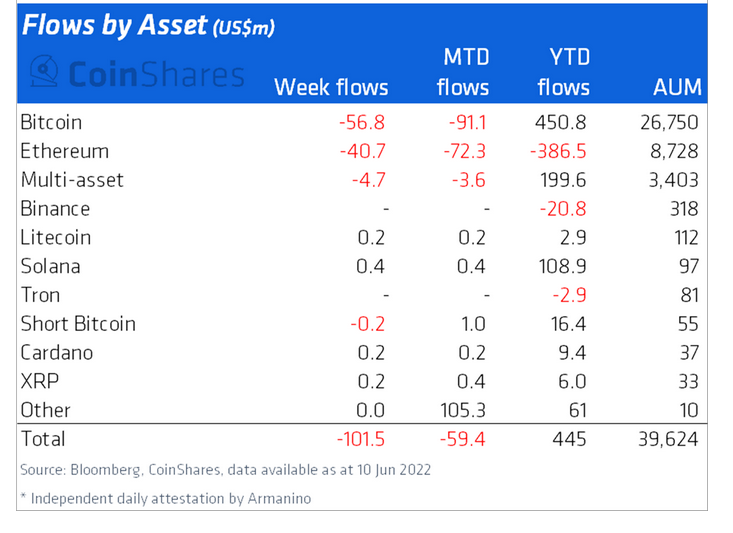
根据CoinShares最新一期的数字资产基金流动周报,6月6日至6月10日之间的资金流出主要是来自美洲的投资者,金额为9800万美元,而欧洲仅占200万美元。

提供加密领域前两大资产——比特币和以太坊敞口的产品几乎占据了所有流出的资金,分别为5680万美元和4070万美元。这个月到目前为止的数据也很严峻,BTC产品的流出价值为9110万美元,ETH产品总计流出7230万美元。

“过去6个月将比特币推入‘加密冬天’的原因,大体上可以被解释为美联储日益鹰派的言论的直接结果。”

虽然CoinShares暗示比特币已经进入了加密冬天,但今年迄今为止,比特币投资产品的资金流入仍达到4.508亿美元。相比之下,提供以太坊敞口的基金今年迄今已出现3.865亿美元的大规模资金流出,这表明机构投资者仍对数字黄金十分青睐。

该报告还强调,截至上周,以太坊基金的总资产管理规模(AUM)已“从2021年11月230亿美元的峰值降至87亿美元”。

值得注意的是,机构投资者似乎在BTC和ETH这两种资产最近的价格暴跌发生之前抛售了他们的BTC和ETH产品。

CoinGecko数据显示,6月6日至10日,BTC和ETH价格分别下跌4.7%和5.9%。但自6月11日以来,BTC和ETH分别暴跌25.7%和33.2%左右。

除了BTC和ETH出现资金流出,多元资产基金流出470万美元,Short Bitcoin产品流出20万美元。与此同时,投资者也“避免增持山寨币”。
İlgili Okumalar

Re-evaluating Founder-Market Fit Amidst the Crypto Bear Market

In the current crypto bear market, the concept of founder-market fit emerges as the most enduring investment signal. While markets, regulations, and products constantly change, the alignment between a specific founder and a specific market remains the constant, compounding factor, especially when prices stall. The blockchain space is now attracting a higher caliber of founders than ever before. Talent has converged on solving serious problems in two key verticals: AI and fintech. The most compelling challenge has become building institutional-grade financial infrastructure, drawing serious operators from firms like Citadel, Stripe, Block, Nvidia, and Goldman Sachs. This shift is supported by maturing on-chain data: stablecoin settlement now surpasses Visa and Mastercard combined, institutional adoption is rising, and tokenized real-world assets are growing rapidly. When evaluating founders, four key traits are sought: deep domain expertise, high agency, an unfair advantage in networks, and obsession. Examples like Offchain Labs (Arbitrum), Ondo Finance, Morpho, Circle (USDC), and Alchemy demonstrate that projects possessing all four traits can define categories and endure through cycles. For founders already building, bear markets strip away momentum and reveal true conviction. This period offers the quiet, uncrowded space to build foundational products that will define the next cycle when capital returns. Capital is still available, and lower valuations present an opportunity. The advice is to extend runway, focus on genuine product-market fit, and recruit strategically. For talented individuals still within traditional finance giants, the moment to act is now. The hard problems in crypto now align with their skills in institutional infrastructure—settlement, credit, custody, compliance. The bear market is not a risk but a testing ground, clearing out noise and creating the ideal conditions for builders with the right fit to establish themselves. The defining founders of the next cycle are not waiting; they are building in the quiet of the winter, anchored by a deep belief in their market that price action cannot shake. The ultimate question is not if the market will return, but who will be standing, stronger, in the market they were inherently meant to win.

Foresight News3 dk önce

Re-evaluating Founder-Market Fit Amidst the Crypto Bear Market

Foresight News3 dk önce

SEC Pushes for All-Day Trading in US Stocks, Will RWA's Biggest Advantage Disappear?

**Summary: SEC Advances Towards 24-Hour U.S. Stock Trading, Impact on Crypto RWA Tokens** The U.S. Securities and Exchange Commission (SEC) has announced a public roundtable for September 17th to discuss preparations for moving the U.S. equity markets towards 24-hour trading. This signals a potential substantive shift from the traditional 9:30 AM to 4:00 PM ET trading day to a near 24/5 model (23 hours a day, 5 days a week) by late 2026 or early 2027, pending regulatory approval and infrastructure alignment. Key exchanges like NYSE Arca and Nasdaq are planning extended hours, and critical clearing infrastructure from DTCC already supports 24/5 operations. For the crypto industry, particularly the Real World Asset (RWA) tokenization sector, this development directly challenges a core narrative: that tokenized assets offer superior, round-the-clock trading access compared to traditional markets. As U.S. stocks become tradable for most of the global day, the simple advantage of "24/7 availability" for tokenized equities diminishes. This may pressure RWA platforms that relied heavily on this differentiation. However, the shift also presents opportunities for deeper integration. True 7x24 trading including weekends, near-instant atomic settlement on-chain, and programmable features like automated dividends remain inherent blockchain advantages. The regulatory environment is evolving in parallel, with the SEC including tokenized securities in its agenda, potentially creating clearer pathways for compliant RWA markets. Platforms are already innovating, such as Backpack offering 24/7 access to real stocks for international users and Ondo's tokenized products linked to traditional liquidity. Ultimately, the competitive edge for RWA is shifting from trading hours to other value propositions: settlement finality, global accessibility, DeFi composability, and interoperability with traditional finance. Tokenization of private credit, real estate, and other alternative assets may benefit from increased acceptance of the model. The key challenge will be managing risks like low overnight liquidity and navigating an evolving regulatory landscape that may favor compliant, asset-backed tokens over synthetic derivatives.

Foresight News8 dk önce

SEC Pushes for All-Day Trading in US Stocks, Will RWA's Biggest Advantage Disappear?

Foresight News8 dk önce

Tokenized Stocks Are Gaining Momentum, But Traditional Market Infrastructure Faces Severe Challenges

Tokenized stocks are rapidly moving from pilot tests to live trading, but the core infrastructure underpinning traditional equity markets—corporate action processing, entitlement distribution, reference data maintenance, and settlement mechanisms—is not prepared for these new assets designed for multi-venue, continuous trading. While platforms like Nasdaq and NYSE have received SEC approval to list tokenized versions of major stocks and ETFs, and the DTCC has launched a pilot, significant challenges remain. Regulatory paths diverge: one ties tokenized shares directly to the underlying traditional shares (using the same CUSIP, following T+1 settlement), while a potential "innovative exemption" could allow crypto-native platforms to list price-tracking tokens without issuer consent. This raises critical questions about whether such tokens truly replicate all shareholder rights, such as dividends, voting, and corporate actions. The real complexity lies in replicating a stock's full attributes—far beyond price feeds—across potentially dozens of blockchains operating 24/7. This strains systems built for centralized, fixed-hour trading. Fragmentation is a key systemic risk: without unified standards, multiple unconnected platforms issuing tokens for the same stock could lead to fractured price discovery, information asymmetry, and liquidity splits. Ultimately, tokenized stocks represent a broader infrastructure transformation. The next phase will be led by those who can integrate disparate tokenized venues into a coherent market system, ensuring consistent investor rights, reliable corporate action handling, and trustworthy settlement—regardless of the settlement "rail." Success requires close collaboration between tech providers, traditional players, and regulators to harness blockchain's efficiency while upholding investor protection.

Foresight News12 dk önce

Tokenized Stocks Are Gaining Momentum, But Traditional Market Infrastructure Faces Severe Challenges

Foresight News12 dk önce

İşlemler

Spot
活动图片