New research reveals Terra’s collapse may have been an inside job

Finbold2022-06-14 tarihinde yayınlandı2022-06-14 tarihinde güncellendi

Özet

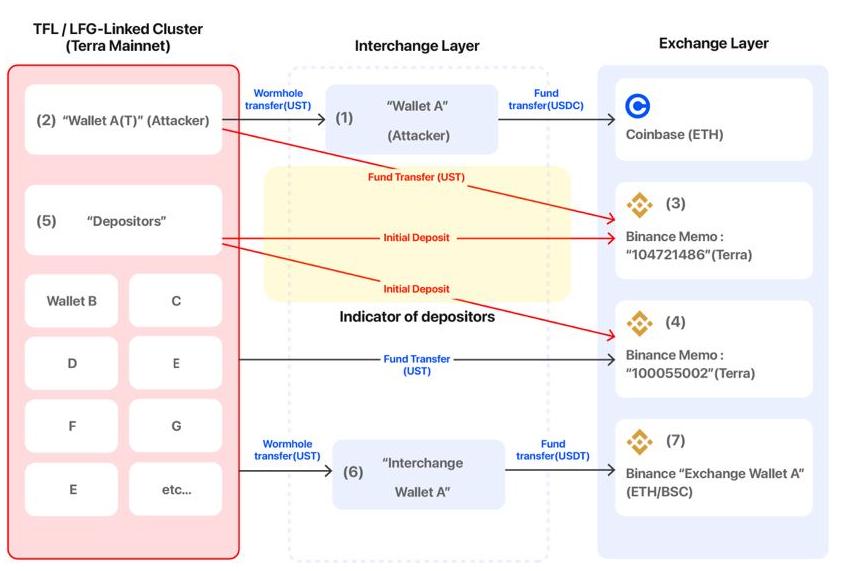
Apparently, the wallet identified as an “attacker” for generating a transaction that caused the collapse of the algorithm-based stablecoin project Terra was actually maintained by Do Kwon’s Terraform Labs.

Apparently, the wallet identified as an “attacker” for generating a transaction that caused the collapse of the algorithm-based stablecoin project Terra was actually maintained by Do Kwon’s Terraform Labs.

Consequently, this indicates that the collapse of the Terra (LUNA) ecosystem, which resulted in losses to investors of tens of billions of dollars, was brought about by activities taken inside the firm, according to new research uncovered by blockchain security company Uppsala Security and CoinDesk Korea published on June 14.

South Korean prosecutors also confirmed that the information revealed that the attackers who hit Terra were not the rumored Wall Street whales, but rather the wallets and internal behavior managed by Terraform Labs itself, which is now being investigated.

Using on-chain data forensic tools, Uppsala Security and CoinDesk Korea have been examining the reason for the Terra project’s crash on May 7 for approximately a month. The wallet (0x8d47f08ebc5554504742f547eb721a43d4947d0a) or referred to as “Wallet A” for convenience had been flagged as an attacker wallet by a slew of research firms.
Terra ecosystem collapses

Wallet A, which was built on the Ethereum blockchain, came into being on May 7, at around 4:32 PM, based on Coordinated Universal Time (UTC).

On the same day, an attempt to de-peg the UST currency, which had been supposed to be tied to the dollar, failed. At around 9:44 p.m. on the same day, Terraform Labs withdrew approximately 150 million USTs, which is equivalent to approximately $150 million, from the DeFi service curve.

This action ensured that the Terra blockchain retained its liquidity. In reference to this topic, the Ceo Kwon Do-hyeong said, “the reason for subtracting the UST worth 150 million dollars from the curve is to provide a more stable UST liquidity.”

TerraUSD de-pegging takes place

The same day, at 9:57 p.m., wallet A swapped 85 million UST for Curve, another stable coin. Wallet A generated a large-scale UST transaction within 13 minutes after Terraform Labs temporarily removed the liquidity of UST from the curve.

Wallet A then transmitted USDC to Coinbase, the biggest North American virtual asset exchange, after exchanging UST. A substantial quantity of UST was put into numerous exchanges throughout the globe before and after this transaction, which accelerated de-pegging and finally led to a bank run.

As a result, Wallet A has been identified as the attacker’s wallet by various blockchain research firms across the globe. Some people speculated that this wallet belonged to a Wall Street financial firm out to bring Terra down.

İlgili Okumalar

$9.4 Billion: The Largest Robotics Funding This Year Has Emerged

Munich-based humanoid robotics company Neura has completed a $1.4 billion (approximately RMB 94.9 billion) Series C funding round, valuing the company at around $7 billion and positioning it among the global leaders in the sector. The investment round is notable not just for its size—reportedly the largest in robotics this year—but also for its strategic backers, which include tech giants like NVIDIA and Amazon, alongside established industrial players such as German engineering firms Bosch and Schaeffler. This mix of investors signals a significant shift in the industry's focus from technological demonstrations and general-purpose narratives toward practical, industrial deployment and commercialization. Neura's approach centers on developing humanoid robots for defined, high-value industrial tasks rather than pursuing a general-purpose model. Its early validation comes from a partnership with BMW, where its robots are being tested on actual production lines. The involvement of Bosch and Schaeffler, companies deeply embedded in global manufacturing, underscores a growing belief that humanoid robots are transitioning from labs to viable factory-floor solutions. The article highlights two converging trends driving investment: advancements in AI and large language models, which enhance robots' perception and decision-making in unstructured environments, and mounting pressure from labor shortages and rising costs in major manufacturing regions. The funding landscape is now bifurcating between companies like Figure AI, focusing on versatile general-purpose robots, and firms like Neura, targeting specific vertical industrial applications with clearer, shorter paths to ROI. While technical hurdles remain, the core challenges for widespread adoption are increasingly seen as engineering and commercial in nature: managing the high integration and customization costs for different factory environments and establishing robust, localized maintenance and service networks. The record investment in Neura, particularly from industrial capital, indicates the industry's growing confidence in moving from proving feasibility to solving the practical problems of scalability, reliability, and building sustainable business models around humanoid robots in real-world settings like automotive manufacturing and hazardous labor environments.

marsbit3 saat önce

$9.4 Billion: The Largest Robotics Funding This Year Has Emerged

marsbit3 saat önce

"119 to 176 Dollars": Behind SpaceX's Listing, MSX Once Again Successfully Executes the Pre-IPO Closed Loop

Following May's 300% gain on Cerebras, MSX delivered another outstanding performance during SpaceX's listing night. On June 12, SpaceX (SPCX) launched on Nasdaq, reaching a high of $176. This marked the successful culmination of MSX's Pre-IPO project launched in March, where users subscribed at $119, achieving gains of approximately 40-48%. This event validated MSX's complete Pre-IPO mechanism, a crucial advantage in a market where access to top-tier private company equity is typically limited to institutions. MSX's model provides a full cycle for users: subscription (at $119 for SpaceX), real-time on-chain portfolio tracking, optional early redemption, seamless conversion to tradable spot assets (SPCX.M) upon IPO, and final settlement in stablecoins. This end-to-end process distinguishes MSX from platforms that faced settlement issues during the SpaceX IPO, highlighting that the core challenge of Pre-IPO is not just access, but a clear exit and conversion path post-listing. This success with SpaceX is MSX's second major Pre-IPO verification, following the Cerebras listing in May, which yielded ~300% returns for early participants. These back-to-back achievements demonstrate MSX's capability to source, structure, and deliver real assets through a replicable on-chain model. The true barrier for Pre-IPO products lies not in providing an entry point, but in ensuring reliable fulfillment from subscription through to post-IPO liquidity. MSX's proven闭环 (closed-loop) process addresses this, offering Web3 users a structured way to access high-growth, pre-public companies in sectors like AI and frontier tech. MSX plans to continue expanding its Pre-IPO portfolio with this focus on authenticity, transparency, and post-listing execution.

Odaily星球日报15 saat önce

"119 to 176 Dollars": Behind SpaceX's Listing, MSX Once Again Successfully Executes the Pre-IPO Closed Loop

Odaily星球日报15 saat önce

İşlemler

Spot
Futures
活动图片