比特币跌破2.4万美元!虚拟币价格再次暴跌,美联储加息是主因?

今天有更懂这个世界一点了吗2022-06-14 tarihinde yayınlandı2022-06-14 tarihinde güncellendi

Özet

在美联储加息的大背景下,美元和相关资产的升值对虚拟币形成挤压效应,虚拟币被作为优先抛售的高风险资产是大概率事件。

以比特币、以太坊为代表的虚拟货币本身属于风险资产,在美联储加息的大背景下,美元升值对风险资产贬值压力加大,因此虚拟币价格下跌是必然的,成交量、流动性下滑也是必然的。

虚拟币再现暴跌行情!截至6月13日17时47分,比特币(BTC)跌破2.4万美元,以太坊(ETH)跌破1300美元,24小时跌幅分别为12.97%和16.56%。随着BTC、ETH暴跌,BNB(币安币)、ADA(艾达币)、XRP(瑞波币)、SOL(索拉纳)、DOGE(狗狗币)等多个虚拟币种跟跌,24小时跌幅均超10%。

对于虚拟币本轮暴跌行情,业内人士普遍认为,在美联储加息的大背景下,美元和相关资产的升值对虚拟币形成挤压效应,虚拟币被作为优先抛售的高风险资产是大概率事件。“如果今年美国的通胀数据持续超预期,引发美联储进一步加快紧缩步伐,虚拟币在未来一段时间内仍然有较大概率进一步走弱”。

虚拟币价格再次暴跌

“今天上午看盘,比特币跌穿2.6万美元,下午再看时已经跌破2.5万美元,傍晚再看已经跌破2.4万美元……真是跌跌不休!”一位币圈人士向《国际金融报》记者感叹道。

近几日,币圈主基调就是“跌跌不休”。英为财情数据显示,截至6月13日17时47分,BTC跌破2.4万美元,报23978.6美元,24小时跌幅达12.97%,7日跌幅达23.15%;ETH更是跌破1300美元,报1223.96美元,24小时跌幅达16.56%,7日跌幅达35.45%,创下年内新低。
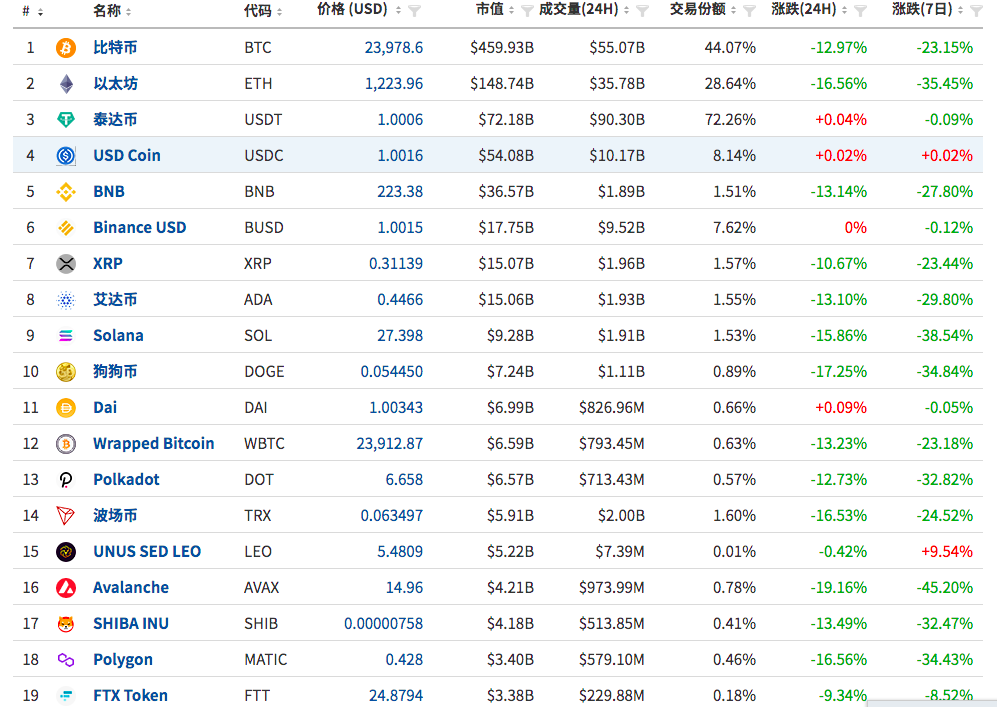
随着比特币、以太坊等主流虚拟币暴跌,其他虚拟币也不能幸免。其中,币安币(BNB)、艾达币(ADA)、瑞波币(XRP)、索拉纳(SOL)、狗狗币(DOGE)、波场币(TRX)等多个虚拟币种24小时跌幅超10%,7日跌幅超23%。

记者注意到,虚拟币在今年2月也曾暴跌。截至北京时间2月24日16时47分,比特币、以太坊等主流虚拟货币悉数下跌,其中比特币24小时跌幅达7.46%,以太坊24小时跌幅达12.45%、币安币24小时跌幅达11.43%。

实际上,以比特币为代表的虚拟币暴跌已不是新鲜事。今年初,比特币曾向下触及43000美元/枚,日内跌幅达6.16%。今年1月20日23时至1月21日11时,比特币从43325.2美元跌至38465.3美元,12小时跌了4859.9美元。

2021年12月4日午间,比特币曾短时跌破42000美元,24小时跌幅超20%。截至当天20时,过去的24小时内共有41.7万人爆仓,虚拟货币全网合约爆仓金额达到25.84亿美元,其中比特币24小时内的爆仓金额超过10亿美元。

美联储加息是主因?

对于虚拟币本轮暴跌,业内人士普遍认为,在美联储加息的大背景下,美元和相关资产的升值对虚拟币之类高风险标的形成挤压效应,虚拟币被抛售导致暴跌。

浙江大学国际联合商学院数字经济与金融创新研究中心联席主任、研究员盘和林对《国际金融报》记者分析指出,比特币和以太坊的跌势是因为这些虚拟货币本身属于风险资产,而在美联储加息的大背景下,美元升值对风险资产贬值压力加大,所以当前虚拟币在一轮跌势当中。在美联储加息过程中,加密币下跌是必然的,成交量、流动性下滑也是必然的。

一位涉虚拟币企业高管高鸿(化名)告诉《国际金融报》记者,最近几个月,虚拟币市场的走势与全球通胀的关联性进一步增加。影响全球资产定价的美国基准利率可能在2022年出现方向性的转变。投资者发现美联储的措辞更加鹰派,引发市场对于Taper(缩减资产购买规模)节奏加快、加息次数增加、加息时间提前的担忧。

“从一些指标来看,市场短期内出现超跌的情况,比特币在目前价格上震荡的概率比较高。但是,如果今年美国的通胀数据持续超预期,引发美联储进一步加快紧缩步伐,虚拟币在未来一段时间内仍然有较大概率进一步走弱。”高鸿表示。


İlgili Okumalar

Podcast Notes: Hyperliquid Has Become the Top Interest Point for Traditional Hedge Funds

Empire Podcast hosts Jason Yanowitz and Santiago Santos discuss the surging institutional interest in Hyperliquid, a decentralized perpetual exchange, marking the highest level of engagement from traditional hedge fund managers since Paul Tudor Jones endorsed Bitcoin in 2020. The primary driver is the demand for weekend trading of commodities like oil, especially during geopolitical tensions such as the Iran conflict, as Hyperliquid provides the only active price discovery venue when traditional markets are closed. Trade XYZ, a front-end on Hyperliquid, has seen significant growth, with weekend oil price predictions having a median error of only 50 basis points. Santos predicts commodity trading volume on Hyperliquid will surpass Bitcoin within the year and that its market cap could rise from $25 billion to $100 billion. Other key points include Kraken raising $200 million at a reduced valuation of $13.3 billion, and the SEC clarifying that self-custodied DeFi frontends like MetaMask are not subject to broker-dealer rules, resolving a major regulatory uncertainty. The hosts also note the strong correlation between crypto and macro markets, with the S&P 500 posting one of its best 10-day rallies since 1950. They highlight MicroStrategy's continued Bitcoin acquisitions and the potential of real-world asset (RWA) tokenization as a key trend. The discussion concludes with skepticism towards many L2 projects, predicting a wave of protocols truly going to zero as capital concentrates in proven assets like Bitcoin and Hyperliquid.

marsbit5 saat önce

Podcast Notes: Hyperliquid Has Become the Top Interest Point for Traditional Hedge Funds

marsbit5 saat önce

a16z: The Next Frontier of AI, The Triple Flywheel of Robotics, Autonomous Science, and Brain-Computer Interfaces

a16z presents a comprehensive investment thesis for the next frontier of AI: Physical AI, centered on a synergistic flywheel of robotics, autonomous science, and novel human-computer interfaces (HCIs) like brain-computers. While the current AI paradigm scales on language and code, the most disruptive future capabilities will emerge from three adjacent fields leveraging five core technical primitives: 1) learned representations of physical dynamics (via models like VLA, WAM, and native embodied models), 2) embodied action architectures (e.g., dual-system designs, diffusion-based motion generation, and RL fine-tuning like RECAP), 3) simulation and synthetic data as scaling infrastructure, 4) expanded sensory channels (touch, neural signals, silent speech, olfaction), and 5) closed-loop agent systems for long-horizon tasks. These primitives converge to power three key domains: * **Robotics:** The literal embodiment of AI, requiring all primitives for real-world physical interaction and manipulation. * **Autonomous Science:** Self-driving labs that conduct hypothesis-experiment-analysis loops, generating structured, causally-grounded data to improve physical AI models. * **Novel HCIs:** Devices (AR glasses, EMG wearables, BCIs) that expand human-AI bandwidth and act as massive data-collection networks for real-world human experience. These domains form a mutually reinforcing flywheel: Robotics enable autonomous labs, which in turn generate valuable data for robotics and materials science. New interfaces provide rich human-physical interaction data to train better robots and scientists. Together, they represent a new scaling axis for AI, moving beyond the digital realm to interact with and learn from physical reality, promising significant emergent capabilities and value.

marsbit5 saat önce

a16z: The Next Frontier of AI, The Triple Flywheel of Robotics, Autonomous Science, and Brain-Computer Interfaces

marsbit5 saat önce

İşlemler

Spot
Futures
活动图片