No! Judge Rejects Former Celsius CEO’s Attempt To Dismiss Fraud Charges

bitcoinist2024-11-13 tarihinde yayınlandı2024-11-13 tarihinde güncellendi

Özet

A former executive of a now-defunct cryptocurrency firm, Celsius Network, will have to continue to face his legal battle as...

A former executive of a now-defunct cryptocurrency firm, Celsius Network, will have to continue to face his legal battle as a US federal court denied his motion to dismiss the charges against him.

It might seem only like a legal battle of a former crypto CEO but in the greater scheme of things, it’s a reflection of the saga of the government’s scrutiny on the digital currency industry.

Motion Denied

The ex-CEO of Celsius Network, Alex Mashinsky, failed to convince a US federal judge to drop two counts of criminal charges against him relating to the manipulation of crypto prices and fraud.

Judge John Koeltl of the US District Court for the Southern District of New York rejected Mashinsky’s motion asking the court to dismiss the two raps against him. Thus, Mashinsky will continue to face the seven complaints in relation to his role in Celsius in January 2025 — a setback that made it inevitable for Mashinsky to defend himself in court when the trial started.

Koeltl ruled that the crypto exec’s arguments to drop the cases were “either moot or without merit.”

Mashinsky’s Argument

Mashinsky’s lawyers argued that their client cannot be charged with violations of the Commodity Exchange Act and the Securities Exchange Act of 1934, saying the court is charging the former CEO with two charges for the same conduct.
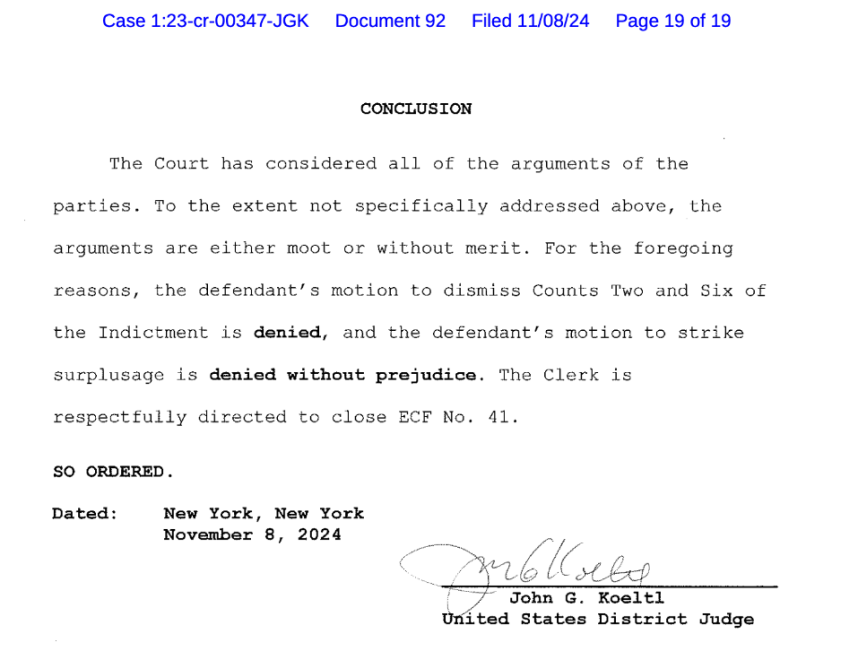
Source: US District Court for the Southern District of New York

However, Koeltl disagreed with their argument, saying a conviction on violating the Securities Exchange Act would not mean that Mahinsky would be acquitted of violating the Commodity Exchange Act.

Mahinsky also claimed that the commodities charge is “legally insufficient”, explaining that the state prosecutors failed to sufficiently allege that the platform’s investors were depositing Bitcoin into a program that offered a weekly reward scheme. The federal judge argued that this argument is a factual question that “cannot be resolved” at this point in the case.

BTCUSD trading at $86,340 on the daily chart: TradingView.com

Koeltl also denied Mashinsky’s motion to dismiss market manipulation charges, saying it is “meritless”. The judge added that the US Court of Appeals for the Second Circuit has already ruled before that “open-market transactions that are not inherently manipulative may constitute manipulative activity when accompanied by manipulative intent.”

Celsius: Legal Woes

Celsius used to be a prominent crypto platform in the industry. Unfortunately, the firm collapsed in 2022 following the freezing of customer withdrawals. The company also filed for bankruptcy amidst the huge balance sheet deficit.

As a result, the SEC charged Mashinsky with fraud and manipulating the market which caused the collapse of the crypto firm.

State authorities said that the crypto CEO deceived the investors and claimed that CEL, the firm’s coin, was safer than it was.

If convicted of all the seven charges, Mashinsky could spend 115 years in state prison. The former CEO has not yet pleaded not guilty to these charges.

Featured image from Public Policy Institute of California, chart from TradingView

Christian Encila

Christian Encila

Christian, a journalist and editor with leadership roles in Philippine and Canadian media, is fueled by his love for writing and cryptocurrency. Off-screen, he's a cook and cinephile who's constantly intrigued by the size of the universe.

İlgili Okumalar

When Hyperliquid Steals Solana's 'Internet Capital Market' Script

The article "When Hyperliquid Steals Solana's 'Internet Capital Markets' Playbook" discusses Solana's struggles to maintain its "internet capital markets" narrative by 2026. Despite its initial success as a high-performance "Ethereum killer," SOL's price has underperformed, dropping significantly compared to other major cryptocurrencies. Solana's vision of a global, on-chain trading network for all assets is being challenged not primarily by Ethereum, but by Hyperliquid. Hyperliquid, evolving from a perpetual contracts platform into a dedicated financial infrastructure Layer 1, has become a major beneficiary of the shift of derivatives trading from centralized exchanges to on-chain. The article argues that for high-frequency financial trading, a specialized, performance-focused chain like Hyperliquid may be more suitable than a general-purpose ecosystem like Solana. Further compounding Solana's issues was a major $200+ million exploit on its key perpetual protocol, Drift, in April, which damaged market confidence. In response, Solana founder Anatoly Yakovenko heavily promoted the protocol Phoenix as a replacement, boosting its visibility but not its trading volume, which remains far behind leading platforms. Solana supporters have launched a public critique of Hyperliquid's decentralization, pointing to its limited validators and closed-source code. Critics, however, note Solana's own declining validator count and centralization metrics. This strategy has also caused internal friction, with developers of other Solana protocols expressing discontent over the foundation's perceived favoritism towards Phoenix. The conclusion is that Hyperliquid's rise represents a challenge to the "general-purpose blockchain" narrative, proving that the core of a capital market might be a specialized trading engine rather than a broad ecosystem. If Solana cannot regain dominance in derivatives, it risks remaining a "meme coin paradise" while its grand "internet capital markets" ambition slips away.

marsbit51 dk önce

When Hyperliquid Steals Solana's 'Internet Capital Market' Script

marsbit51 dk önce

When Hyperliquid Steals Solana's 'Internet Capital Markets' Playbook

The article discusses how Solana's grand vision of becoming an "Internet Capital Markets" platform is facing significant challenges in 2026, primarily from the unexpected rise of Hyperliquid. Solana's performance has weakened, with its token SOL experiencing the largest price decline among major cryptocurrencies. Its core narrative of building a global, chain-based marketplace for all assets is under pressure both internally and externally. Hyperliquid, originally a perpetual futures exchange, has evolved into a dedicated Layer 1 financial infrastructure network. Its focused, trading-centric approach is attracting capital and challenging the assumption that a "general-purpose" ecosystem like Solana is necessary for a capital market. Hyperliquid's success suggests that for high-frequency trading, superior performance, liquidity, and user experience may be more critical than a broad application ecosystem. Internally, Solana's strategy suffered a blow from a major hack on the Drift Protocol in April, resulting in over $200 million in losses. In response, Solana founder Anatoly Yakovenko has heavily promoted Phoenix as a new decentralized perpetual futures platform on Solana. While this boosted Phoenix's visibility, its trading volume remains far behind leading platforms. Solana's community has launched a rhetorical attack against Hyperliquid, questioning its decentralization due to its limited validator set and closed-source code. Critics, however, point out Solana's own decreasing validator count and increasing centralization of stake. This focus on "decentralization metrics" has also caused internal friction, with other Solana ecosystem developers expressing discontent over the foundation's perceived favoritism towards Phoenix. The article concludes that the rise of Hyperliquid represents a challenge to the "general-purpose blockchain" narrative, proving that an efficient trading engine might be more central to a capital market than a vast ecosystem. If Solana cannot regain dominance in the derivatives space, it risks remaining a "meme coin paradise" rather than achieving its ambition of hosting global assets.

链捕手59 dk önce

When Hyperliquid Steals Solana's 'Internet Capital Markets' Playbook

链捕手59 dk önce

Samsung Bets on Mobile HBM: AI Moves from Cloud to Palm, a New Frontier in Semiconductor Investment?

Samsung is betting on bringing high-bandwidth memory (HBM) technology from servers to mobile devices, aiming to enable powerful on-device AI features in smartphones and tablets. This move is driven by the booming AI market, where HBM demand from data centers has fueled Samsung's record profits, with HBM4 already in mass production. By integrating mobile HBM, Samsung seeks to transform user AI experiences—making tasks like image generation and real-time translation faster, seamless, and more private by processing data locally. Strategically, this allows Samsung to leverage its vertical integration in memory, advanced packaging, and Exynos processors to differentiate its Galaxy devices against competitors like Apple and Qualcomm. It also opens a new consumer growth avenue, reducing reliance on volatile server HBM demand alone. The initiative is expected to benefit the broader supply chain, boosting demand for advanced packaging materials, thermal solutions, and other components. While promising, risks include potential delays in mobile HBM mass production beyond 2027, high initial costs, and the cyclical nature of the memory market. Nonetheless, Samsung's push signals a broader industry shift toward hybrid cloud-edge AI computing, positioning it as a key player in defining the future of AI-powered devices and presenting a potential long-term investment theme in semiconductors.

marsbit1 saat önce

Samsung Bets on Mobile HBM: AI Moves from Cloud to Palm, a New Frontier in Semiconductor Investment?

marsbit1 saat önce

Trillion-Dollar Banking Giant Adjusts Portfolio: Buys XRP Heavily, Clears Out Solana

In a significant portfolio rebalancing move, Italian banking giant Intesa Sanpaolo, with $1.1 trillion in assets, has made a notable shift in its cryptocurrency holdings. According to disclosures from Q4 2025 to Q1 2026, the bank's total crypto exposure surged from $100 million to approximately $235 million. The most striking action was its first-time establishment of an XRP position, investing around $18 million through the Grayscale XRP Trust. This marks a milestone as one of the first major European banks to adopt XRP via a regulated investment vehicle. This move is part of a broader, systematic digital asset strategy. The bank also substantially increased its Bitcoin exposure via ETFs and initiated its first Ethereum investment through a staking trust. In a contrasting strategic pivot, Intesa Sanpaolo drastically reduced its Solana holdings by over 99%, nearly exiting its position in a Bitwise Solana staking ETF. This shift is interpreted as reflecting a institutional preference for assets perceived with lower regulatory and operational risk, especially following Solana's network stability issues and improved clarity for XRP after its legal settlements. The bank's actions highlight key drivers for institutional adoption: clearer regulations, the availability of compliant ETF products, and the search for portfolio diversification. This trend signifies crypto's evolving status from a niche experiment to a recognized component of mainstream asset allocation, with institutions favoring gradual, regulated entry points over direct token ownership.

marsbit2 saat önce

Trillion-Dollar Banking Giant Adjusts Portfolio: Buys XRP Heavily, Clears Out Solana

marsbit2 saat önce

İşlemler

Spot
Futures
活动图片