Dogecoin Price Prediction: Analyst Says Massive Parabolic Run Is Coming, Here’s The Target

bitcoinist2024-10-18 tarihinde yayınlandı2024-10-18 tarihinde güncellendi

Özet

Crypto analyst Javon Marks has predicted that the Dogecoin price will soon witness a parabolic run. This prediction follows his...

Crypto analyst Javon Marks has predicted that the Dogecoin price will soon witness a parabolic run. This prediction follows his analysis of the meme coin’s historical performance, which he claimed could lead to a price rally of over 400%. 

Dogecoin Price To Reach All-Time High Soon Enough

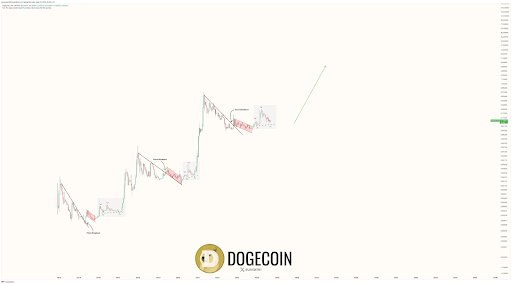
Marks predicted in an X post that the Dogecoin price could reach its current all-time high (ATH) of $0.73 as it enjoys a quick 431% rally from its current price. The analyst noted that this price prediction was based on the meme coin’s price and past performances in previous cycles. In line with this, Marks believes that DOGE could be in the early stages of another parabolic run.  

Dogecoin
Source: X

Based on Marks’ analysis, the Dogecoin price’s rally to its current ATH will likely be the start of its bull run in this cycle. The analyst predicts that the foremost will rise beyond the $0.7 price level and reach as high as $3. This isn’t the first time Javon Marks has predicted that DOGE could enjoy such a massive rally. 
Dogecoin 2
Source: X

The analyst previously predicted that Dogecoin could enjoy a 21,700% rise to $17 based on its bull market trend. He noted that Dogecoin has always enjoyed larger price gains in every successive market cycle. As such, he doesn’t expect this time to be different, with DOGE topping its last cycle’s gains in this bull run. 

Crypto analyst Dima James also recently echoed a similar sentiment, asserting that DOGE will surpass its previous gains in the last two cycles and outperform Bitcoin in the process. James also believes the Dogecoin price could reach double digits with a price target of $10 in this market cycle. 

Dogecoin Rallies Again Thanks To Elon Musk

The Dogecoin price has increased by over 7% in the last 24 hours. This price rally followed Elon Musk’s appearance at a Pennslyvania town hall, where he discussed his plans for the proposed ‘Department of Government Efficiency’ (D.O.G.E). 

DOGE continues to react positively to Musk’s mention of the D.O.G.E department because of the world’s richest man’s ties to the meme coin. Dogecoin had also rallied by over 7% on October 16 following Musk’s mention of the D.O.G.E department in an X post. 

Meanwhile, thanks to the most recent rally, DOGE reached its highest level since late July, sparking optimism that it is time for the meme coin to make its run in this market cycle. The foremost meme coin has so far underperformed compared to other top meme coins like Pepe (PEPE) and Dogwifhat (WIF)

At the time of writing, the Dogecoin price is trading at around $0.13, up in the last 24 hours, according to data from CoinMarketCap. 

Dogecoin price chart from Tradingview.com
DOGE price shows bullish strength | Source: DOGEUSDT on Tradingview.com
Featured image created with Dall.E, chart from Tradingview.com
Scott Matherson

Scott Matherson

Scott Matherson is a leading crypto writer at Bitcoinist, who possesses a sharp analytical mind and a deep understanding of the digital currency landscape. Scott has earned a reputation for delivering thought-provoking and well-researched articles that resonate with both newcomers and seasoned crypto enthusiasts. Outside of his writing, Scott is passionate about promoting crypto literacy and often works to educate the public on the potential of blockchain.

İlgili Okumalar

24/5 Settlement Is Here for US Stocks, but Cryptocurrency Didn't Get a Ticket

The U.S. National Securities Clearing Corporation (NSCC), a subsidiary of the Depository Trust & Clearing Corporation (DTCC), has announced the implementation of 24-hour clearing operations on weekdays. This move, approved by the SEC and being rolled out in phases, fundamentally challenges a core narrative of the cryptocurrency industry: that digital assets offer a unique advantage with their 7x24 trading availability, unlike traditional markets that close at 4 p.m. The transition to near-continuous clearing for stocks and other traditional assets diminishes this perceived crypto edge. While crypto markets still operate on weekends, the article notes that DTCC could potentially expand to weekend clearing in the future if demand warrants. The development is presented as another instance where DTCC has disappointed crypto enthusiasts. Despite frequent speculation from communities supporting Ethereum, XRP Ledger, and others that DTCC would integrate public blockchains, the clearing giant consistently opts for private, permissioned distributed ledger solutions for its projects, such as its Ion platform and a recent U.S. Treasury tokenization initiative on the Canton network. The article concludes that the successful launch of this traditional finance "always-on" market relied entirely on existing mature infrastructure, with the cryptocurrency industry failing to secure a role or "admission ticket" in its implementation.

Foresight News14 dk önce

24/5 Settlement Is Here for US Stocks, but Cryptocurrency Didn't Get a Ticket

Foresight News14 dk önce

Karpathy's Genius Strikes Again, Challenging RAG, Turning Your Notes into a Second Brain

Andrej Karpathy has proposed a revolutionary concept for managing personal knowledge: treating notes as immutable "source code" and using LLMs as "compilers" to build a structured, interlinked wiki. This approach fundamentally shifts the cognitive workflow away from the limitations of RAG (Retrieval-Augmented Generation), which merely retrieves and pieces together fragments, leading to contradictions and "digital mummies"—unused, decaying notes. The LLM-Wiki framework introduces a three-layer architecture: the **Raw Layer** for original, immutable notes; the **Schema Layer** defining rules for structuring knowledge; and the **Wiki Layer**, where the LLM continuously compiles and maintains a coherent, cross-referenced knowledge base. Key operations are **Ingest** (adding new material, which triggers updates across related pages), **Query** (asking the compiled wiki, with answers that can become new pages), and **Lint** (periodic AI audits to find contradictions, outdated claims, or gaps). This system automates the tedious maintenance—updating links, resolving conflicts, keeping summaries fresh—that has historically made large-scale personal knowledge management unsustainable. It realizes Vannevar Bush's 1945 "Memex" vision by finally solving the maintenance problem. Karpathy's proposal represents a third piece in human-AI collaboration, following "Vibe Coding" and "Agentic Engineering." It liberates human attention from organizational drudgery, refocusing it on what matters: deciding what to read and deriving meaning.

marsbit24 dk önce

Karpathy's Genius Strikes Again, Challenging RAG, Turning Your Notes into a Second Brain

marsbit24 dk önce

Claude Science Completes Two Years' Work in a Few Weeks, Is 10x Research Acceleration Really Here?

Claude Science, a new AI workbench from Anthropic, is being tested by scientists, reportedly accelerating specific research workflows by up to 10x. A neuro-scientist at the Allen Institute completed a lengthy literature review in weeks instead of nearly two years using the tool, which automates tasks like citation verification. The platform is an integrated environment for macOS and Linux, connecting to local or remote computing resources. It streamlines the fragmented research process—literature analysis, computation, visualization, and drafting—into a single, auditable workflow. A key feature is its emphasis on reproducibility: every chart generated includes the exact code, environment, and history used to create it. Claude Science uses a multi-agent system. A coordinator manages over 60 pre-configured skills for life sciences (genomics, proteomics, etc.) and can spawn specialized agents. A dedicated reviewer agent checks citations and calculations for accuracy, creating a form of internal AI peer review. The system operates with a human-in-the-loop, requiring user approval for major steps. Initial applications are in life sciences. Examples include target identification for biotech company Manifold Bio and germline variant analysis for glioma research at UCSF, completing analyses in roughly one-tenth the previous time. The approach contrasts with competitors: Google focuses on proprietary models like AlphaFold, while OpenAI is advancing models' scientific reasoning with benchmarks like GeneBench-Pro. Claude Science differentiates by automating and integrating the practical research pipeline, not just the model's intelligence, aiming to make AI-aided science more reproducible and integrated into daily lab work.

marsbit27 dk önce

Claude Science Completes Two Years' Work in a Few Weeks, Is 10x Research Acceleration Really Here?

marsbit27 dk önce

İşlemler

Spot
活动图片