$500M of on-chain collateral will face liquidation if ETH falls to…

Ambcrypto2022-06-12 tarihinde yayınlandı2022-06-12 tarihinde güncellendi

Özet

$500M of on-chain collateral will face liquidation if ETH falls to…

Ethereum [ETH], the world’s largest altcoin, might be losing its plot despite anticipation around the Merge. Rather, one can say that the token is seeing a delayed plot. Ethereum core developer Tim Beiko recently opined that the merge to proof-of-stake (PoS) would happen between August and November. This announcement follows more bad news for Ethereum enthusiasts hoping for the completion of the Ethereum 2.0 Merge in August.

Here comes another bomb…

Data on Coinbase revealed that Ethereum was priced at $1,519.03 to the U.S dollar at press time, having fallen by 11.53% over the past 24 hours. In fact, ETH remains well below its all-time high of $4,891.70. In the last week alone, the crypto fell by 14.04%.

According to blockchain data explorer Blockchair, exactly 1,228,131 Ethereum transactions failed between 1 May and 31 May. Furthermore, the trend seemed to continue at the time of writing. Ergo, Ethereum’s transaction volumes have also dropped substantially given the current situation.

Towards the beginning of the week on 5 June, it went as low as 1.22 million ETH — A level not seen since mid-2020. At press time as well, the number stood in the one million to two million bracket. Indeed, a downtrend since May 2021.
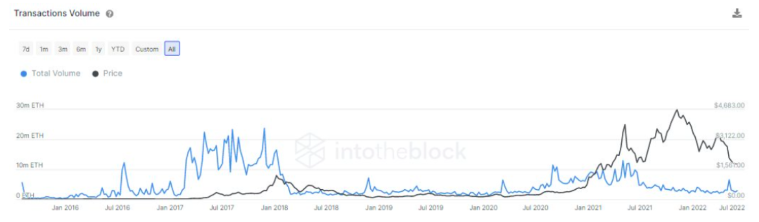
While most cryptocurrency market participants continue to struggle with bearish days, HODLers of the second-largest asset by market capitalization are also facing record lows in profit. Indeed, the percentage of Ethereum addresses in profits is at its monthly low.

Also, as revealed by Glassnode’s on-chain alerts account on 12 June, HODLers in losses have significantly inclined.
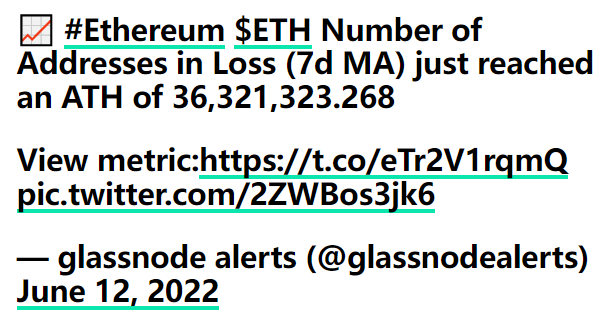
This is the after-effect of increasing Ethereum selling pressure as the price continues to trade down south.

Saving the best for the last?

Another MAJOR concern for Ethereum is unprecedented liquidation at the moment. Around $230 million worth of ETH tokens were liquidated in a day as the price declined. This is now, but the sheer decline could have some serious implications soon. Consider this, for instance –

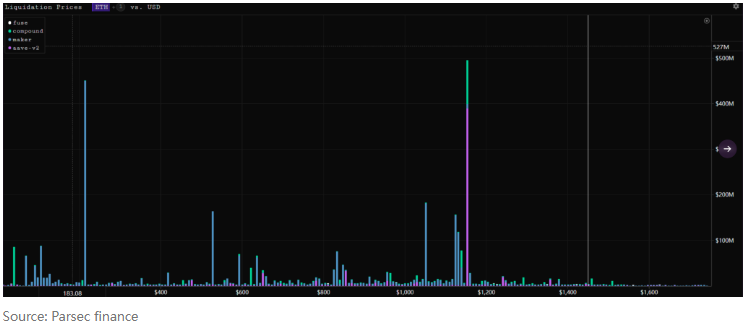
According to parsec finance, when ETH falls to around $1,150, nearly $500 million of on-chain collateral will face liquidation. wBTC will have more than $300 million of on-chain collateral near $21,600 or face liquidations.
Additionally, as per Curve, the stETH/ETH pool asset ratio is skewed, with ETH accounting for 24.11% and stETH accounting for 75.89%. stETH de-pegged slightly and the unbalanced pool signified that one of the assets, stETH in this case, is becoming more illiquid i.e. It would become difficult to sell as there isn’t enough ETH liquidity to incorporate sell orders of stETH at current prices.

Looks like we just have to wait and look for what’s in store next?

İlgili Okumalar

$9.4 Billion: The Largest Robotics Funding This Year Has Emerged

Munich-based humanoid robotics company Neura has completed a $1.4 billion (approximately RMB 94.9 billion) Series C funding round, valuing the company at around $7 billion and positioning it among the global leaders in the sector. The investment round is notable not just for its size—reportedly the largest in robotics this year—but also for its strategic backers, which include tech giants like NVIDIA and Amazon, alongside established industrial players such as German engineering firms Bosch and Schaeffler. This mix of investors signals a significant shift in the industry's focus from technological demonstrations and general-purpose narratives toward practical, industrial deployment and commercialization. Neura's approach centers on developing humanoid robots for defined, high-value industrial tasks rather than pursuing a general-purpose model. Its early validation comes from a partnership with BMW, where its robots are being tested on actual production lines. The involvement of Bosch and Schaeffler, companies deeply embedded in global manufacturing, underscores a growing belief that humanoid robots are transitioning from labs to viable factory-floor solutions. The article highlights two converging trends driving investment: advancements in AI and large language models, which enhance robots' perception and decision-making in unstructured environments, and mounting pressure from labor shortages and rising costs in major manufacturing regions. The funding landscape is now bifurcating between companies like Figure AI, focusing on versatile general-purpose robots, and firms like Neura, targeting specific vertical industrial applications with clearer, shorter paths to ROI. While technical hurdles remain, the core challenges for widespread adoption are increasingly seen as engineering and commercial in nature: managing the high integration and customization costs for different factory environments and establishing robust, localized maintenance and service networks. The record investment in Neura, particularly from industrial capital, indicates the industry's growing confidence in moving from proving feasibility to solving the practical problems of scalability, reliability, and building sustainable business models around humanoid robots in real-world settings like automotive manufacturing and hazardous labor environments.

marsbit1 saat önce

$9.4 Billion: The Largest Robotics Funding This Year Has Emerged

marsbit1 saat önce

"119 to 176 Dollars": Behind SpaceX's Listing, MSX Once Again Successfully Executes the Pre-IPO Closed Loop

Following May's 300% gain on Cerebras, MSX delivered another outstanding performance during SpaceX's listing night. On June 12, SpaceX (SPCX) launched on Nasdaq, reaching a high of $176. This marked the successful culmination of MSX's Pre-IPO project launched in March, where users subscribed at $119, achieving gains of approximately 40-48%. This event validated MSX's complete Pre-IPO mechanism, a crucial advantage in a market where access to top-tier private company equity is typically limited to institutions. MSX's model provides a full cycle for users: subscription (at $119 for SpaceX), real-time on-chain portfolio tracking, optional early redemption, seamless conversion to tradable spot assets (SPCX.M) upon IPO, and final settlement in stablecoins. This end-to-end process distinguishes MSX from platforms that faced settlement issues during the SpaceX IPO, highlighting that the core challenge of Pre-IPO is not just access, but a clear exit and conversion path post-listing. This success with SpaceX is MSX's second major Pre-IPO verification, following the Cerebras listing in May, which yielded ~300% returns for early participants. These back-to-back achievements demonstrate MSX's capability to source, structure, and deliver real assets through a replicable on-chain model. The true barrier for Pre-IPO products lies not in providing an entry point, but in ensuring reliable fulfillment from subscription through to post-IPO liquidity. MSX's proven闭环 (closed-loop) process addresses this, offering Web3 users a structured way to access high-growth, pre-public companies in sectors like AI and frontier tech. MSX plans to continue expanding its Pre-IPO portfolio with this focus on authenticity, transparency, and post-listing execution.

Odaily星球日报14 saat önce

"119 to 176 Dollars": Behind SpaceX's Listing, MSX Once Again Successfully Executes the Pre-IPO Closed Loop

Odaily星球日报14 saat önce

İşlemler

Spot
Futures
活动图片