Ethereum: To buy or not to buy?

Ambcrypto2022-06-11 tarihinde yayınlandı2022-06-11 tarihinde güncellendi

Özet

Ethereum: To buy or not to buy? The third point might save your portfolio

Disclaimer: The findings of the following analysis are the sole opinions of the writer and should not be considered investment advice.

The entire cryptocurrency market is still reeling following the crash triggered by Terra UST‘s depegging fiasco. As explained in one of our earlier articles, even the flagship Bitcoin has been stuck in a narrow range ever since the crash and is showing no signs of any major recovery yet. And, Ethereum seems to be no different.

Dead price action

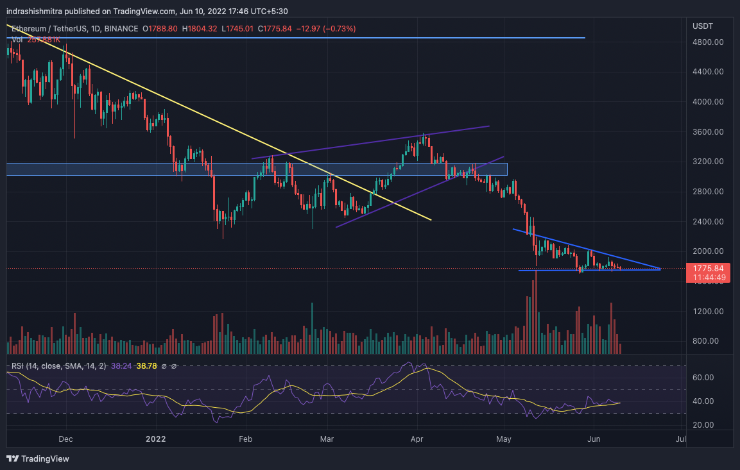
Technically speaking, there’s little to no chance of recovery in the short term for the top altcoin. In fact, a closer look at the last few weeks shows that it is currently in the process of jumping about in a descending triangle and a convincing breakdown below the bottom trendline can have catastrophic consequences.
It must also be noted that despite Ethereum blockchain’s Ropsten testnet’s successful ‘merge’ – moving from the PoW execution layer to the Beacon Chain’s PoS consensus chain on 8 June – it has had no effect whatsoever on the price (or optimism) regarding the coin.

Thus, even though there’s nothing wrong – ironically it seems, people are beginning to fear the market and especially its volatility.

Say whaa…?

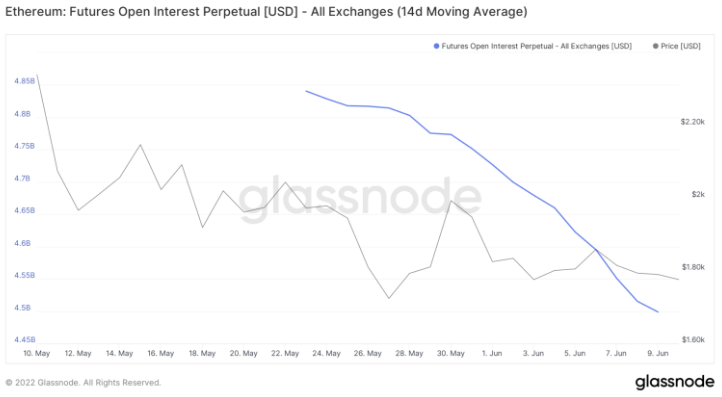
Yes, this could be one possible answer from a variety of reasons that could be behind Ethereum’s lackluster performance on the charts. For example, Ethereum Perpetual Futures open interest has been dipping over the past few days, ever since the beginning of June in fact.

It suggests that derivatives traders are cutting down their exposures to the asset fearing, most probably, on-coming volatility and mitigating some of the risks.
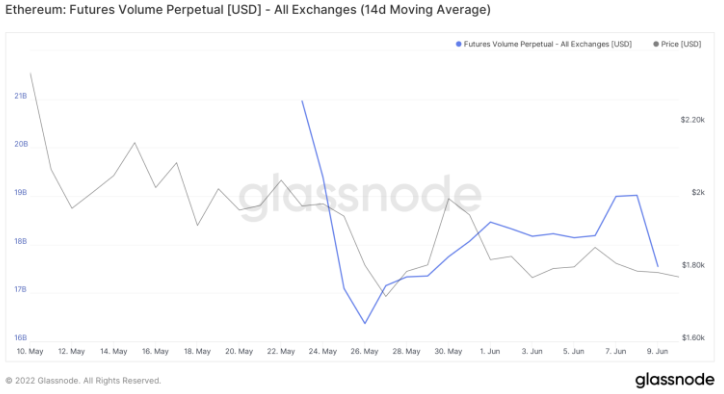
Along with that, Ethereum Perpetual Futures volumes have also been dipping, with a sharp dip between 8 and 9 June – further adding weight to the above view.
Not all’s bad

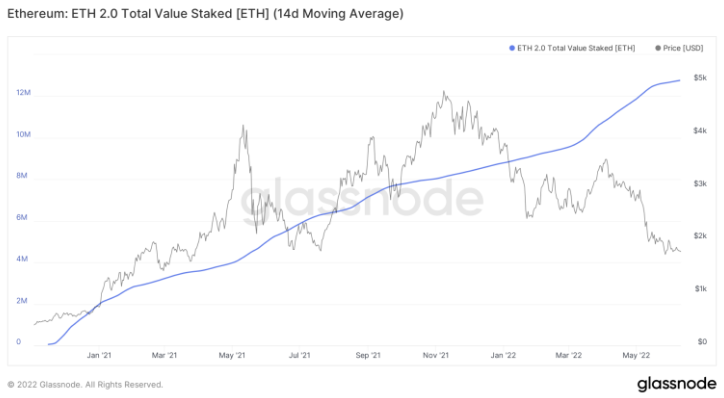
Despite the poor reaction of prices to the first successful merge on the Ropsten testnet, ETH 2.0 staking has been stable. Total deposits to the ETH 2.0 deposit contract have been holding very steady and are rising continuously – which provides much-needed support for the Merge and its eventual consequences.
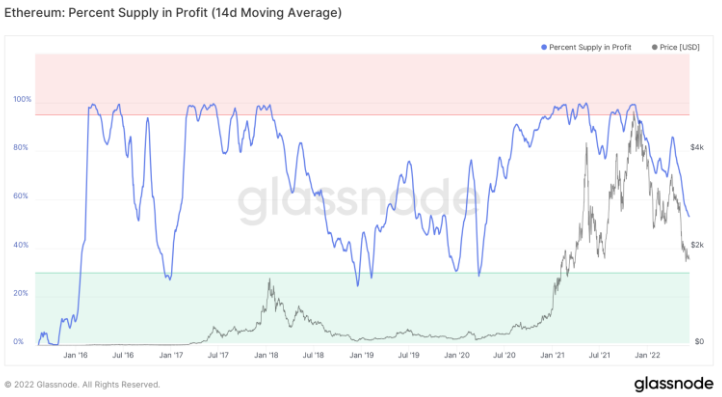
Along with that, despite the massive crash in the past few months, over 53% of the supply is still in profit. Therefore, a further fall triggered by a panic sell seems to be quite low. Unless of course, there is a major profit booking on major whale accounts.

Moreover, according to data from Glassnode, the percentage of circulating supply in profit, that is, the percentage of existing coins whose price at the time they last moved was lower than the current price.
So, noting all the points above, Ethereum can be considered to be in a consolidation phase and buy-on-dips can be a foolproof strategy to abide by, going forward. But nevertheless, the possibility of further crashes cannot be ruled out amidst the impressively poor market sentiments all around.

İlgili Okumalar

$9.4 Billion: The Largest Robotics Funding This Year Has Emerged

Munich-based humanoid robotics company Neura has completed a $1.4 billion (approximately RMB 94.9 billion) Series C funding round, valuing the company at around $7 billion and positioning it among the global leaders in the sector. The investment round is notable not just for its size—reportedly the largest in robotics this year—but also for its strategic backers, which include tech giants like NVIDIA and Amazon, alongside established industrial players such as German engineering firms Bosch and Schaeffler. This mix of investors signals a significant shift in the industry's focus from technological demonstrations and general-purpose narratives toward practical, industrial deployment and commercialization. Neura's approach centers on developing humanoid robots for defined, high-value industrial tasks rather than pursuing a general-purpose model. Its early validation comes from a partnership with BMW, where its robots are being tested on actual production lines. The involvement of Bosch and Schaeffler, companies deeply embedded in global manufacturing, underscores a growing belief that humanoid robots are transitioning from labs to viable factory-floor solutions. The article highlights two converging trends driving investment: advancements in AI and large language models, which enhance robots' perception and decision-making in unstructured environments, and mounting pressure from labor shortages and rising costs in major manufacturing regions. The funding landscape is now bifurcating between companies like Figure AI, focusing on versatile general-purpose robots, and firms like Neura, targeting specific vertical industrial applications with clearer, shorter paths to ROI. While technical hurdles remain, the core challenges for widespread adoption are increasingly seen as engineering and commercial in nature: managing the high integration and customization costs for different factory environments and establishing robust, localized maintenance and service networks. The record investment in Neura, particularly from industrial capital, indicates the industry's growing confidence in moving from proving feasibility to solving the practical problems of scalability, reliability, and building sustainable business models around humanoid robots in real-world settings like automotive manufacturing and hazardous labor environments.

marsbit1 saat önce

$9.4 Billion: The Largest Robotics Funding This Year Has Emerged

marsbit1 saat önce

"119 to 176 Dollars": Behind SpaceX's Listing, MSX Once Again Successfully Executes the Pre-IPO Closed Loop

Following May's 300% gain on Cerebras, MSX delivered another outstanding performance during SpaceX's listing night. On June 12, SpaceX (SPCX) launched on Nasdaq, reaching a high of $176. This marked the successful culmination of MSX's Pre-IPO project launched in March, where users subscribed at $119, achieving gains of approximately 40-48%. This event validated MSX's complete Pre-IPO mechanism, a crucial advantage in a market where access to top-tier private company equity is typically limited to institutions. MSX's model provides a full cycle for users: subscription (at $119 for SpaceX), real-time on-chain portfolio tracking, optional early redemption, seamless conversion to tradable spot assets (SPCX.M) upon IPO, and final settlement in stablecoins. This end-to-end process distinguishes MSX from platforms that faced settlement issues during the SpaceX IPO, highlighting that the core challenge of Pre-IPO is not just access, but a clear exit and conversion path post-listing. This success with SpaceX is MSX's second major Pre-IPO verification, following the Cerebras listing in May, which yielded ~300% returns for early participants. These back-to-back achievements demonstrate MSX's capability to source, structure, and deliver real assets through a replicable on-chain model. The true barrier for Pre-IPO products lies not in providing an entry point, but in ensuring reliable fulfillment from subscription through to post-IPO liquidity. MSX's proven闭环 (closed-loop) process addresses this, offering Web3 users a structured way to access high-growth, pre-public companies in sectors like AI and frontier tech. MSX plans to continue expanding its Pre-IPO portfolio with this focus on authenticity, transparency, and post-listing execution.

Odaily星球日报13 saat önce

"119 to 176 Dollars": Behind SpaceX's Listing, MSX Once Again Successfully Executes the Pre-IPO Closed Loop

Odaily星球日报13 saat önce

İşlemler

Spot
Futures
活动图片