Биткоин-разработчик представил «самый анонимный» мессенджер

cryptonews.ru2023-06-04 tarihinde yayınlandı2024-10-04 tarihinde güncellendi

Мессенджер DarkIRC, который позиционируется как «самый надежный анонимный чат в мире», перешел в фазу альфа-тестирования. Об этом сообщил биткоин-разработчик «старой школы» Амир Тааки.

DarkIRC is the world's strongest anonymous chat. There is no identity. Messages have no link.

Free society means free speech. That means all speech. Without limits.

We made this chat because of the brutal censorship of crypto devs by authoritarian regimes.

The power regime… pic.twitter.com/AXf6YlGf5J

— Amir Taaki (@Narodism) October 2, 2024

По его словам, причиной создания решения стала «жестокая цензура разработчиков криптовалют со стороны авторитарных режимов».

Основной особенностью DarkIRC является «отсутствие идентификации». Пользователи приложения могут менять свой псевдоним в любое время, поэтому сообщения невозможно сопоставить с конкретной личностью.

«Все другие приложения заставляют вас регистрироваться или генерировать ключи. Затем это становится вашим идентификатором. Все ваши сообщения привязаны к этому идентификатору. Но у DarkIRC нет идентификации. Вы просто отправляете сообщения в анонимную P2P-сеть на базе Tor», — объяснил Тааки.

Для борьбы со спамом мессенджер использует обнулители ограничения скорости на сетевом уровне, которые предотвращают переполнение сети. Каждый канал может устанавливать собственную политику для публикаций, а пользователи добавлять опциональную модерацию.
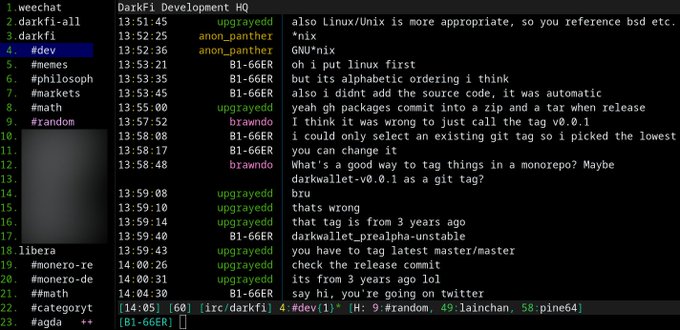
Полный узел DarkIRC, работающий через Tor. Данные: X.

DarkIRC работает на любых компьютерах и мобильных устройствах. Для приложения можно установить собственный интерфейс или IRC-фронтенд.

«ЕС заставил Telegram передать им все данные чатов. Это новая норма. Но хватит. Свободное общество должно иметь свободу слова. Свобода слова подразумевает любое слово. […] Наша цель — снова сделать интернет диким с помощью густого темного леса шифрования. Этот темный лес укрывает и защищает свободу. Это интернет с массовой сильной криптографией повсюду, непроницаемый для наблюдения», — подытожил разработчик.

Напомним, в конце сентября управляющий партнер Variant Fund Джесс Уолден спрогнозировал смерть «ценностей шифропанка» в блокчейне в течение следующих 10 лет.

İlgili Okumalar

The Domestic Answer to Space Computing Power: Photonics Are More Efficient, Musk and Huang's Approaches Are Too Roundabout

The Space Computing Race: A Photonic Advantage The competition for space-based computing has intensified, with figures like Elon Musk and NVIDIA's Jensen Huang highlighting its potential. Musk predicts solar-powered AI satellites could offer the most cost-effective computing by 2032. However, space presents extreme challenges for traditional electronic chips: radiation from cosmic particles can cause errors, the vacuum environment hinders heat dissipation, and limited solar power constrains energy-hungry systems. Photonic computing, using light instead of electrons, offers a promising solution. Its core advantages for space are threefold: 1) **Radiation Resistance**: Photons are charge-neutral, making them inherently immune to particle interference. 2) **Low Heat Generation**: Light propagation in waveguides generates minimal heat, bypassing critical thermal management issues. 3) **Low Power Consumption**: Photonic chips have near-zero static power draw, aligning perfectly with the energy constraints of satellites. Furthermore, for a given payload weight and volume, photonic systems can potentially deliver higher total compute density. Since they require less bulky cooling and power infrastructure, more space can be allocated to the compute units themselves. While photonic computing holds great promise, current industry approaches face hurdles like the memory-compute bottleneck (separate storage and processing) and challenges in large-scale integration. Engineering for space—withstanding launch vibrations and validating full system operation in orbit—remains a critical step. The path forward resembles the evolution from single GPUs to computing clusters, but via a photonic route. As electronic chips approach physical limits in miniaturization, photonic computing and optical interconnects (光算光联) may provide a key alternative to bypass these constraints and define the next generation of space-based computing capabilities.

marsbit35 dk önce

The Domestic Answer to Space Computing Power: Photonics Are More Efficient, Musk and Huang's Approaches Are Too Roundabout

marsbit35 dk önce

İşlemler

Spot
活动图片