The European Blockchain Convention (EBC) took over Barcelona for its 10th edition. The two-day event featured a line-up of speakers that fostered exciting dialogues between the industry experts.
The Catalan capital saw some of the crypto industry’s brightest minds discuss digital assets, Decentralized Finance (DeFi), tokenization, Web3, and sustainability, exploring the industry’s future amid the growing adoption and evolving regulatory framework worldwide.
Day 1: “Crypto Adoption Can’t Be Forced”
On September 25, EBC10 kickstarted its “biggest edition yet” with Daniel Salmeron and Victoria Gago, two of EBC’s founders, discussing why the world needs crypto. The day was followed by a debate between Alireza Siadat (Annerton), Yael Ossowski (Consumer Choice Center), and Vugar Adigozalov (Bidget).
The panelists discussed the slow adoption of the industry and the importance of user experience (UX) and self-custody, as Ossowski emphasized. He highlighted the need for “products that people can use every day,” which was countered by Adigozalov, who noted the challenges of privacy in a transparent ecosystem.

Salmeron And Gago Welcome EBC10's attendees on Day 1.Source: EBC
During the ‘Will Crypto Payments Be THE Killer Use Case?’ panel, the experts noted that people in developing nations are “more willing” to “tolerate bad” UX to benefit from DeFi, emphasizing the “transformative power” of stablecoins in countries like Nigeria, where traditional finance (TradFi) lacks trust.
Zoltan Vardai (Cointelegraph EU) and Eric Demuth (Bitpanda) took the stage together to underscore the necessity of regulatory clarity for the industry’s long-term growth. Demuth also spoke about adoption, explaining that it can’t be forced. However, he argued that “when crypto becomes more efficient and cheaper, people will naturally switch.”
Day 2: Blockchain, A “Game-Changer” For Sustainability
On September 26, the agenda was packed with dialogues between the panelists. A crucial conversation, led by Laurent Marochini (Société Générale Securities Services), took place between Martijn Siebrand (ABN AMRO BANK N.V.) and Emilie Allaert (Luxembourg Blockchain Lab).
The panelists discussed Blockchain’s role in combating greenwashing, with Allaert highlighting the “game-changing benefits” of Distributed Ledger Technology (DLT) to prevent it. “With blockchain, you can verify if companies are truly following through on their sustainability claims,” she asserted.
Notably, the discussion tackled some misconceptions about Blockchain technology’s energy consumption. Allaert pointed out that the new technology has evolved to use 50 times less energy than before and noted that Artificial intelligence (AI) energy consumption is largely unchallenged.
Web 3 gaming and its future were discussed by Nirav Bakshi (Blockchain Founders Fund), Sebastian Borget (The Sandbox), Bay Backner (Decentraland), and Pablo Monti (BingX) in an engaging panel. Borget noted how players earn their first NFTs and experiment with blockchain through gaming, as blockchain games become a gateway to Web3.
He highlighted the industry’s shift toward empowering the creator economy, which offers a “fresh approach” from the challenges of traditional web2 gaming. Meanwhile, Monti underscored the sector’s maturity, moving from the “play-to-earn fever” to a service that “supports the broader gaming industry,” surpassing DeFi in daily wallet use.
Other panels discussed digital assets regulation in the UK, Europe, and the US. Lisa Cameron (House of Commons) passionately called for global regulatory collaboration in Web 3, remarking on the need for tailored solutions across all jurisdictions. Cameron also urged regulators to consult and engage with younger generations, highlighting the importance of shaping a beneficial future for the next generation.
Infrastructure and collaboration were also touched on EBC10’s second day. The discussion, led by Yves-Michel Leporcher (Renault), highlighted the “long-standing challenges” of each blockchain operating independently.
“There’s a digital generation, and we must ensure no one is left behind” – Lisa Cameron (House of Commons)
“Institutions are still catching up—ETFs have unlocked the door, but the best is yet to come” – Elliot Johnson (Evolve ETFs).
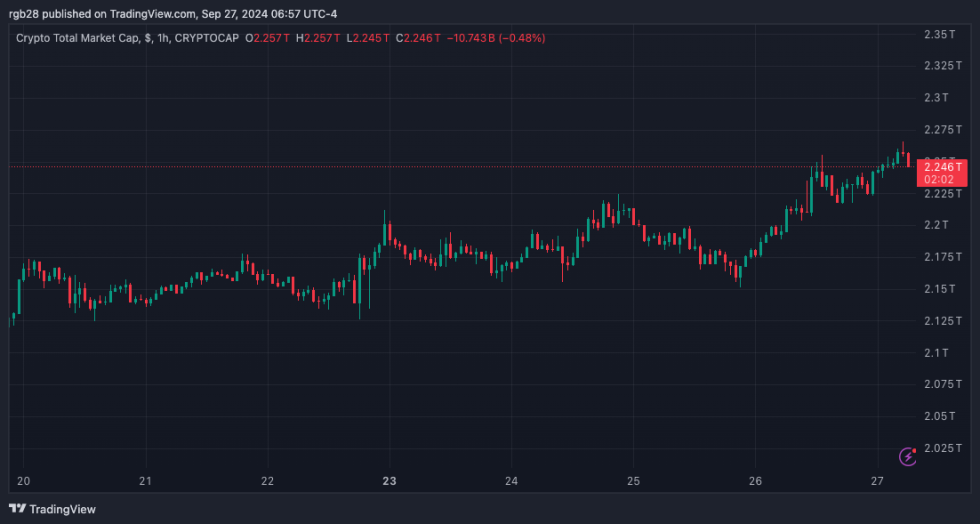
Total crypto market capitalization is at $2.24 trillion in the 7-day chart. Source: TOTAL on TradingView
Bitcoinist Chats with a Gemini Top Executive on the Future of the Industry in the Old Continent
During the event, our team at Bitcoinist talked with Gillian Lynch, CEO of the crypto exchange Gemini for Ireland and Europe, about the upcoming MiCA regulation and its potential consequences for the industry and retail consumers.
During the conversation, Lynch highlighted the increase in adoption, claiming that the number of crypto holders in the region has increased from 1 in 10 to 1 in every 5 individuals over the last decade.
This rate could hike further with MiCA, the upcoming package of regulations set to be implemented by 2025 to oversee the nascent industry. Upon its implementation, crypto exchanges like Gemini, Lynch argued, and its users will finally have clarity.
The new regime of regulations could make the European region the new hub for digital assets as the US failed to provide certainty to its crypto sector. Furthermore, Lynch told us that the region and crypto actors like Gemini will benefit from increased investments as MiCA materializes.
The bigger challenge for Gemini and others will reside in educating its users on MiCA and the new regulatory regime, Lynch told us:
I think the challenge for the industry is to take regulation and educate people as to why it’s important (…) so that customers will know the difference between a regulated and a non-regulated company or exchange and make an informed choice then based on that. (…) I think we have a challenge to really educate.
Lynch said that to win the educational fight, crypto exchanges should rely on many tools, including social media and in-house educational programs such as Gemini’s CryptoPedia.
The next year will be decisive for the European crypto industry as MiCA enters the sector. Its consequences and future consequences, along with the progress of Web3, blockchain, and crypto, will be discussed during the European Blockchain Convention and its already-announced eleventh edition.
And that’s a wrap on #EBC10! 🎉
What an incredible two days of innovation, networking, and groundbreaking ideas. From powerful keynotes to exciting panels and epic hackathon projects, we’ve seen the future of blockchain take shape right before our eyes.
A huge thank you to… pic.twitter.com/OkoGKuwxSu
— European Blockchain Convention (@EBlockchainCon) September 26, 2024

Related Posts