浅析 Jupiter 第二次代币处置提案,1.9 亿美元的 JUP 将去往何处?

深潮2024-09-26 tarihinde yayınlandı2024-09-26 tarihinde güncellendi

JUP质押用户有望再续一年55%的“保底”收益。

撰文:Azuma,Odaily 星球日报

Solana 之上最大的去中心化交易所 Jupiter 正在推进关于其代币 JUP 处置的第二次重大投票(J4J #2),投票结果将直接决定约 2.15 亿枚 JUP(约 1.9 亿美元)的处置结果。

今年 8 月初,Jupiter 社区曾以 95% 的赞成率通过了关于 JUP 处置的第一次重大投票(J4J #1 ),该项投票决定销毁 30 亿枚 JUP(占总供应量的 30% ,以缩减 Jupiter 的最大供应。
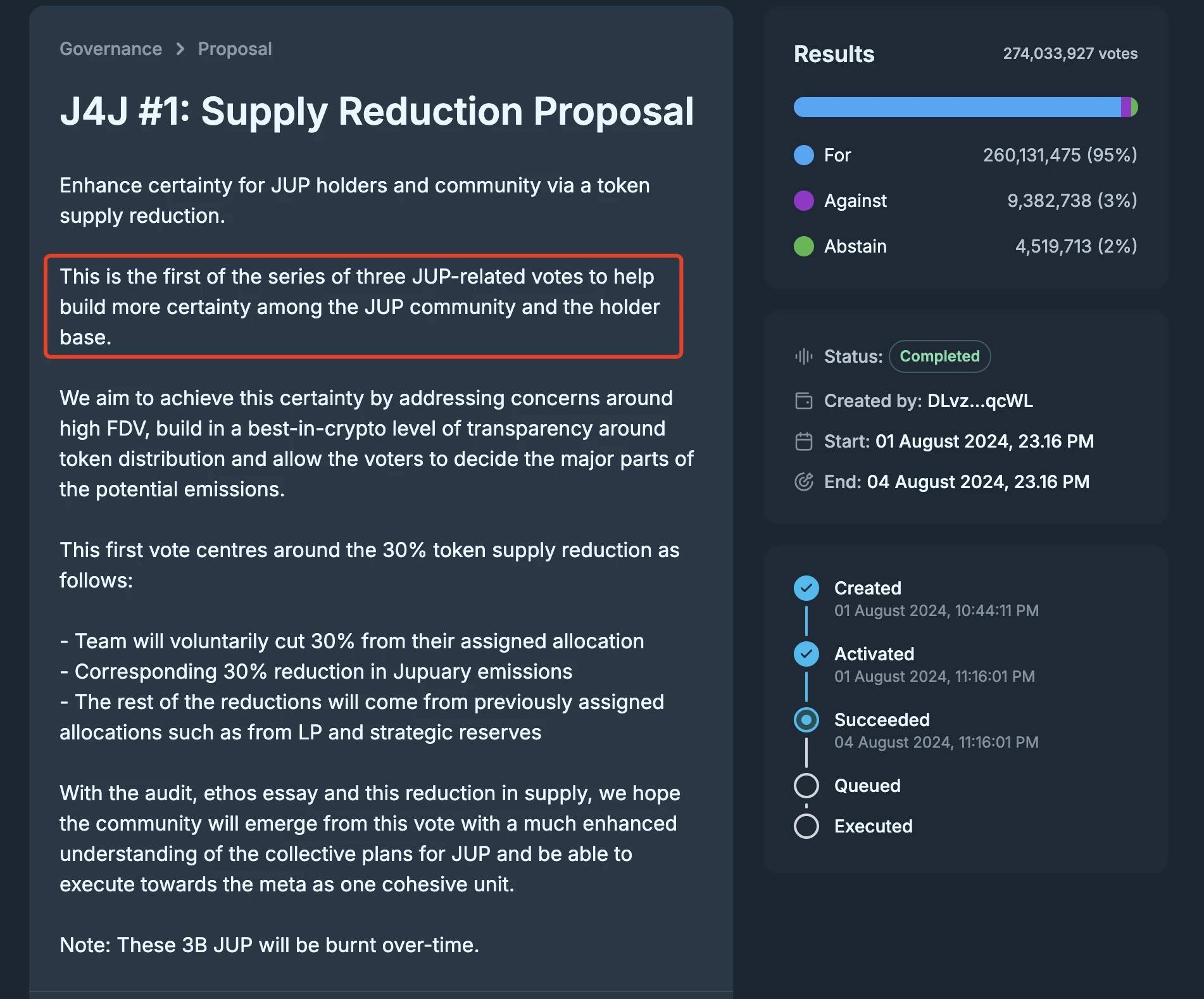
根据 Jupiter 创始人 meow 曾提及的规划,Jupiter 计划发起三次名为 J4J 的 JUP 处置投票,以解决 JUP 过高的 FDV 问题,在代币分配方面建立最佳的透明度,以及允许社区投票决定 JUP 的潜在发行。

当前正在推进的提案正是这三次重要投票中的第二次,即 J4J #2 。

此项提案的背景为,Jupiter 在今年早些时候执行了名为 Jupuary 的空投活动,由于空投未被全部认领,目前仍剩余大约 2.15 亿(215, 461, 850.21)枚 JUP。以当前约 0.88 美元的市价计算,该部分 JUP 的总价值高达 1.9 亿美元,对于任何协议而言都是一笔不容忽视的资产。

昨日晚间,Jupiter 创始人 meow 于治理论坛发起了关于如何处置这 2.15 亿枚 JUP 的治理草案,草案共计提到了三种处置方案,分别为:

  • 将代币用于未来一年的主动质押奖励(ASR)计划;

  • 销毁代币;

  • 将代币返还给社区多重签名钱包。

meow 提到,目前 Jupiter 团队更为倾向第一种方案,因为 ASR 在过去几个月内已成功地证明了可推动社区参与到每一项提案、讨论和投票,所以将资金投入 ASR 可帮助 Jupiter 社区继续增长。

在下文中,我们将简单统计 ASR 的具体规模,并计算上述方案对于现有 ASR 计划的奖励增幅效果。

所谓 ASR,直接翻译过来就是「主动质押奖励(Active Staking Rewards)」。ASR 是 Jupiter 重点设计的一种质押及治理奖励方式,旨在奖励质押 JUP 并积极参与治理、投票和讨论的社区成员,鼓励他们更深入地融入 Jupiter 生态系统。

ASR 的奖励来源主要由两部分构成,一是 0.75% 的 LFG Launchpad 费用(这部分来源于具体的 LFG 发行项目,所以会由多种代币组成),另一部分则来源于财库所提供的 1 亿枚 JUP 初始拨款。

今年 7 月初,Jupiter 发放了第一轮 ASR 奖励,向在今年 3 月至 6 月期间对提案进行投票的所有社区用户发放了合计 5000 万枚 JUP,如今 ASR 计划仍剩余 5000 万枚 JUP,并计划 10 月份开始分配给在 7 月 1 日至 9 月 30 日之间对所有提案进行过投票的社区用户。

结合过往两个季度的成绩来看,ASR 在激励社区活跃度方面发挥了重大效果。

截至 meow 发文,合计共有 58.5 万个地址质押了 3.61 亿枚 JUP;在该计划启动后的 12 场投票后,平均每场投票可吸引 2.8 亿枚 JUP 参与;每场投票的相关治理页面内都可以看到大量的讨论与建议。

因此,出于维持 ASR 激励的想法,meow 及 Jupiter 团队建议将上文提到的 2.15 亿枚 JUP 继续用于未来一年的 ASR 激励,平均每个季度释放 5000 万枚,剩余的 1500 万枚盈余则会暂时退还至财库并用于未来的具体需求。

以当下的 ASR 质押规模为基准进行静态计算,2 亿枚 JUP 投入至 ASR 激励池,意味着 3.61 亿枚 JUP 的质押用户可以在未来一年享有 55% 的保底收益 —— 未计算来源于 0.75% LFG Launchpad 费用的其他收益。

显然,该方案可足以继续保证 ASR 计划的吸引力,进而维持社区对于 Jupiter 协议发展的参与意愿。

也正是因为如此,meow 及其他 Jupiter 团队成员才会明牌站队这一方案,呼吁社区如此投票。

不过,这也并不意味着此方案一定通过。在 meow 列出的其他潜在方案中,「直接销毁」的选项也被部分社区人员视作更加符合所有 JUP 持币者,而非仅限于质押者的利益,不过考虑到参与投票的用户都是与 ASR 激励直接挂钩的质押用户,所以第一项方案的通过概率依旧更大。

根据目前的时间规划,该项提案将于 UTC 时间 9 月 27 日 15: 30 (北京时间 23: 30)开始投票,Odaily 星球日报将继续保持关注。

İlgili Okumalar

A Trillion-Dollar Frenzy for Memory Sellers, Halved Profits for Memory Buyers

Summary: A stark divide has emerged in the tech industry. While memory chipmaker Micron's stock soared 19% in a single day, pushing its market cap over $1 trillion, smartphone manufacturer Xiaomi reported a 43% plunge in adjusted net profit. The core driver is a severe supply crunch in memory chips, particularly for AI applications. Wall Street analysts, led by UBS and its unprecedented 204% target price hike for Micron, argue that long-term agreements (LTAs) from AI cloud giants are fundamentally ending the sector's notorious boom-and-bust cycles, justifying a re-rating from cyclical to infrastructure-like valuations. However, the "storage" market is now fragmented into three tiers. The first, AI-grade memory like HBM and server DDR5, faces extreme shortages and soaring prices driven by massive cloud capex. The second, mobile memory for smartphones, is also seeing sharp price hikes as manufacturers like Xiaomi are forced to pay more for remaining capacity, severely squeezing their margins. The third, PC retail channels, shows price declines due to existing inventory. The article questions the sustainability of the "supercycle" narrative. It highlights that Micron's revenue surge is driven almost entirely by price increases, not shipment volumes, making it vulnerable to a potential demand slowdown. While LTAs may dampen volatility, history suggests they are often tested during downturns. The current peak earnings, used to justify high valuations, represent a classic cyclical top. The piece concludes with a note of caution: when the entire Street chants "this time is different," it's wise to remember past bubbles, even as it acknowledges AI demand may indeed be structural.

marsbit58 dk önce

A Trillion-Dollar Frenzy for Memory Sellers, Halved Profits for Memory Buyers

marsbit58 dk önce

This New Generation of US Stock Trading Gods No Longer Read Financial Reports

The new generation of "stock gods" in the 2026 US AI bull market are not analyzing traditional financial reports. Instead of focusing on giants like NVIDIA, figures like the 22-year-old Leopold Aschenbrenner (who reportedly turned $200M into $14B) and influencers like Serenity on platforms like Reddit's WallStreetBets, X, and Substack are gaining fame and returns by targeting obscure, low-cap "micro-cap" stocks. Their strategy, dubbed "supply chain sniping," involves identifying critical, often monopolistic, bottlenecks in the AI hardware supply chain—such as specific materials or components essential for giants like Google and NVIDIA—that are missed by mainstream Wall Street analysts. Serenity's call on AXTI, a $700M company supplying indium phosphide substrates crucial for photonics and optical interconnects, saw the stock soar from ~$12 to nearly $150. Similarly, accounts like KawzInvests and PhotonCap focus on thematic, supply-chain-driven research in areas like AI infrastructure, optics, and cloud services for SMEs, bypassing traditional valuation metrics. This shift represents a cultural move away from Warren Buffett-style value investing based on deep financial statement analysis. The new approach thrives on low liquidity, early narratives, and strong community propagation on social media, similar to meme stocks or crypto. However, this "attention economy" strategy carries risks: it depends on sustained information gaps, the underlying companies' ability to deliver fundamental results, and the potential for crowded, volatile exits as narratives shift. The trend also shows crypto traders applying their narrative-sensing skills to US micro-caps, marking a significant evolution in trading culture.

marsbit1 saat önce

This New Generation of US Stock Trading Gods No Longer Read Financial Reports

marsbit1 saat önce

Trillion-Dollar Euphoria for Memory Sellers, Halved Profits for Memory Buyers

Title: The Trillion-Dollar Memory Seller's Carnival vs. The Buyer's Halved Profits On May 26, a stark contrast unfolded. While memory chipmaker Micron's market cap surged past $1 trillion, smartphone maker Xiaomi reported plummeting profits. Xiaomi's Q1 2026 profits fell 43% year-on-year. Executive Lu Weibing cited memory prices quadrupling from last year, adding roughly $210 to a phone's cost. To survive, Xiaomi is cutting entry-level models, sacrificing volume. Micron's stock, however, skyrocketed over 19% in a day, capping an 8x gain in a year. Major banks like UBS and JPMorgan issued bullish reports, raising price targets drastically. Their core thesis: Long-Term Agreements (LTAs) with AI cloud giants (Microsoft, Google, etc.) are eliminating the memory industry's notorious boom-bust cycle. By locking in fixed-price, multi-year contracts for AI-grade memory (HBM, server DDR5), these deals promise stable, utility-like earnings, justifying a higher valuation (20-30x P/E vs. the historical 8-15x). The article reveals a three-tiered memory market in 2026: 1) **AI Storage (HBM/DDR5/Enterprise SSD)**: Extreme shortage, soaring prices, LTAs. This is Micron's story. 2) **Mobile/Embedded Memory**: Also facing sharp price hikes as AI production crowds out capacity, severely pressuring phone makers like Xiaomi. 3) **PC Retail**: Some spot prices are falling due to channel inventory liquidation, creating a divergence from contract markets. The author questions if LTAs truly end the cycle. It hinges on sustained, hyper-growth AI demand. Micron's current profits are at a cycle peak, driven mostly by price hikes, not volume. If AI capital expenditure growth slows, the massive industry capacity expansion (e.g., Micron's $250B+ CapEx plan) could lead to a glut. Historically, using peak-cycle earnings for valuation is a classic trap. While the AI-driven structural shift might be real, the unanimous Wall Street euphoria warrants caution, echoing past bubbles like Cisco's in 2000. The memory seller's trillion-dollar狂欢 (carnival) continues, but the cycle's shadow remains.

链捕手1 saat önce

Trillion-Dollar Euphoria for Memory Sellers, Halved Profits for Memory Buyers

链捕手1 saat önce

İşlemler

Spot
Futures

Popüler Makaleler

JUP Nasıl Satın Alınır

HTX.com’a hoş geldiniz! Jupiter (JUP) satın alma işlemlerini basit ve kullanışlı bir hâle getirdik. Adım adım açıkladığımız rehberimizi takip ederek kripto yolculuğunuza başlayın. 1. Adım: HTX Hesabınızı OluşturunHTX'te ücretsiz bir hesap açmak için e-posta adresinizi veya telefon numaranızı kullanın. Sorunsuzca kaydolun ve tüm özelliklerin kilidini açın. Hesabımı Aç2. Adım: Kripto Satın Al Bölümüne Gidin ve Ödeme Yönteminizi SeçinKredi/Banka Kartı: Visa veya Mastercard'ınızı kullanarak anında Jupiter (JUP) satın alın.Bakiye: Sorunsuz bir şekilde işlem yapmak için HTX hesap bakiyenizdeki fonları kullanın.Üçüncü Taraflar: Kullanımı kolaylaştırmak için Google Pay ve Apple Pay gibi popüler ödeme yöntemlerini ekledik.P2P: HTX'teki diğer kullanıcılarla doğrudan işlem yapın.Borsa Dışı (OTC): Yatırımcılar için kişiye özel hizmetler ve rekabetçi döviz kurları sunuyoruz.3. Adım: Jupiter (JUP) Varlıklarınızı SaklayınJupiter (JUP) satın aldıktan sonra HTX hesabınızda saklayın. Alternatif olarak, blok zinciri transferi yoluyla başka bir yere gönderebilir veya diğer kripto para birimlerini takas etmek için kullanabilirsiniz.4. Adım: Jupiter (JUP) Varlıklarınızla İşlem YapınHTX'in spot piyasasında Jupiter (JUP) ile kolayca işlemler yapın.Hesabınıza erişin, işlem çiftinizi seçin, işlemlerinizi gerçekleştirin ve gerçek zamanlı olarak izleyin. Hem yeni başlayanlar hem de deneyimli yatırımcılar için kullanıcı dostu bir deneyim sunuyoruz.

122 Toplam GörüntülenmeYayınlanma 2024.12.12Güncellenme 2025.03.21

JUP Nasıl Satın Alınır

Tartışmalar

HTX Topluluğuna hoş geldiniz. Burada, en son platform gelişmeleri hakkında bilgi sahibi olabilir ve profesyonel piyasa görüşlerine erişebilirsiniz. Kullanıcıların JUP (JUP) fiyatı hakkındaki görüşleri aşağıda sunulmaktadır.

活动图片