降息落地市场未来走势如何,交易员们怎么看?

Odaily星球日报2024-09-19 tarihinde yayınlandı2024-09-19 tarihinde güncellendi

Özet

利好兑现情况如何,比特币会重现2022年的走势吗?山寨币能否承接流动性?

今晚又是金融历史上载入史册的一天,美联储的降息似乎已成定局,大家已经不在讨论降息与否,而是降息幅度。

美银、高盛、摩根士丹利、巴克莱和花旗银行等金融机构纷纷预测今晚美联储将降息 25 个基点,但更激进的降息幅度也不是没可能,CME「美联储观察」上预计 9 月降息 50 基点的概率为 61% 。

所以现在对于我们的问题就是,降息对比特币的价格会如何影响。

律动 BlockBeats 梳理了一些值得关注的观点,供读者们参考,今晚拭目以待。

环境不同以往,持乐观态度

对冲基金 Sky Bridge 创始人 Anthony Scaramucci

对冲基金 Sky Bridge 创始人 Anthony Scaramucci 在周三接受采访时表示,美联储今晚可能会降息 50 个基点,这是未来 18 个月累计至少降息 150 个基点的一部分。他认为,这对美国和全球的资产价格来说都是好事。在美联储一系列降息以及美国加密货币监管更加清晰的推动下,比特币将在年底前创下历史新高,达到 10 万美元。

Scaramucci 表示,美国下一届国会任期初期将通过一些支持加密货币、比特币和稳定币的立法,这些立法是受到民主党和共和党共同支持的两党立法。同时,他对哈里斯政府下加密规则的前景表示乐观,因为其竞选团队的一名顾问表示,哈里斯将支持帮助该行业发展的措施,同时保持适当的保障措施。

Grayscale Investments 的研究主管 Zach Pandl

Grayscale Investments 的研究主管 Zach Pandl 曾在两周前接受福布斯采访时表示,「在软着陆的背景下降息,对美元来说是相当不利的,但对比特币等资产来说则是有利的。综合这些因素,市场将在未来几个月内再次探索历史高点。」

但 Zach Pandl 也表示,如果失业率继续上升,开始出现裁员迹象,将「可能会看到一段经济疲软期,在此期间,比特币和科技股等许多资产也会以典型的周期性方式走弱」。Zach Pandl 认为,经济衰退时期将是积累比特币的绝佳时机,因为接下来市场很可能会看到宽松的货币政策和宽松的财政政策,就像疫情期间发生的一样。但如果美国劳动力市场继续恶化,美国经济陷入短暂衰退,比特币可能会面临价格下行风险。这是未来 6 至 12 个月内我们面临的主要风险。

重现 2022 年降息走势?

Wintermute 的场外交易员 Jake Ostrovskis

做市商 Wintermute 的场外交易员 Jake Ostrovskis 在接受 Decrypt 中表示,降息将标志着货币政策的「转向」,并认为这可能会提振加密货币。「从历史上看,此举增加了金融体系的流动性,这往往有利于比特币等风险资产,」换句话说,愿意承担风险的投资者越多,他们愿意投入该领域的资金就越多,这可能会导致数字资产的价格上涨。

CryptoSea 创始人 Crypto Rover

CryptoSea 创始人 Crypto Rover 认为,预计美联储将在 24 小时内降息 50 个基点,并看好比特币的后市发展。「上次发生这种情况时,比特币的牛市就开始了。」
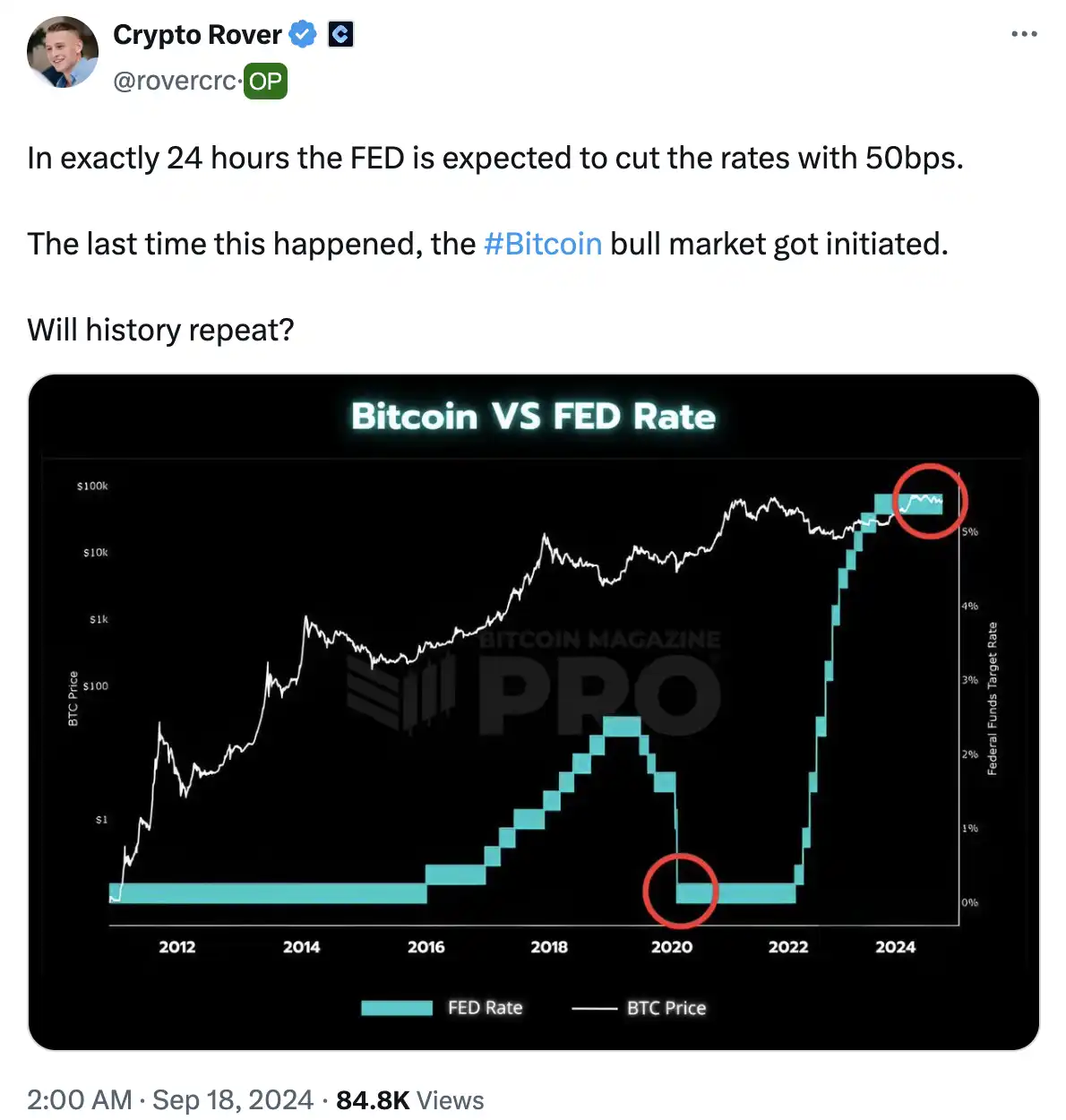
降息落地市场未来走势如何,交易员们怎么看?

Wealth Mastery 创始人 Lark Davis

Wealth Mastery 创始人 Lark Davis 也结合了 2022 年美联储降息时比特币的走势来预测本次降息带来的影响,「上次美联储降息时,比特币呈上升的抛物线走势,如果历史重演,接下来的 6-12 个月将是疯狂的。」
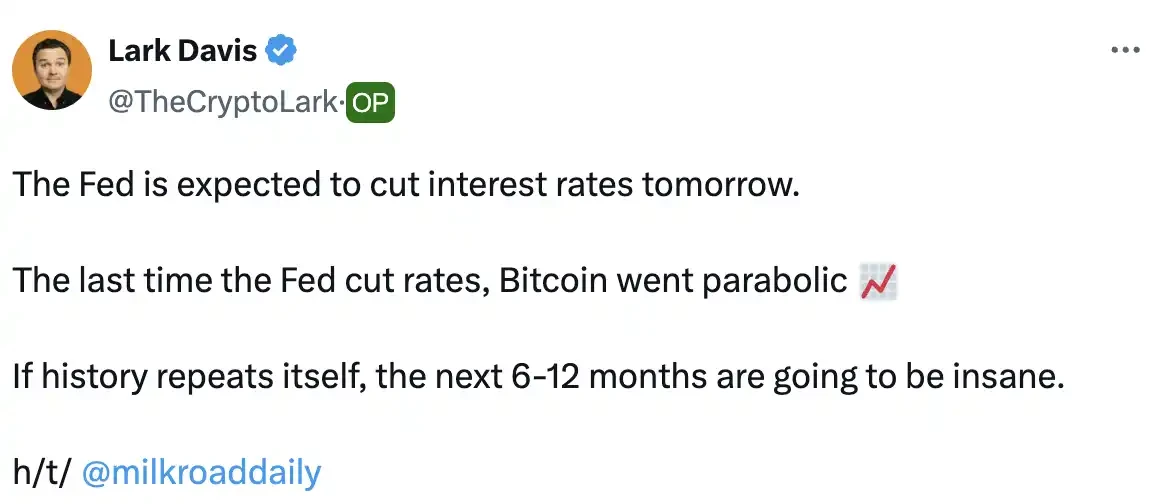
降息落地市场未来走势如何,交易员们怎么看?

交易员 Ahmed@CryptoBheem

交易员 Ahmed 也认为降息将利好比特币上涨,但这个兑现过程较为曲折。他预测在 50 个基点的降息情况下市场可能会发生剧烈波动,而在 25 个基点的降息后,市场会经历短期的下跌,然后才开始恢复上涨趋势。「如果(美联储降息) 50 个基点,我会卖出所有(持有的比特币)」。
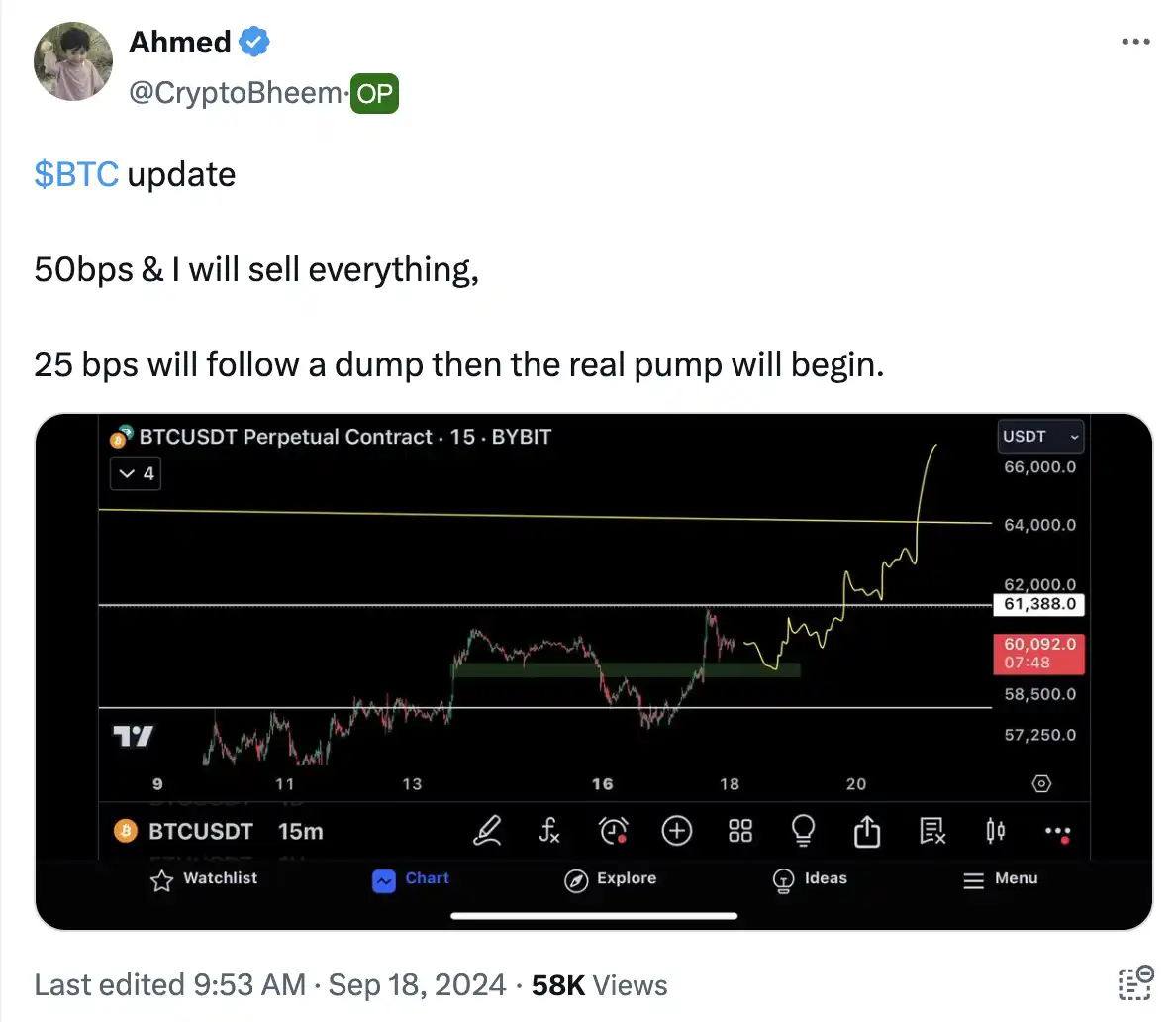
降息落地市场未来走势如何,交易员们怎么看?

山寨币将迎来上涨空间

Arthur Hayes:市场将在降息后先崩盘再进入牛市,ETH 将在降息周期中表现强劲

BitMEX 联合创始人 Arthur Hayes 在参与 TOKEN 2049 主会场首日进行「Thoughts on Macroeconomics Current Events」(关于宏观经济时事的思考)主题演讲时表示:

美联储在美国政府疯狂支出花费最多资金的时候,降息是一个巨大的错误。当通货膨胀超过他们的目标,而过去大约 8 到 9 个季度的实际 GDP 增长超过 2% 时,情况就更为复杂。因此,虽然我认为很多人期待降息,认为这会推动股市和其他市场的上涨,但实际上情况并非如此。我认为市场将在利率调整几天后崩溃,因为这将缩小美元与日元之间的利差。

我想列出一些在利率环境变化中因国库券利率下降而产生的赢家和输家,以及通过持有最安全的法定资产所能产生的利息收入。赢家包括 ENA、ETH、ETHFI 和 PENDLE,我个人持有大量这些资产,但我不持有 ONDO。Maelstrom(他的家族办公室)的投资组合非常适合利率下降的环境。

很多人认为,以太坊在本轮中根本没有什么进展。在过去几个月的牛市中,Solana 表现得非常强劲。关于以太坊的主要论点是,它是一种互联网债券,一种收益率为 4% 的互联网债券。那么当国债收益率高于这个水平,我为什么要投资这只债券呢?但如果国债收益迅速下降,那么投资 ETH 就变得有利可图了。获得的以太坊收益将超过在美元收益和国债中获得的收益。美联储将会降息,市场将会崩溃,然后重新点燃牛市。

交易员 Noodles

交易员 Noodles 认为,降息通常会增加市场上的流动性,降息会导致美元贬值,使得美元指数(DXY)下跌。美元贬值通常会使得以美元计价的资产更具吸引力。投资者的风险偏好可能会上升。投资者可能会转向风险资产,如股票和加密货币,寻求更高的回报。

但 Noodles 的观点更激进一些,他认为「降息 -> 美元指数(DXY)下跌 -> 风险偏好上升 -> 比特币市场主导地位下降 -> ETH/BTC 反弹 -> 山寨币反弹」。当市场对风险资产的兴趣增加时,投资者可能会将资金从比特币等主要加密货币转移到其他资产,导致比特币在整体市场中的占比下降。资金流向以太坊及其他主流山寨币时,市场上更多的资金也会流入其他山寨币。结果,整体山寨币市场可能会出现反弹,ETH/BTC 交易对也会出现反弹。
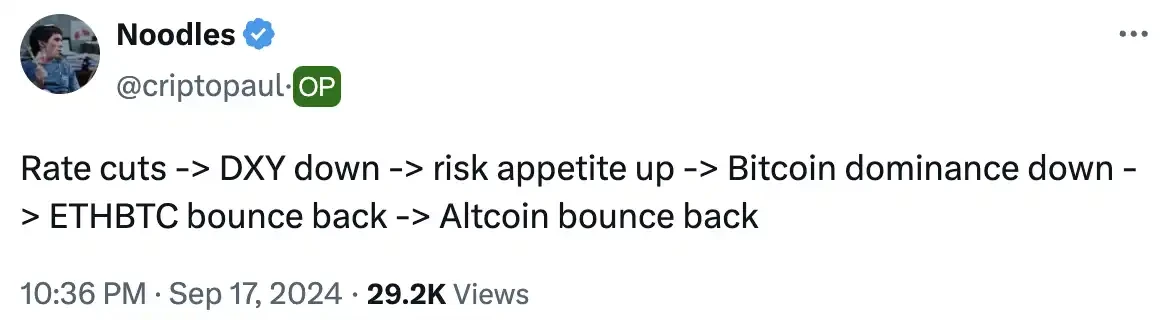
降息落地市场未来走势如何,交易员们怎么看?

MN Consultancy 创始人 Michaël van de Poppe

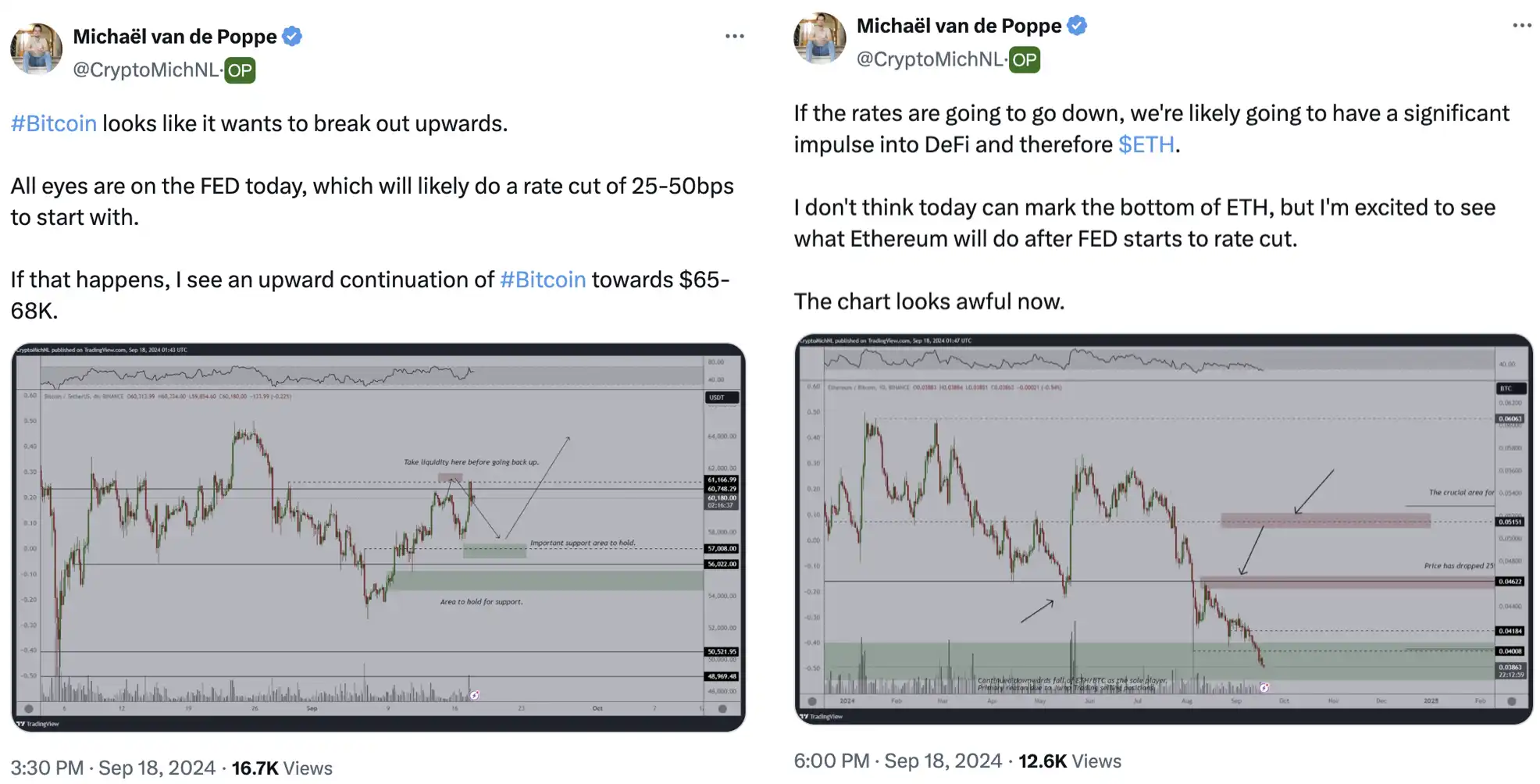
MN Consultancy 创始人 Michaël van de Poppe 认为,美联储可能会首先降息 25-50 个基点。如果发生这种情况,比特币会继续上涨至 65-68 K 美元,同时,降息也会利好 DeFi 从而助推 ETH 的上涨。尽管 ETH 的图标现在看起来很糟糕,但降息之后,「ETH 也会做点什么」。

降息落地市场未来走势如何,交易员们怎么看?

降息落地市场未来走势如何,交易员们怎么看?

İlgili Okumalar

China's AI Fronts: From Yan'an to Midway

This article analyzes the competitive landscape of China's AI industry through a dual-front war analogy: the "Eastern Front" of business model competition and the "Western Front" of global strategic positioning. **The Eastern Front: The Scramble for Supply Lines and Monetization** The "Eastern Front" examines the contrasting strategies of three Chinese tech giants—Tencent, Alibaba, and ByteDance—in the face of AI's high marginal costs. Tencent integrates AI as a catalyst within its existing ecosystems (advertising, gaming, cloud) for monetization, prioritizing high-value scenarios over user growth. Alibaba bets on a full-stack, self-developed approach from chips to applications, aiming to control costs and ecosystem, though this requires immense patience and resources. ByteDance, with Doubao as its flagship, pursues a traditional traffic-driven, "super app" strategy but faces severe monetization challenges as its massive user base incurs unsustainable operational costs. The central challenge for all is building a reliable "supply line" (sustainable funding/profit) and achieving efficient monetization, moving beyond being mere "token factories." **The Western Front: "Preserving Land" vs. "Preserving People"** The "Western Front" frames a global strategic divergence. The U.S. model ("preserving land") focuses on closed-source, high-premium models (e.g., Anthropic) targeting lucrative enterprise markets. China's strategy ("preserving people") leverages open-source models (e.g., Alibaba's Qwen, DeepSeek) and extremely low pricing to attract global developers and capture long-tail markets, akin to a "surround the cities from the countryside" approach. The goal is to make Chinese models the default infrastructure, locking in future ecosystem value. However, the critical test is whether this open-source ecosystem can achieve a commercial闭环, converting developer adoption into tangible revenue (e.g., via cloud services), and bridging the monetization gap with Western models that charge for value, not just tokens. **Conclusion: The Long March from Factory to Brand** The article concludes that China's AI industry possesses technology, users, and scenarios but must integrate them to create and capture value. Its ultimate success depends on navigating both fronts: companies must establish sustainable monetization on the Eastern Front, while the industry's Western strategy must evolve from simply "preserving people" (developer adoption) to truly "preserving both people and land" — transforming open-source ecosystem dominance into commercial success and premium brand value. This journey from being a "token factory" to a "value highland" will require strategic patience and the ability to outlast competitors in a prolonged contest.

marsbit26 dk önce

China's AI Fronts: From Yan'an to Midway

marsbit26 dk önce

A History of Technological Evolution Powered by Electricity: Aluminum, Bitcoin, and AI

The journey from the Rockdale aluminum smelter in Texas to space-based data centers illustrates a core economic principle: whoever controls the cheapest electricity dictates the use of computing power. The evolution is clear. Old industrial sites with pre-existing, high-capacity power grids are being repurposed. In Rockdale, a former Alcoa plant now houses vast Bitcoin mining rigs, which are increasingly being replaced by AMD chips for AI training. The logic is purely financial: while smelting aluminum yields $0.17–0.27 per kWh and Bitcoin mining $0.05–0.11, AI inference on H100 GPUs generates $1.27–3.67 per kWh. Recent deals confirm the rush for power infrastructure. Riot Platforms leases space to AMD; TeraWulf bought an old Kentucky aluminum plant for its grid; NYDIG secured a New York site for its cheap hydropower to mine Bitcoin. As AI giants like Anthropic, Microsoft, Google, and Amazon aggressively expand, they now directly compete with crypto miners for the same industrial power resources, often outbidding them. This has led to a decline in Bitcoin's global hash rate and a wave of miner conversions to AI data centers. This "digital resource curse" extends globally. Gulf nations, long offering subsidized power to attract heavy industry like aluminum, are now pivoting to become AI and cloud computing hubs—exporting computational power instead of physical commodities. Similarly, Bhutan halted its sovereign Bitcoin mining to sell hydropower directly to India for a steadier return. The frontier is space. Projects like Starcloud plan orbital solar-powered data centers, leveraging constant sunlight and natural cooling, with Bitcoin mining as a secondary use for surplus power. Even consumer brands are transforming; Allbirds shifted from footwear to AI infrastructure, causing its stock to surge. Meanwhile, crypto projects like Bittensor, Render, and Akash propose a decentralized alternative, creating markets to aggregate distributed, idle computing resources from individual hardware. The underlying infrastructure—the power grid—remains constant. As profit margins shift, the facilities built upon it will continue to evolve, from aluminum to Bitcoin to AI and beyond, always chasing the highest yield per kilowatt-hour, whether in Texas, Abu Dhabi, or low Earth orbit.

marsbit36 dk önce

A History of Technological Evolution Powered by Electricity: Aluminum, Bitcoin, and AI

marsbit36 dk önce

Conquering is easy, governing is hard: Polymarket must bow to regulations to plant its flag globally

Polymarket, a decentralized prediction market platform, faces significant regulatory hurdles in its global expansion. Its "permissionless" model, which bypasses traditional identity and financial controls, has led to widespread crackdowns. India recently blocked the site, categorizing it as illegal online gambling under new 2025 laws. Brazil also banned it and similar platforms, though it simultaneously authorized a regulated, investor-only version on its national exchange. Across Europe, countries like France, Portugal, and the Netherlands are enforcing bans based on existing gambling and financial regulations. To enter key markets, Polymarket is adopting a pragmatic, compliant approach. In the U.S., it paid a $1.12 million fine, acquired a CFTC-licensed exchange, and now operates a regulated, KYC-mandatory platform for American users. It also secured a major investment from Intercontinental Exchange (ICE), which will distribute its prediction data to institutional investors. In Japan, where gambling laws are strict, Polymarket has begun a long-term lobbying effort, aiming for legalization by 2030 through building institutional partnerships and community presence. Despite these challenges, the prediction market industry is booming, with global volume projected to surge from $51 billion to potentially $1 trillion by 2030. Polymarket's core dilemma remains: adapting its decentralized, anonymous model to fit within sovereign regulatory frameworks focused on licensing, consumer protection, and anti-money laundering rules. Its survival in each market depends on navigating this complex political and legal landscape.

marsbit39 dk önce

Conquering is easy, governing is hard: Polymarket must bow to regulations to plant its flag globally

marsbit39 dk önce

It's Easier to Conquer than to Govern: Polymarket Must Bend to Every Rule to Plant Its Flag Globally

Polymarket, a decentralized prediction market platform, is facing significant regulatory hurdles as it expands globally, illustrating the tension between permissionless, crypto-native platforms and national legal frameworks. The platform, which allows users to bet on event outcomes, was recently blocked in India under new online gambling laws and faces similar outright bans in Brazil and Ukraine, the latter citing moral objections to wagering on active war events. In Europe, countries like France, the Netherlands, and the UK are restricting access by enforcing existing gambling and financial derivatives regulations, forcing Polymarket to geo-block users or operate in view-only modes. To navigate this complex landscape, Polymarket is adopting a market-by-market, compliant strategy. In the U.S., it paid a $1.4 million CFTC fine, acquired a licensed exchange (QCEX) for $112 million, and now operates a regulated U.S. entity with strict KYC, abandoning anonymity. It also secured a major investment from Intercontinental Exchange (ICE), which will distribute its prediction data to institutional investors. In Japan, a high-potential market, it has begun a long-term lobbying effort aiming for legalization by 2030, acknowledging the country's strict anti-gambling laws and slow regulatory processes. The article concludes that while the global prediction market is growing rapidly—projected to reach $2.4 trillion by 2030—Polymarket's core challenge is transforming its decentralized model to fit sovereign regulatory systems built on licensing, consumer protection, and anti-money laundering rules. Its survival depends on proving its legitimacy in each jurisdiction.

链捕手43 dk önce

It's Easier to Conquer than to Govern: Polymarket Must Bend to Every Rule to Plant Its Flag Globally

链捕手43 dk önce

İşlemler

Spot
Futures
活动图片